Insects Guide
Bess Beetle
What Is a Bess Beetle? The bess beetle, Odontotaenius disjunctus, is a large, shiny black beetle native to the woodlands of eastern North America. Also called the horned passalus, patent-leather beetle, or betsy beetle, …
At a glance
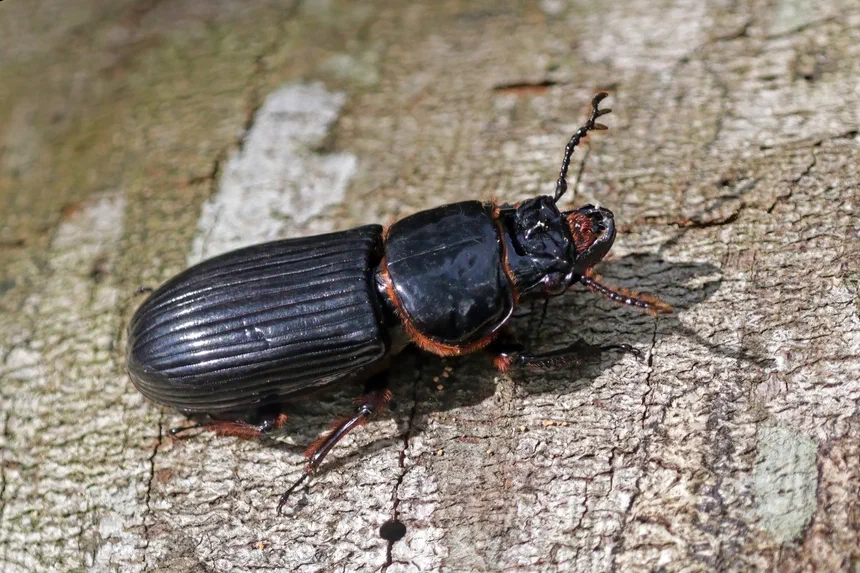
Image: Charles J. Sharp — CC BY-SA 4.0 · source
What Is a Bess Beetle?
The bess beetle, Odontotaenius disjunctus, is a large, shiny black beetle native to the woodlands of eastern North America. Also called the horned passalus, patent-leather beetle, or betsy beetle, it belongs to the family Passalidae, a group known for living in family groups inside decaying logs. It is one of the few beetles capable of producing audible sounds and caring for its young.
Appearance and Identification
Adult bess beetles are robust insects measuring roughly 30 to 40 mm in length, with a smooth, glossy black body that can appear dark brown in younger individuals. The wing covers, or elytra, are marked by deep parallel grooves that give the back a ridged, sculpted look. A short, forward-curving horn sits on top of the head, and the antennae end in comb-like segments that the beetle can fan open. Fine reddish-orange hairs are often visible along the leg joints and body margins, and the polished surface is the source of the nickname “patent-leather beetle.”
Habitat and Range
The species occurs across much of eastern North America, from southern Canada through the eastern and central United States. It favors moist deciduous and mixed forests where fallen timber is plentiful. Bess beetles spend nearly their entire lives inside rotting hardwood logs and stumps, tunneling through the soft, decomposing wood. This dependence on decaying wood makes them a familiar find for anyone who peels the bark off an old log.
Diet
Bess beetles are xylophagous, meaning they feed on wood, specifically the moist, partially decomposed wood of the logs they inhabit. The wood is not very nutritious on its own, so the beetles rely on fungi and microbes that break it down, along with their own gut microorganisms, to extract nourishment. Adults also consume their own frass, or chewed wood droppings, which have been further processed by microbes. Larvae are fed pre-chewed wood prepared by the adults.
Behavior
One of the most remarkable traits of the bess beetle is its use of sound. By rubbing parts of its wings against its abdomen, it produces a squeaking or hissing noise called stridulation, and researchers have described more than a dozen distinct calls used in different situations. These sounds help coordinate life within the colony and may signal alarm when the beetle is disturbed. Bess beetles are also unusually social for beetles, living in cooperative family groups within a single log. Adults and older larvae work together, and the larvae even communicate with their own scraping sounds.
Life Cycle and Reproduction
Bess beetles undergo complete metamorphosis, passing through egg, larva, pupa, and adult stages. A mated pair excavates galleries in a decaying log and tends the eggs and young together, a level of parental care rare among beetles. The adults prepare food for the grub-like larvae and help construct the pupal case in which each larva transforms. Newly emerged adults are reddish and soft before hardening into the familiar glossy black. The full cycle typically spans about a year, and adults may live for one to two years, often remaining in the same log or family group.
Conservation Status
The bess beetle has not been formally assessed by the IUCN and is not considered threatened. It remains widespread and locally common throughout its range wherever suitable rotting wood is available. As a decomposer, it plays a valuable ecological role by helping break down fallen timber and recycle nutrients back into forest soils. The main long-term concern for the species is the loss of mature forests and the removal of dead wood that it depends on.
Frequently Asked Questions
Do bess beetles bite or harm people? No. Bess beetles are harmless to humans; they do not bite in any meaningful way, are not venomous, and do not damage living plants or homes.
Why do bess beetles make noise? They stridulate by rubbing body parts together to produce squeaks. These sounds are used to communicate within their family group and as an alarm response when handled.
Are bess beetles good for the garden or forest? Yes. By feeding on and breaking down decaying wood, they speed up decomposition and help return nutrients to the soil, making them beneficial decomposers.
References
The conservation status and key facts in this profile are supported by these sources:
- GBIF — Odontotaenius disjunctus (Illiger, 1800) (accessed 2026-08-06)
- University of Florida Featured Creatures — Horned passalus (Odontotaenius disjunctus) (accessed 2026-08-06)
Found an error, source problem, or image concern? Report this page.