Insects Guide
Atlas Moth
What Is a Atlas Moth? The atlas moth (Attacus atlas) is one of the largest moths in the world, a member of the giant silk moth family Saturniidae. Native to the forests of South and Southeast Asia, it is famous for its …
At a glance
What Is a Atlas Moth?
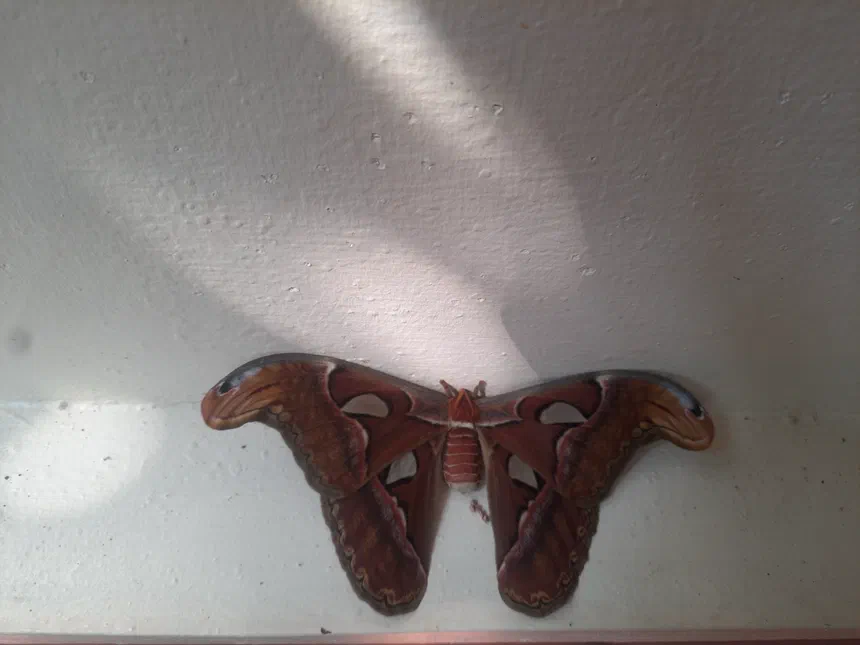
The atlas moth (Attacus atlas) is one of the largest moths in the world, a member of the giant silk moth family Saturniidae. Native to the forests of South and Southeast Asia, it is famous for its enormous, boldly patterned wings and its curved, snake-head-like wingtips. Despite its dramatic size, the adult moth lives only briefly and never eats.
Appearance and Identification
Few insects are as striking as the atlas moth. Its wingspan commonly reaches 9 to 12 inches (about 24 to 30 cm), and the total wing surface area is among the largest of any moth. The wings are a rich reddish-brown, crossed by bands of white, black, tan, and pink, and each wing carries a triangular, translucent “window” free of scales. The most distinctive feature is the hooked forewing tip, which resembles the head of a cobra and is thought to deter predators. Females are noticeably larger and heavier-bodied than males, while males have broader, more feathery antennae used to detect female scent.
Habitat and Range
Atlas moths occur across a broad swath of Asia, from India, Sri Lanka, and southern China through Southeast Asia and into the Malay Archipelago and Indonesia. They favor warm, humid tropical and subtropical forests, but also live in scrubland, secondary growth, and gardens where suitable host plants grow. The species is closely tied to lowland and hill forest environments where year-round warmth allows breeding.
Diet
Diet in the atlas moth is entirely a caterpillar affair. The large green larvae are voracious leaf-eaters, feeding on the foliage of many shrubs and trees, including citrus, cinnamon, guava, and members of the willow and privet families. They build up all the energy reserves the insect will ever use. The adult moth has only a small, non-functional proboscis and does not feed at all, instead surviving on fat stored during the larval stage.
Behavior
Atlas moths are primarily nocturnal and are most active in the hours after dusk. Adults are relatively weak, fluttering fliers and tend to rest with wings spread during the day, relying on camouflage and their intimidating wing pattern for protection. Because adults cannot eat, they conserve energy and stay close to where they emerged. Males may fly considerable distances at night, guided by their sensitive antennae, to locate a female releasing pheromones.
Life Cycle and Reproduction
Like all moths, the atlas moth undergoes complete metamorphosis. A female lays clusters of eggs on the underside of host-plant leaves, and the caterpillars hatch after roughly one to two weeks. The larvae feed and grow rapidly through several molts, reaching lengths of 4 to 5 inches (about 10 to 12 cm) before spinning a papery brown cocoon among the leaves. After several weeks in the pupa, the adult emerges. Adults live only about one to two weeks, during which their sole purpose is to mate and, for females, to lay eggs. Females often attract mates the same night they emerge.
Conservation Status
The atlas moth has not been formally assessed on the IUCN Red List, and it remains locally common across much of its range. It faces pressure from deforestation and habitat loss in some areas, but it also adapts to gardens and disturbed habitats. The cocoons produce a durable brown silk called fagara, and the moth is reared in parts of Asia both for this silk and for the butterfly-house and specimen trade.
Frequently Asked Questions
Is the atlas moth the largest moth in the world? It is one of the largest by wing surface area and wingspan, rivaled mainly by the white witch moth and the Hercules moth. By total wing area, the atlas moth is often ranked at or near the top.
Do atlas moths bite or sting? No. Adults have no functional mouthparts and cannot bite, and they have no sting. They are entirely harmless to people.
Why do adult atlas moths die so quickly? Because adults cannot eat, they live only on fat stored as caterpillars. Once that energy is spent on flying and reproducing, usually within one to two weeks, the moth dies.
References
The conservation status and key facts in this profile are supported by these sources:
- Animal Diversity Web — Attacus atlas (accessed 2026-08-06)
- GBIF — Attacus atlas (Linnaeus, 1758) (accessed 2026-08-06)
Found an error, source problem, or image concern? Report this page.