Insects Guide
Atlas Beetle
What Is a Atlas Beetle? The atlas beetle (Chalcosoma atlas) is one of the largest and most striking scarab beetles in the world, famous for the enormous horns carried by males. It belongs to the rhinoceros beetle group …
At a glance
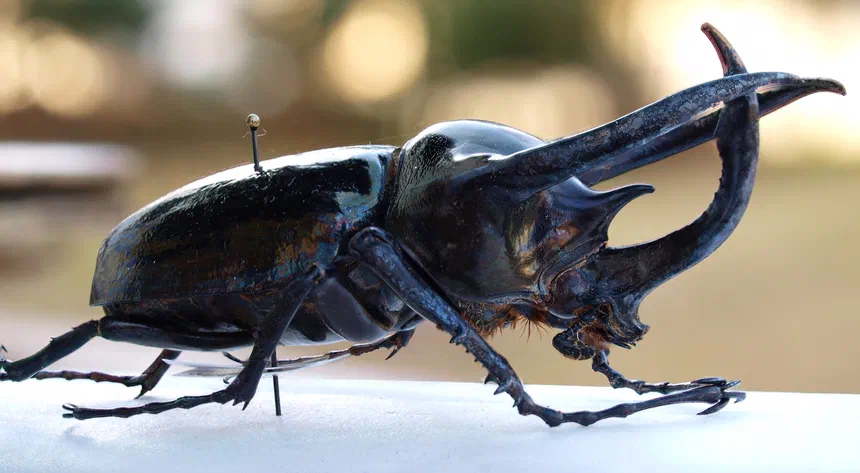
Image: JohnSka — CC BY-SA 3.0 · source
What Is a Atlas Beetle?
The atlas beetle (Chalcosoma atlas) is one of the largest and most striking scarab beetles in the world, famous for the enormous horns carried by males. It belongs to the rhinoceros beetle group within the family Scarabaeidae and takes its name from the Titan Atlas of Greek mythology, a nod to the great load-bearing “horns” it appears to shoulder.
Appearance and Identification
Adult atlas beetles have a heavily armored, glossy exoskeleton that ranges from deep black to a dark bronze or greenish sheen. Males are unmistakable, sporting three long curved horns: two projecting forward from the thorax and one rising from the head. These horns can make up a large share of the animal’s total length, with big males reaching around 13 centimeters. Females are considerably smaller, hornless, and have a duller, more textured surface. Like other scarabs, the body is divided into a robust head, a powerful thorax, and a broad wing-case (elytra) that protects the membranous flight wings underneath. The legs are strong and tipped with claws suited to gripping bark and climbing.
Habitat and Range
The species is native to the warm, humid forests of southern and Southeast Asia, including parts of India, southern China, and the islands and mainland of the region such as Indonesia, Malaysia, the Philippines, and Thailand. Atlas beetles favor lowland and hill tropical rainforest where there is abundant rotting wood and leaf litter for the larvae, along with fruiting and sap-producing trees for the adults. They are most active in warm, moist conditions and are strongly associated with undisturbed or lightly disturbed forest.
Diet
Atlas beetles are herbivorous, but their food changes dramatically across the life cycle. The large, C-shaped larvae, or grubs, feed on decaying wood, rotting plant matter, and rich forest humus, playing a useful role as decomposers that recycle nutrients back into the soil. Adults switch to a liquid diet, feeding on tree sap, the juices of overripe and fallen fruit, and other sugary plant secretions. This energy-rich food fuels their activity and, in males, the demanding business of fighting rivals.
Behavior
These beetles are largely nocturnal and are frequently drawn to lights at night. Males are notably aggressive and use their long horns as living pry bars and levers during contests over females and feeding sites. In a typical duel, a male will slide his horns beneath a rival and attempt to lift, unbalance, and toss him off the branch. Despite their bulky appearance, adults are capable fliers, unfolding their hind wings from beneath the elytra to move between trees. Outside of these confrontations they tend to be solitary.
Life Cycle and Reproduction
Atlas beetles undergo complete metamorphosis, passing through egg, larva, pupa, and adult stages. After mating, the female lays her eggs in rotting wood or rich soil where the hatching larvae will have plenty to eat. The grubs grow through several molts over many months, becoming very large before constructing a chamber in which they pupate. Whether a male develops large horns depends heavily on how well the larva was fed, so the biggest, best-nourished grubs tend to become the most impressively horned adults. Once transformed, the adult beetle emerges to feed, mate, and, for males, compete. Adults generally live for several months to about a year.
Conservation Status
The atlas beetle has not been formally assessed by the IUCN, and it remains reasonably common across much of its range. Even so, it faces pressures from tropical deforestation and habitat loss, and it is widely collected for the pet and hobbyist beetle trade, where large-horned specimens are prized. Maintaining healthy rainforest with plenty of dead wood is the key to keeping local populations stable.
Frequently Asked Questions
Are atlas beetles dangerous to humans? No. Their horns and jaws are used against rival beetles, not people. A large male can deliver a firm pinch or scratch if handled roughly, but they are not venomous and pose no real threat.
Why do only male atlas beetles have horns? The horns are a sexual trait used to fight other males and to win access to mates and food. Females do not fight in this way, so they remain hornless and put their resources into egg production.
How big can an atlas beetle get? Large males, horns included, can reach roughly 13 centimeters, making them among the biggest beetles in Asia. Females are typically about half that length.
References
The conservation status and key facts in this profile are supported by these sources:
- Animal Diversity Web — Chalcosoma atlas (accessed 2026-07-29)
- GBIF — Chalcosoma atlas (Linnaeus, 1758) (accessed 2026-07-29)
Found an error, source problem, or image concern? Report this page.