Library Section
Fleas
How to identify if you have fleas Fleas are very small, wingless insects, about 2.5 mm long, dark brown in colour, and visible to the naked eye. The body appears flattened on the sides, giving it a thin appearance. The …
At a glance
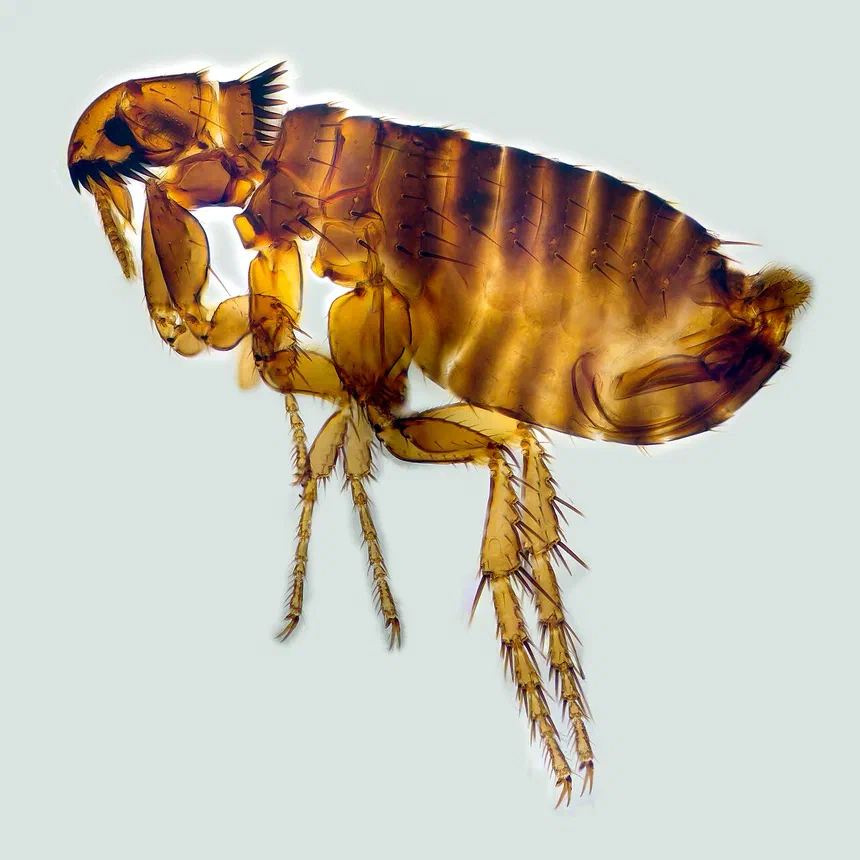
Image: Sam Thomas — CC BY-SA 2.0 · source
How to identify if you have fleas
Fleas are very small, wingless insects, about 2.5 mm long, dark brown in colour, and visible to the naked eye. The body appears flattened on the sides, giving it a thin appearance. The hind legs are bigger and well adapted for jumping. Fleas are wingless but remain capable of jumping moderate distances by using their long hind legs. They can jump as high as 15 cm vertically and as far as 40 cm horizontally. Flea larvae are whitish, about three to six millimetres long, and have protruding hair encircling each body segment. Other Key Characteristics
- Are laterally flattened (i.e. flat at the sides)
- Are wingless; cannot fly
- Normally are brownish-black in colour; however, after feeding they will take on a reddish hue
- Have long and powerful hind legs that are adapted for jumping; can jump up to 20 cm vertically and about 40 cm horizontally
- Have short, 3-segmented antennae
- Mouthparts adapted for piercing and sucking
Why do I have fleas
Fleas are sometimes forced inside homes due to prolonged periods of excessively wet weather. Fleas can gain entry into homes by attaching themselves to common household pets. Once inside, the parasites tend to gravitate toward places frequented by potential host animals. Pet beds, as well as cracks and crevices, make popular harbourage sites for fleas.
Where Do Fleas Live
Fleas can be found throughout the world. As part of the flea life cycle includes laying eggs on a warm-blooded animal, they commonly live in areas densely populated by potential hosts. The presence of high humidity and temperatures assists the development of larvae. The pests are sometimes forced inside homes due to prolonged periods of excessively wet weather. Fleas can gain entry into homes by attaching themselves to common household pets. Once inside, the parasites tend to gravitate toward places frequented by potential host animals. Pet beds, as well as cracks and crevices, make popular harbourage sites for fleas.
What Do Fleas Eat
Adult fleas rely on warm-blooded hosts for nourishment. The frequency and duration of feeding varies from species to species. The flea’s mouthpart is modified to pierce a host’s skin and suck up blood. Flea bites often cause irritation and, in extreme cases, can lead to secondary infections. The larvae feed on hair, skin particles, and adult flea feces.
How Long Do Fleas Live
Fleas undergo complete metamorphosis with four distinct stages: egg, larva, pupa, and adult. Once the adult stage is reached, fleas can live up to about a year, although 30 to 90 days represents the typical lifespan. Adult females lay eggs on the host animal after consuming a blood meal. In the right conditions, eggs hatch within 2 to 12 days. Newly hatched fleas spend as many as 200 days in the larval stage before pupating. Generally, the pupal stage lasts between 5 and 14 days. In the absence of a potential host, the pupae can lay dormant until a host shows up before emerging from the pupal stage to adulthood.
How worried should I be about fleas
Fleas can wreak havoc on people and household pets. A severe untreated infestation can kill a cat or dog, but not before the animal undergoes serious suffering. Other medical conditions caused by fleas include bartonellosis (cat scratch fever), feline anemia, and flea allergies. If a preferred host is unreachable, adult fleas often jump to the first warm-blooded animal that it finds. Most notably, fleas are historically known as carriers of the plague. Fleas are also intermediate hosts of dog and rodent tapeworms; they can transmit the worms to humans and pets.
How can I prevent getting fleas
One of the best ways to prevent a flea infestation is to generally maintain a clean household by steam-cleaning the carpets. The cleaning method works due to the fact that fleas spend up to 90 percent of time away from hosts in furniture or carpeting. Steam cleaning effectively kills fleas in all developmental stages. A comprehensive cleaning will also eliminate any risk of flea infestation in buildings where the parasites might not be apparent due to their ability to go without food for months at a time. Owners of cats or dogs should thoroughly and regularly inspect pets for fleas. Over-the-counter and vet-prescribed products are available to treat flea infestations on pets, though it also remains imperative to treat the entire house for flea removal. A pest control professional should be contacted to perform such treatments. Regardless, an appropriate, off-the-shelf product can be used for treatment based on label instructions. In addition to targeting fleas directly, look for and remove the nests of wild animals on the property. The removal of unwelcome nests helps eliminate fleas and allows pets to roam freely. For assistance in properly handling and removing a flea infestation, contact a pest control specialist.
Browse This Section
Every guide in Fleas
Use these links to move quickly between closely related pages in the same section.
Can Fleas Fly?
Do Fleas Have Wings? Fleas do not fly and are wingless as adults. Jumping Fleas Their preferred method of movement is …
Cat Flea
What Do Cat Flea Bites Look Like? Cat flea bites can cause itchy, swollen red bumps. If a cat flea bites you, try to …
Cat Flea Facts & Information
Appearance Size: Adult cat fleas are about ¼ inch long. Color: Cat fleas are small, dark brown to black insects whose …
DIY Flea Repellents For Homes And Lawns
What attracts fleas to yards? Fleas prefer to live in outdoor places that are shaded, humid, and warm. Direct …
Do Dogs & Cats Get the Same Kind of Fleas?
Cat fleas ( Ctenocephalides felis ) are a different species than dog fleas ( Ctenocephalides canis ). However, their …
Do Home Flea Treatments Work?
Home flea treatments can work, but many are not completely effective. They may help manage a flea problem but do not …
Dog Flea
What Do Dog Flea Bites Look Like? Dog flea bites can cause itchy red bumps, typically located on the armpit or in the …
Flea Diseases
Flea-Borne Diseases in Humans According to a recent CDC statement, the number of illnesses caused by mosquito, tick, and …
Fleas
What Other Threats Do Fleas Pose? Fleas are the most common transmitter of the rare bubonic plague. They also transmit …
How to Detect Signs of a Flea Infestation
Identifying a flea infestation can often be simple, while eradicating their population proves much more difficult. Check …
How to Identify Fleas
Characteristics length - adult fleas are approximately 2.5 mm long color - dark in color, ranging from brown to reddish …
How to Identify Species of Fleas
Flea Species Commonly Found in the US Hundreds of different types of fleas thrive across the U.S. These jumping pests …
Sand Flea Identification and Control
Understanding Sand Fleas The term sand flea is used to describe many species of animals. Magnified Sand Flea Image What …
What Do Flea Larvae Look Like?
Life Cycle of Fleas Fleas are parasitic, blood-feeding insects that often enter homes in the fur of household pets. The …
What is the Life Cycle of a Flea?
Flea Life Cycle Stages A flea’s life cycle consists of four stages: Egg, Larvae, Pupa, Adult How many eggs does a flea …