Fish Guide
Spiny Dogfish
What Is a Spiny Dogfish? The spiny dogfish (Squalus acanthias) is a small, slender shark of cool temperate seas, named for the sharp spine that stands in front of each of its two dorsal fins. It is one of the most …
At a glance
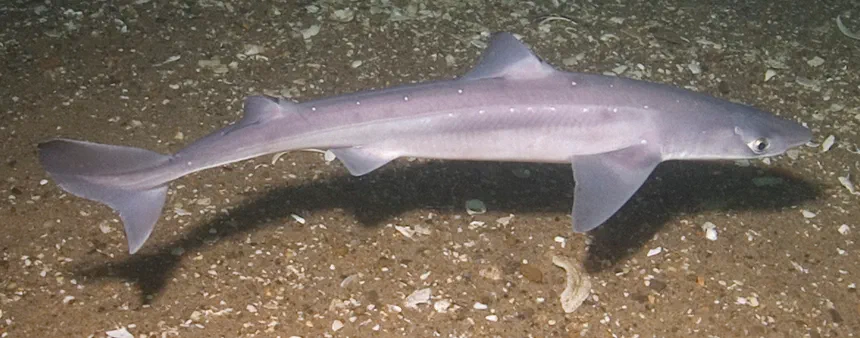
Image: Doug Costa, NOAA/SBNMS — Public domain · source
What Is a Spiny Dogfish?
The spiny dogfish (Squalus acanthias) is a small, slender shark of cool temperate seas, named for the sharp spine that stands in front of each of its two dorsal fins. It is one of the most abundant and wide-ranging sharks in the world, and for generations it has been familiar to fishers, biology students, and seafood markets alike.
Appearance and Identification
This is a modestly sized shark, with most adults measuring roughly 70 to 120 centimeters (about 2.5 to 4 feet). Females typically grow larger than males. The body is streamlined and slate-gray to brownish above, fading to a pale gray or white belly, and it is often marked with a scattering of small white spots along the flanks.
The most reliable field mark is the pair of stout spines, one just ahead of each dorsal fin. These spines carry a mild venom and can deliver a painful jab to careless handlers. Unlike many sharks, the spiny dogfish lacks an anal fin, and its snout is fairly narrow and pointed. Large, greenish eyes give it a distinctive look up close.
Habitat and Range
Spiny dogfish live in temperate and subarctic waters around much of the globe, including the North Atlantic, North Pacific, and cooler waters of the Southern Hemisphere. They favor continental shelves and slopes, generally staying in water between about 10 and 20 degrees Celsius.
Although often found near the bottom, these sharks range from the surface down to depths of several hundred meters. They are strongly migratory, following preferred water temperatures across seasons and sometimes traveling long distances in large schools.
Diet
The spiny dogfish is an opportunistic carnivore. Its diet is dominated by small schooling fish such as herring, capelin, sand lance, and mackerel, along with squid, octopus, crabs, shrimp, and other invertebrates. Jellyfish and comb jellies are also eaten at times.
Hunting in packs, dogfish can overwhelm dense shoals of prey, which historically brought them into conflict with commercial fishers whose catches and nets they raid. Their small, cusped teeth are well suited to gripping and slicing soft-bodied prey.
Behavior
These sharks are highly social and often travel in enormous schools, sometimes loosely sorted by size and sex. Such aggregations can number in the thousands and move together as they follow prey and favorable temperatures.
Spiny dogfish are slow-moving but persistent, relying on stealth and numbers rather than speed. They are generally harmless to people, though the dorsal spines warrant respect. As bottom-associated predators, they play an important role in shaping populations of the fish and invertebrates they eat.
Life Cycle and Reproduction
Reproduction in the spiny dogfish is remarkably slow. Females are ovoviviparous, meaning the eggs develop inside the body and the young are born live. The gestation period is exceptionally long, commonly cited at around 18 to 24 months, among the longest of any vertebrate.
Litters are small, typically ranging from a few pups to a dozen or so, each born fully formed at roughly 20 to 30 centimeters. Individuals mature late, sometimes not until their teens or twenties, and they can be very long-lived, with some estimates exceeding several decades. This combination of late maturity, long pregnancy, and small litters makes populations slow to recover from decline.
Conservation Status
Because it reproduces so slowly, the spiny dogfish is vulnerable to overfishing. Heavy commercial harvest, much of it destined for food markets in Europe, drove sharp declines in some regions during the twentieth century. The species is assessed as Vulnerable on the IUCN Red List globally, though the status of individual stocks varies, and some well-managed populations have recovered. Careful, science-based catch limits remain essential for its long-term health.
Frequently Asked Questions
Are spiny dogfish dangerous to humans? Not really. They are small and not aggressive toward people, but the venomous spines in front of the dorsal fins can inflict a painful wound if the shark is handled carelessly.
Why is it called a “dogfish”? The name reflects their habit of hunting in packs, like a pack of dogs, as well as their abundance and the way schools chase down prey together.
How long are spiny dogfish pregnant? Their gestation lasts roughly 18 to 24 months, one of the longest pregnancies known in the animal kingdom.