Fish Guide
Largemouth Bass
What Is a Largemouth Bass? The largemouth bass (Micropterus salmoides) is a freshwater fish in the sunfish family, Centrarchidae, and one of the most popular sport fishes in North America. It is easily recognized by its …
At a glance
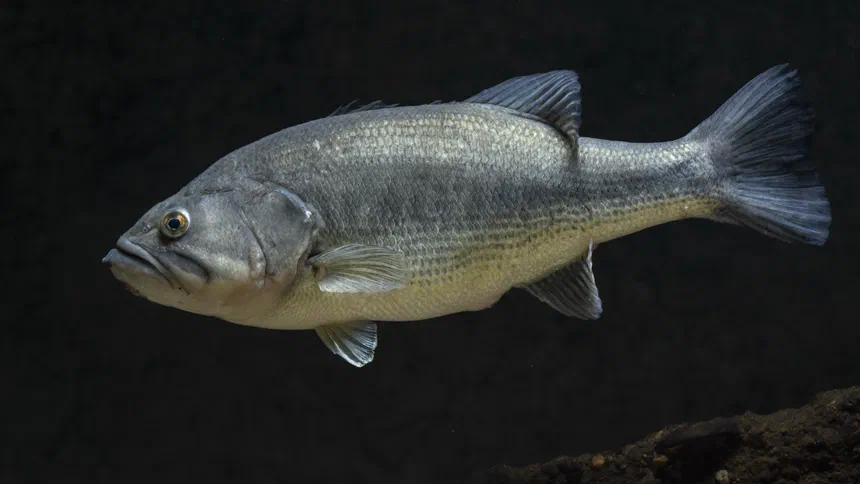
Image: USFWS Mountain Prairie (Sam Stukel) — Public domain · source
What Is a Largemouth Bass?
The largemouth bass (Micropterus salmoides) is a freshwater fish in the sunfish family, Centrarchidae, and one of the most popular sport fishes in North America. It is easily recognized by its large mouth and stout, greenish body, and it thrives in warm, weedy waters across much of the continent.
Appearance and Identification
Largemouth bass have a robust, elongated body that is olive to dark green on the back, fading to a lighter green on the sides and a whitish belly. A series of dark, irregular blotches usually forms a broken horizontal stripe along each flank. The species gets its name from its notably large jaw: when the mouth is closed, the rear edge of the upper jaw extends behind the eye, which helps distinguish it from the similar smallmouth bass. Adults commonly measure about 12 to 20 inches (30 to 50 cm) and weigh from roughly 1 to 10 pounds (0.5 to 4.5 kg), though trophy fish in favorable southern waters can grow considerably heavier. Females typically reach larger sizes than males.
Habitat and Range
This species favors warm, calm, and often shallow waters. It is most abundant in lakes, ponds, reservoirs, and the slow-moving stretches of rivers, especially where there is abundant cover such as submerged vegetation, fallen timber, docks, and undercut banks. Largemouth bass are native to eastern and central North America, from the Great Lakes region and the St. Lawrence drainage south to Florida and northern Mexico. Because of their value to anglers, they have been widely introduced elsewhere in the United States and on other continents, and in some regions they are considered an invasive species that pressures native fish.
Diet
Largemouth bass are opportunistic ambush predators. Young fish feed heavily on zooplankton, aquatic insects, and small invertebrates, while adults shift to larger prey. Their diet includes smaller fish, crayfish, frogs, and large insects, and big individuals may take small aquatic birds, snakes, or even young of their own kind. They typically hunt by lurking near cover and lunging at passing prey, using their large mouth to engulf it with a sudden gulp of water.
Behavior
Largemouth bass are most active in warmer months and become sluggish as water temperatures drop, feeding little during cold winter periods. They tend to be solitary as they grow larger, holding station near structure that offers shade and ambush points. Feeding activity often peaks around dawn and dusk. The species is highly sensitive to water temperature and oxygen levels, and individuals will move between deeper and shallower water through the day and across seasons to stay within a comfortable range.
Life Cycle and Reproduction
Spawning takes place in spring and early summer when water temperatures rise into roughly the 60s Fahrenheit (around 16 to 20 degrees Celsius). The male sweeps out a shallow, saucer-shaped nest on a firm bottom in shallow water. After a female deposits her eggs, the male fertilizes them and then guards the nest, fanning the eggs to keep them oxygenated and driving off intruders. He continues to protect the young fry for a time after they hatch. A single female can produce thousands of eggs, though only a small fraction survive to adulthood. Individuals often live around 10 to 16 years in the wild.
Conservation Status
The largemouth bass is listed as Least Concern by the IUCN. It is abundant across its native range and has been so widely stocked that its overall population is very large and secure. Management concerns focus less on protecting the species and more on the effects of introduced populations on native fish communities, as well as maintaining healthy fisheries through habitat management and catch regulations.
Frequently Asked Questions
How big can a largemouth bass get? Most caught fish weigh a few pounds, but exceptional individuals in warm southern waters can exceed 10 pounds, and the largest verified specimens have approached the low 20-pound range.
What is the difference between largemouth and smallmouth bass? The largemouth has a bigger jaw that extends past the eye and a broken dark stripe along the side, while the smallmouth has a smaller mouth, a more bronze color, and vertical bars.
Are largemouth bass good to eat? They are edible and mild in flavor, but many anglers practice catch-and-release, prizing the fish more for sport than for the table.
References
The conservation status and key facts in this profile are supported by these sources:
- Animal Diversity Web — Micropterus salmoides (largemouth bass) (accessed 2026-07-29)
- GBIF — Micropterus salmoides (Lacepède, 1802) (accessed 2026-07-29)
Found an error, source problem, or image concern? Report this page.