Fish Guide
John Dory
What Is a John Dory? The John Dory (Zeus faber) is a strikingly flat, oval-bodied marine fish easily recognized by the large dark spot on each of its flanks. It belongs to the family Zeidae and is prized as a delicate …
At a glance
What Is a John Dory?
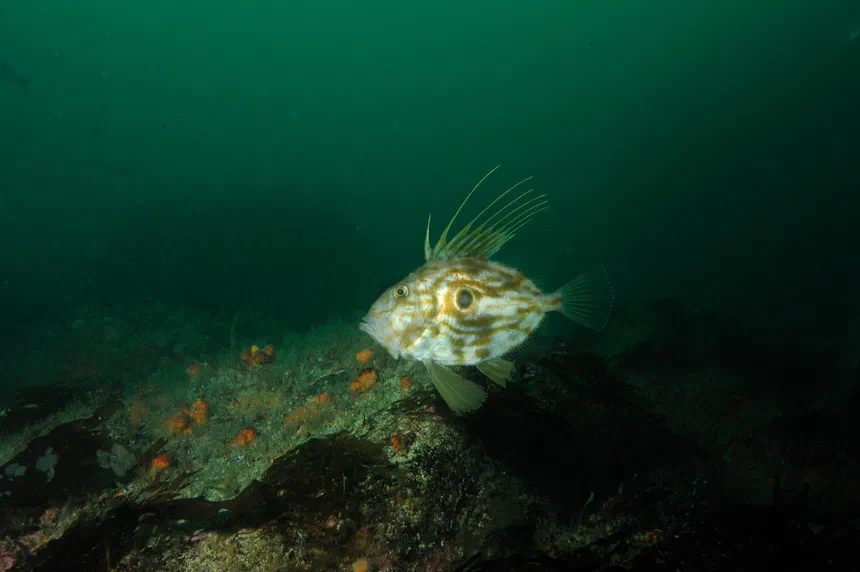
The John Dory (Zeus faber) is a strikingly flat, oval-bodied marine fish easily recognized by the large dark spot on each of its flanks. It belongs to the family Zeidae and is prized as a delicate food fish in many parts of its range. Despite its awkward, disc-like shape, it is a patient and surprisingly effective ambush predator.
Appearance and Identification
The John Dory has a deep, laterally compressed body that looks almost circular when viewed from the side but remarkably thin when seen head-on. Its coloring ranges from olive-yellow to a muddy silver, often with faint marbling, and each side bears a conspicuous round black blotch ringed with a pale halo. Long, trailing spines extend from the front dorsal fin, and the mouth is large and highly protrusible, able to shoot forward suddenly to engulf prey. Adults typically measure between 30 and 60 centimeters in length, though larger individuals are recorded. The dark side spots are sometimes said to represent the fingerprints of St. Peter, giving the fish one of its common nicknames.
Habitat and Range
This species favors coastal and continental-shelf waters, usually staying close to the seabed over sandy, muddy, or rocky bottoms. It is found from shallow inshore zones down to depths of around 400 meters, though it is most common in moderate depths. The John Dory has a broad distribution, occurring in the eastern Atlantic from Scandinavia and the British Isles south to West Africa, throughout the Mediterranean and Black Sea, and along the coasts of the Indo-Pacific, including waters off southern Africa, Japan, Australia, and New Zealand. It tends to be solitary and does not form large schools.
Diet
The John Dory is an ambush carnivore that feeds mainly on small schooling fishes such as sardines, herring, and sand eels, supplementing this with squid, cuttlefish, and other invertebrates. Rather than chasing prey at speed, it relies on its thin profile to approach almost unnoticed, drifting slowly until it is within striking range. When close enough, it thrusts its extendable jaws outward in a fraction of a second, creating suction that pulls the victim into its mouth. Its narrow body makes it difficult for prey to spot head-on, an adaptation that compensates for its otherwise slow swimming.
Behavior
Generally slow-moving and solitary, the John Dory spends much of its time hovering near the bottom, using subtle fin movements to hold position. Its cryptic coloring and thin silhouette help it blend into the background as it stalks. The trailing dorsal spines may serve to make the fish appear larger or less palatable to potential predators. Because it is not a strong swimmer, it depends heavily on stealth and its rapid feeding strike rather than pursuit.
Life Cycle and Reproduction
Spawning generally occurs in late winter and spring, with timing varying across the fish’s wide geographic range. Females release eggs that are fertilized externally and float freely in the water column as part of the plankton. The larvae drift and develop in open water before eventually settling toward the bottom as they mature. John Dory grow relatively slowly and can live for over a decade, with individuals reaching sexual maturity after a few years. Growth rates and maturation age vary with local water temperatures and food availability.
Conservation Status
The John Dory has not been formally assessed on a global scale by the IUCN, so no official conservation category applies. It is caught commercially and as bycatch in trawl fisheries across much of its range and is valued for its firm, white flesh. While it is not currently considered threatened, its slow growth and relatively low reproductive output mean that localized populations could be sensitive to sustained fishing pressure. Managed fisheries and monitoring help support long-term stability.
Frequently Asked Questions
Why does the John Dory have a spot on its side? The large dark spot on each flank likely helps confuse predators or prey and features in folklore as the thumbprint of St. Peter. It is a reliable identifying mark for the species.
Is the John Dory good to eat? Yes. It is highly regarded in many cuisines for its firm, mild, white flesh and is a sought-after food fish, though its bony, thin body yields modest fillets.
Is the John Dory dangerous to humans? No. It is a slow-moving fish that poses no threat to people; its impressive feeding strike is reserved for small fish and invertebrates.