Fish Guide
Jewel Cichlid
What Is a Jewel Cichlid? The jewel cichlid (Hemichromis bimaculatus) is a small, brilliantly colored freshwater fish native to tropical Africa. A member of the large cichlid family, it is prized in the aquarium hobby for …
At a glance
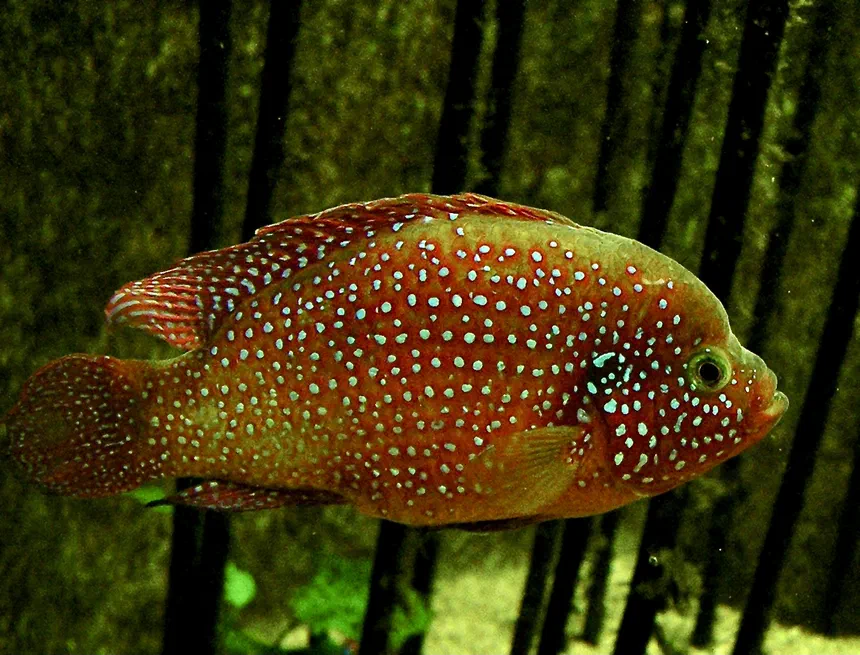
Image: NasserHalaweh — CC BY-SA 4.0 · source
What Is a Jewel Cichlid?
The jewel cichlid (Hemichromis bimaculatus) is a small, brilliantly colored freshwater fish native to tropical Africa. A member of the large cichlid family, it is prized in the aquarium hobby for its vivid red coloring studded with shimmering blue-green flecks that resemble scattered gemstones.
Appearance and Identification
Jewel cichlids have a compact, laterally flattened, oval body that typically reaches 4 to 6 inches (10 to 15 cm) in length. The base color ranges from golden-brown to intense red or orange, most saturated during breeding, and the flanks, fins, and gill covers are dotted with iridescent blue and green spangles. A distinguishing feature is a dark spot on the middle of each flank, often accompanied by a marking near the gill cover and at the base of the tail. Males and females look similar, though breeding adults of both sexes deepen to a striking crimson, which can make sexing difficult outside of spawning. The dorsal fin is long and low, running most of the length of the back.
Habitat and Range
This species occurs across a broad swath of West and Central Africa, with populations reported from countries including Guinea, Liberia, and neighboring regions of the tropical belt. It favors warm, slow-moving to moderately flowing freshwater: rivers, streams, forest creeks, and vegetated lagoons. Jewel cichlids tolerate a range of conditions but thrive in soft to moderately hard, slightly acidic to neutral water at temperatures around 72 to 82 degrees Fahrenheit (22 to 28 degrees Celsius). They tend to stay near cover such as submerged roots, rocks, and dense plants, which offer shelter and spawning sites. The species has also been introduced beyond its native range through the aquarium trade.
Diet
Jewel cichlids are opportunistic omnivores that lean toward a carnivorous diet. In the wild they feed on aquatic insects and their larvae, small crustaceans, worms, tiny fish, and some plant material and algae. Their protrusible mouths and sturdy bodies let them hunt actively among vegetation and sift the substrate for prey. In captivity they accept a wide variety of foods, including quality flakes and pellets, along with live or frozen items such as bloodworms and brine shrimp.
Behavior
These fish are well known for being bold, energetic, and highly territorial, particularly as they mature and around breeding time. A single pair can dominate a considerable area of a stream bottom or aquarium, driving off intruders regardless of size. Outside of spawning they are somewhat more tolerant, but their aggression makes them poor companions for timid tankmates. Jewel cichlids are intelligent and interactive, quickly learning to recognize the person who feeds them. They frequently dig in the substrate and may uproot plants while foraging or preparing a nest.
Life Cycle and Reproduction
Jewel cichlids are substrate spawners and devoted parents, traits that have made them a favorite for observing cichlid breeding behavior. A bonded pair selects and thoroughly cleans a flat surface such as a rock or a broad leaf, where the female deposits several hundred adhesive eggs. Both parents guard the clutch and fan it with their fins to keep it oxygenated. The eggs hatch within a few days, and the parents move the wrigglers to shallow pits, continuing to shepherd the free-swimming fry as a tight school. This intense biparental care can last for several weeks, with the adults fiercely defending their young. In the wild, jewel cichlids generally live around five years, and often somewhat longer under good aquarium care.
Conservation Status
The jewel cichlid has not been formally assessed for the IUCN Red List, and it is not considered globally threatened. It remains widespread across its tropical African range and is enormously abundant in captivity thanks to decades of aquarium breeding. The main conservation concerns tied to the species stem from its popularity in the pet trade: released or escaped individuals have established feral populations in warmer regions outside Africa, where their aggression and adaptability can pressure native fish.
Frequently Asked Questions
Are jewel cichlids aggressive? Yes. They are among the more territorial small cichlids, especially when breeding, and a pair will defend its space against much larger fish.
How big do jewel cichlids get? Most reach about 4 to 6 inches (10 to 15 cm) in length, with males often growing slightly larger than females.
Why do jewel cichlids turn bright red? Their color intensifies with mood and condition, deepening to a vivid crimson during courtship and spawning as a signal tied to breeding.