Fish Guide
Japanese Rice Fish
What Is a Japanese Rice Fish? The Japanese rice fish (Oryzias latipes), also called the medaka, is a tiny freshwater fish native to the flooded rice fields and quiet waterways of East Asia. It belongs to the family …
At a glance
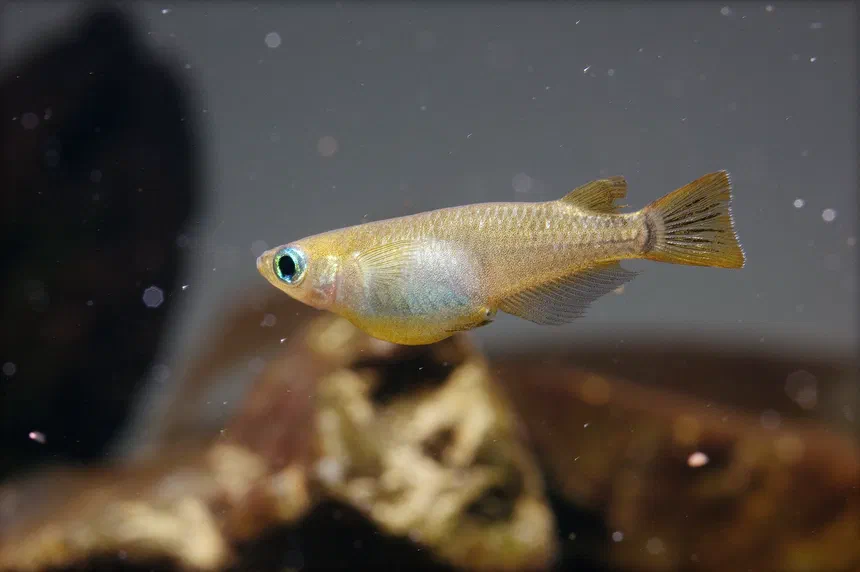
Image: Seotaro — CC BY-SA 3.0 · source
What Is a Japanese Rice Fish?
The Japanese rice fish (Oryzias latipes), also called the medaka, is a tiny freshwater fish native to the flooded rice fields and quiet waterways of East Asia. It belongs to the family Adrianichthyidae and has become one of the most widely studied small fishes in biology, valued both as a hardy aquarium pet and as a laboratory model organism.
Appearance and Identification
This is a diminutive fish, typically reaching only about 2.5 to 4 centimeters (1 to 1.6 inches) in length and weighing well under a gram. Wild individuals are a subdued silvery to pale gold, often with a slightly translucent body and a faint dark stripe running along each side. The eyes sit high on the head and the upturned mouth is adapted for feeding at the water’s surface. Selective breeding has produced many ornamental color forms, including bright orange, white, and even fluorescent strains, but wild fish remain modestly colored. Males and females can be told apart by fin shape: males tend to have larger, more angular dorsal and anal fins.
Habitat and Range
Oryzias latipes is closely tied to the shallow, warm, still or slow-moving waters of lowland East Asia. It thrives in rice paddies, irrigation ditches, ponds, marshes, and the sluggish margins of streams. Its natural range centers on Japan and extends into neighboring parts of eastern Asia, though taxonomic revisions have split some regional populations into separate species. The fish tolerates a remarkable range of conditions, coping with fluctuating temperatures, low oxygen, and even mildly brackish water, which helps explain its success in the shifting environment of managed farmland.
Diet
The rice fish is an opportunistic omnivore that feeds mostly near the water’s surface and in the upper layers. Its diet includes small zooplankton, the larvae of mosquitoes and other insects, tiny crustaceans, and bits of algae and plant material. This appetite for mosquito larvae has long made the species useful in helping to limit insect populations in agricultural water. In captivity it readily accepts flake foods, small live or frozen invertebrates, and finely powdered prepared diets.
Behavior
Medaka are social, active, and generally peaceful fish that gather in loose schools in open water. They are diurnal, spending daylight hours foraging near the surface. The species shows notable resilience to environmental stress, remaining active across a wide temperature band and enduring conditions that would overwhelm many other small fishes. This toughness, combined with a calm temperament, makes them easy to keep and observe, and contributes to their popularity in both home aquariums and research settings.
Life Cycle and Reproduction
Reproduction is strongly seasonal in the wild, peaking during the warmer, longer days of spring and summer. After courtship, a female releases a cluster of eggs that remains attached to her body for a time before the eggs are deposited among aquatic plants. The eggs are relatively large and transparent, and because embryos develop where they can be watched directly, the species has become a classic subject for studying vertebrate development, genetics, and the effects of radiation and pollutants. Young hatch within one to two weeks depending on temperature and mature quickly, often within a few months. Typical wild lifespan is roughly one to two years, though protected aquarium fish may live longer.
Conservation Status
The Japanese rice fish is listed as Least Concern by the IUCN, reflecting its broad distribution and adaptability. Even so, wild populations in some areas have declined because of habitat loss, changes in rice-farming practices, water pollution, and competition from introduced fishes. Local conservation efforts in Japan aim to protect native strains, in part because escaped or released ornamental fish can dilute the genetics of wild populations.
Frequently Asked Questions
Why is the rice fish important to science? Its transparent, externally developing embryos, small size, and hardiness make it an ideal model organism. It has even been raised aboard spacecraft to study reproduction and development in microgravity.
Is the Japanese rice fish the same as the medaka? Yes. “Medaka” is the common Japanese name for this species, and the two names are used interchangeably.
Can rice fish be kept in a home aquarium? They can. They are peaceful, tolerant of varied conditions, and comfortable in cooler water, which makes them a good choice for outdoor tubs and unheated tanks in temperate climates.