Fish Guide
Japanese Eel
What Is a Japanese Eel? The Japanese eel (Anguilla japonica) is a snake-like, ray-finned fish native to the freshwaters and coasts of East Asia. Like other members of the genus Anguilla, it is catadromous, meaning it …
At a glance
What Is a Japanese Eel?
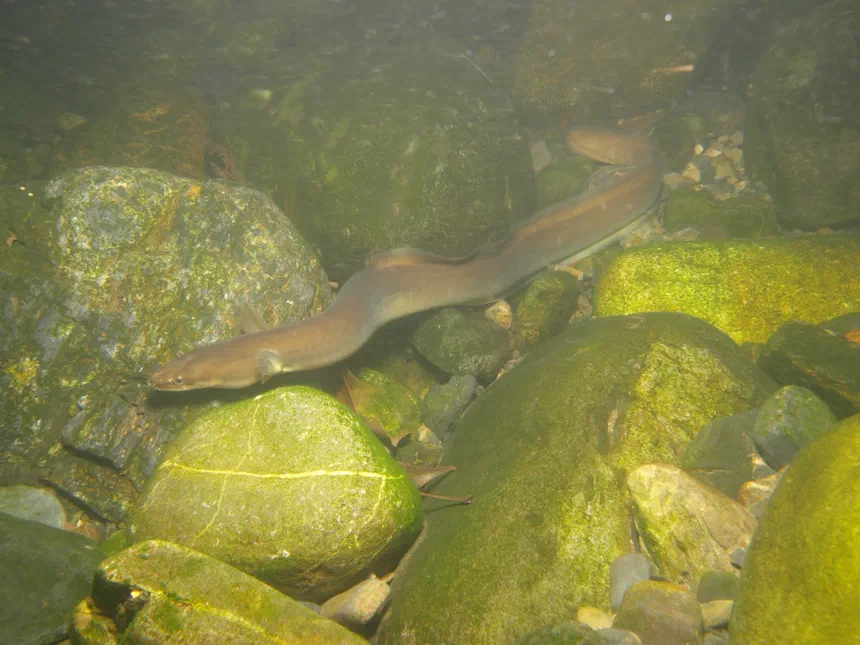
The Japanese eel (Anguilla japonica) is a snake-like, ray-finned fish native to the freshwaters and coasts of East Asia. Like other members of the genus Anguilla, it is catadromous, meaning it spends most of its life in rivers and estuaries but migrates far out to sea to breed. It is a culturally and economically important species, best known as the source of grilled eel dishes such as unagi.
Appearance and Identification
Japanese eels have a long, cylindrical body that tapers toward the tail, with smooth, slippery skin covered by tiny scales embedded in the skin. The dorsal, tail, and anal fins form one continuous fringe along the rear half of the body, and there are no pelvic fins. Coloration shifts with life stage: growing “yellow” eels tend to be olive-brown to gray on the back with a pale, yellowish underside, while eels preparing to migrate to sea take on a darker, more silvery appearance. Adults commonly reach about 40 to 100 centimeters (16 to 40 inches), with females generally growing larger than males.
Habitat and Range
This species is found across East Asia, including Japan, the Korean Peninsula, China, Taiwan, and parts of Vietnam, with its breeding grounds located far away in the western North Pacific near the Mariana Islands. Juveniles and adults occupy a wide range of inland and coastal waters, including rivers, streams, lakes, ponds, and brackish estuaries. Eels favor habitats with cover such as rocks, undercut banks, submerged vegetation, and soft bottoms where they can burrow and shelter during the day.
Diet
The Japanese eel is a carnivore and an opportunistic predator that hunts mostly at night. Its diet includes small fish, crustaceans such as shrimp and crabs, aquatic insects and their larvae, worms, and other small invertebrates. Eels rely heavily on a keen sense of smell to locate prey in murky water and after dark. Larger individuals take proportionally larger prey, and feeding activity generally slows in cold months.
Behavior
Eels are largely solitary and secretive, spending daylight hours hidden in burrows, crevices, or dense cover and emerging at night to forage. They are strong, flexible swimmers able to move through fast currents, and they can wriggle over wet ground or damp obstacles to reach new water bodies. Their skin can absorb some oxygen directly, which helps them survive brief periods out of water and in low-oxygen conditions. Individuals may remain in a favored stretch of river for years before beginning their oceanic migration.
Life Cycle and Reproduction
The life cycle of the Japanese eel is remarkable and still not fully understood. Adults leave freshwater and swim thousands of kilometers to spawning areas in the open Pacific, where they release eggs and then die. The hatched larvae, called leptocephali, are transparent and leaf-shaped, and they drift back toward Asia on ocean currents over several months. Near the coast they transform into slender, see-through “glass eels,” then pigment into “elvers” as they enter rivers and estuaries. There they grow as yellow eels for many years before maturing into silver eels ready to return to the sea, completing the cycle.
Conservation Status
The Japanese eel is listed as Endangered on the IUCN Red List. Populations have declined substantially due to overfishing, especially heavy harvest of glass eels for aquaculture, along with habitat loss from dams and river modifications, pollution, and shifting ocean conditions that may affect larval survival. Because the species is difficult to breed fully in captivity, most farmed eels still begin as wild-caught juveniles, which keeps pressure on natural populations. Conservation efforts focus on managing harvests, restoring river connectivity, and improving fishery regulation.
Frequently Asked Questions
Where do Japanese eels breed? They spawn far out in the western North Pacific, in the region near the Mariana Islands, then the larvae drift back to East Asian coasts.
Are Japanese eels endangered? Yes. The IUCN lists the species as Endangered, largely because of overfishing, habitat loss, and barriers like dams.
Can Japanese eels leave the water? For short periods, yes. Their moist skin can take in some oxygen, allowing them to wriggle across wet ground to reach nearby water.