Fish Guide
Jack Dempsey
What Is a Jack Dempsey? The Jack Dempsey (Rocio octofasciata) is a medium-sized freshwater cichlid native to Central America and prized by aquarists for its glittering coloration and bold personality. It earned its …
At a glance
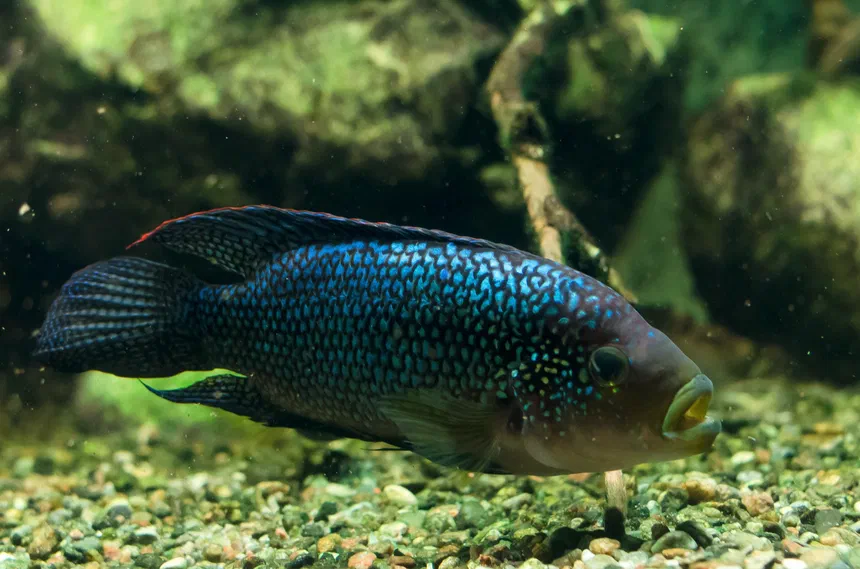
Image: Patrick Ch. Apfeld — CC BY-SA 3.0 · source
What Is a Jack Dempsey?
The Jack Dempsey (Rocio octofasciata) is a medium-sized freshwater cichlid native to Central America and prized by aquarists for its glittering coloration and bold personality. It earned its common name from the American heavyweight boxer Jack Dempsey, a nod to the fish’s pugnacious, territorial temperament. Like many cichlids, it is intelligent, aware of its surroundings, and quick to defend its patch of the tank or riverbed.
Appearance and Identification
A mature Jack Dempsey has a stocky, oval body with a large head and a slightly upturned mouth. The base color ranges from tan or gray in juveniles and stressed fish to a dark, almost purple-black in confident adults. Scattered across the flanks, gill covers, and fins are dozens of shimmering spangles that flash blue, green, and gold under good lighting. Faint vertical bars may appear or fade depending on mood and breeding condition. Adults typically reach about 8 to 10 inches (20 to 25 cm), with males growing larger and developing longer, more pointed dorsal and anal fins than females. A popular selectively bred form, the Electric Blue Jack Dempsey, shows an overall pale sky-blue body.
Habitat and Range
The species occurs naturally in the warm lowland waters of southern Mexico, Guatemala, Belize, and Honduras. It favors slow-moving or still water such as canals, swamps, weedy lagoons, and the murky margins of rivers, often where the bottom is muddy and cover is plentiful. These habitats tend to be warm year-round, roughly in the 72 to 86 degree Fahrenheit range (22 to 30 degrees Celsius). Through the aquarium trade, Jack Dempseys have been released or escaped into waters well outside their native range, and feral populations have established in places such as the United States, Australia, and Thailand, where warm springs or heated outflows allow them to survive.
Diet
Jack Dempseys are carnivores that behave as opportunistic predators and foragers. In the wild they eat aquatic insects and their larvae, worms, small crustaceans, and small fish, snapping up whatever prey fits in their mouths. They will also sift the substrate for edible morsels. In captivity they readily take pellets, frozen and live foods such as bloodworms and brine shrimp, and occasional small feeder items, though a varied diet keeps their color and health at their best.
Behavior
This cichlid is well known for a feisty, territorial disposition, especially as it matures and during breeding. Individuals establish and patrol a home area, chasing off rivals and other fish that stray too close. Despite the aggression, they are curious and can learn to recognize the person who feeds them. Outside of breeding, temperament varies between individuals; some are relatively calm while others are persistent bullies. They tend to hold their brightest colors when they feel secure and dominant, and turn drab when frightened or subordinate.
Life Cycle and Reproduction
Jack Dempseys are substrate-spawning cichlids that form monogamous pairs during breeding. A pair cleans a flat rock, log, or patch of hard ground and the female lays a sheet of adhesive eggs, which the male then fertilizes. A single clutch can number in the hundreds. Both parents guard the eggs and, once they hatch, the wriggling larvae, moving them to shallow pits and fanning fresh water over them. The parents continue to shepherd the free-swimming fry for days to weeks, an intense level of parental care typical of the cichlid family. Youngsters grow quickly and reach breeding size within their first year or two.
Conservation Status
The Jack Dempsey has not been formally assessed on the IUCN Red List, so it carries no official conservation ranking. It is widespread within its native range, adaptable, and enormously abundant in the aquarium trade, so it faces no known threat of extinction. Where it has been introduced beyond its natural range, it can act as an invasive species, competing with and preying on native fish.
Frequently Asked Questions
Why is it called a Jack Dempsey? The fish is named after the boxer Jack Dempsey because of its aggressive, combative behavior and strong facial features.
Are Jack Dempseys aggressive? Yes, they are territorial and can be pugnacious, particularly when mature or guarding a nest, though temperament varies from fish to fish.
How big do Jack Dempseys get? Most reach about 8 to 10 inches (20 to 25 cm), with males typically larger than females.