Fish Guide
Indian Mackerel
What Is a Indian Mackerel? The Indian mackerel (Rastrelliger kanagurta) is a small, fast-swimming schooling fish in the mackerel and tuna family, Scombridae. It is one of the most economically important food fishes …
At a glance
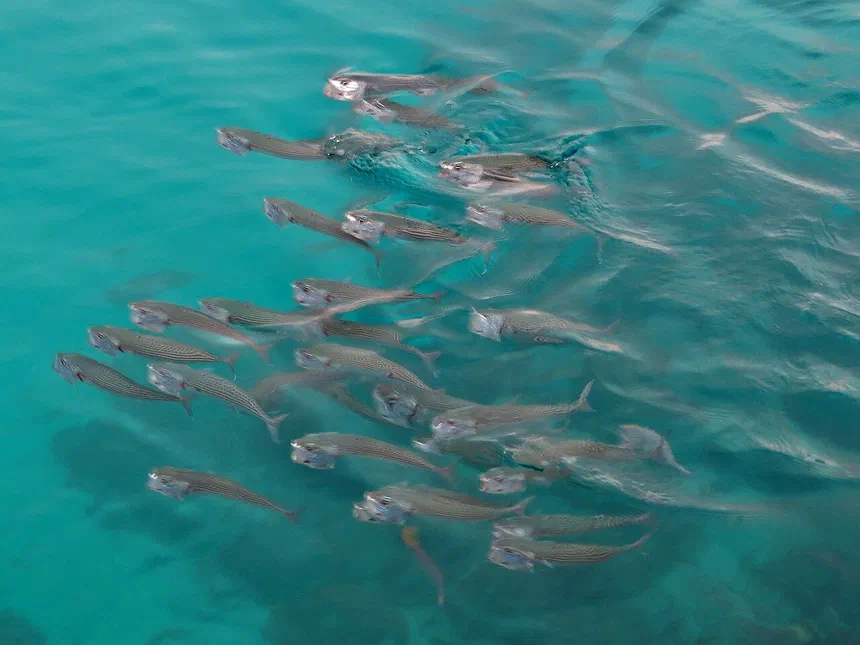
Image: Frédéric Ducarme — CC BY-SA 4.0 · source
What Is a Indian Mackerel?
The Indian mackerel (Rastrelliger kanagurta) is a small, fast-swimming schooling fish in the mackerel and tuna family, Scombridae. It is one of the most economically important food fishes across the tropical Indo-Pacific, supporting large coastal fisheries from East Africa to Southeast Asia. Compact and streamlined, it is built for a life of near-constant movement in warm surface waters.
Appearance and Identification
The Indian mackerel has the classic torpedo-shaped, laterally compressed body of a mackerel, tapering to a slender base and a deeply forked tail. Its back is greenish to blue-green, its flanks are silvery, and a series of faint, narrow dark stripes usually runs along the upper body. A distinct dark spot often sits near the rear edge of the pectoral fin, and a row of small finlets lines the body behind both the dorsal and anal fins. Adults typically reach about 20 to 25 centimeters, occasionally growing to around 35 centimeters. One of the species’ most notable features is its unusually wide gape and long, closely set gill rakers, which it uses to strain tiny food from the water.
Habitat and Range
This species lives in warm coastal and continental-shelf waters, generally at depths from the surface down to a few tens of meters. It favors areas with abundant plankton and can tolerate the slightly lower salinities found near river mouths and turbid inshore zones. Its range spans the Indo-West Pacific, from the Red Sea and the eastern coast of Africa eastward through the Arabian Sea, Bay of Bengal, and Southeast Asian seas to the waters around Indonesia, the Philippines, and parts of Oceania. Large schools are common around bays, lagoons, and coastal upwelling zones where food is plentiful.
Diet
The Indian mackerel is a planktivorous carnivore that feeds mainly by filtering the water. Juveniles rely heavily on phytoplankton and small planktonic animals, while adults take a larger share of zooplankton such as copepods, tiny crustaceans, and fish and invertebrate larvae. Swimming with the mouth open, the fish uses its fine gill rakers to trap suspended particles, allowing it to exploit dense plankton patches efficiently. This flexible, filter-feeding strategy lets it shift between food sources as conditions change through the seasons.
Behavior
Indian mackerel are highly gregarious and spend most of their lives in tightly coordinated schools, sometimes mixing with related species. Schooling provides protection from predators and improves feeding success when the fish work through plankton-rich water together. They are strong, continuous swimmers that often gather near the surface, especially where currents concentrate food. The species undertakes seasonal movements tied to water temperature, plankton blooms, and spawning, which makes its abundance in a given area vary throughout the year.
Life Cycle and Reproduction
The Indian mackerel is a fast-growing, relatively short-lived fish, usually living only about three to four years. Spawning occurs in warm coastal waters, often in one or more pulses linked to seasonal conditions, and females release large numbers of small, buoyant eggs into open water. The eggs and resulting larvae drift as part of the plankton, and the young grow quickly, reaching maturity within their first year or two. This rapid life cycle and high reproductive output help the species sustain the heavy fishing pressure it faces across its range.
Conservation Status
The Indian mackerel is assessed as Least Concern by the IUCN, reflecting its wide distribution and enormous overall population. It is, however, one of the most heavily harvested fishes in tropical Asian waters and forms a staple catch for many small-scale and commercial fisheries. Because local stocks can be depleted by intense fishing, sustainable management and monitoring remain important to keep both the fish populations and the communities that depend on them healthy.
Frequently Asked Questions
Is the Indian mackerel good to eat? Yes. It is a popular, affordable food fish valued for its rich, oily flesh and is eaten fresh, dried, salted, or canned throughout its range.
How big does an Indian mackerel get? Most individuals are around 20 to 25 centimeters long, though some reach roughly 35 centimeters.
Why does it swim with its mouth open? It is filter feeding. By opening its wide mouth while swimming, it strains plankton from the water using its long, fine gill rakers.