Fish Guide
Humphead Wrasse
What Is a Humphead Wrasse? The humphead wrasse (Cheilinus undulatus) is one of the largest reef fish in the world and the giant of the wrasse family. Named for the prominent bulbous hump that develops on the forehead of …
At a glance
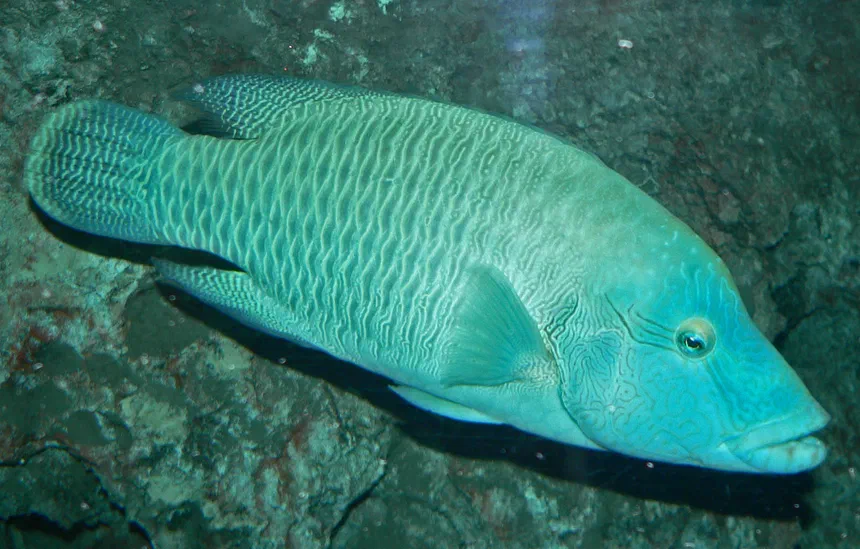
Image: Stan Shebs — CC BY-SA 3.0 · source
What Is a Humphead Wrasse?
The humphead wrasse (Cheilinus undulatus) is one of the largest reef fish in the world and the giant of the wrasse family. Named for the prominent bulbous hump that develops on the forehead of older adults, it is also known as the Napoleon wrasse or Maori wrasse for the intricate lines that decorate its face.
Appearance and Identification
This species is unmistakable at full size. Large adults can reach around 2 meters (6.5 feet) in length and weigh as much as roughly 180 kilograms (400 pounds), though most individuals seen on reefs are considerably smaller. The body is heavy and deep, colored in shifting shades of blue-green, teal, and olive, with thick lips and two black lines running back from each eye. Mature males develop a pronounced fleshy hump above the eyes, while younger fish and females tend to be more reddish-orange with finer patterning. Fine maze-like markings cover the head, giving rise to the “Maori” nickname.
Habitat and Range
The humphead wrasse lives across the tropical Indo-Pacific, from the Red Sea and the coast of East Africa eastward through Southeast Asia and out to islands of the central Pacific. It favors coral-rich habitats, including outer reef slopes, channel walls, lagoons, and drop-offs. Juveniles shelter among branching corals, seagrass beds, and rubble in shallower water, while adults range across deeper reef faces, often to depths of 100 meters or more.
Diet
A powerful predator, the humphead wrasse feeds mainly on hard-shelled and armored prey that many other fish avoid. Its strong jaws and crushing teeth let it eat mollusks, crustaceans, sea urchins, and brittle stars, along with fish. Notably, it is one of the few reef predators that readily consumes toxic or spiny animals such as crown-of-thorns starfish and boxfish, giving it an outsized role in keeping reef invertebrate populations in balance.
Behavior
Humphead wrasse are typically solitary and diurnal, patrolling familiar stretches of reef by day and retreating to caves or ledges to rest at night. They are curious and can become quite tame where they are not hunted, sometimes approaching divers closely. Individuals hold home ranges on the reef, and encounters between adults are usually spaced out rather than schooling, reflecting the fish’s large size and territorial tendencies.
Life Cycle and Reproduction
Like many wrasses, this species is a protogynous hermaphrodite: individuals mature first as females and some later transform into males. Growth is slow and sexual maturity is reached late, often at five to seven years of age, which makes populations slow to recover from losses. Spawning occurs in groups, frequently tied to particular reef sites and lunar cycles, and produces tiny pelagic eggs that drift as plankton before larvae settle onto the reef. Individuals can live 25 to 30 years or more.
Conservation Status
The humphead wrasse is listed as Endangered on the IUCN Red List. Its slow growth, late maturity, and naturally low numbers make it highly vulnerable to overfishing. Demand in the live reef food-fish trade, where large individuals fetch premium prices, has driven sharp declines, and juveniles are sometimes captured to be grown out in captivity. Destructive fishing methods, including the use of cyanide, and the loss of coral reef habitat add further pressure. The species is protected under CITES Appendix II, which regulates international trade.
Frequently Asked Questions
How big can a humphead wrasse get? The largest individuals approach 2 meters (about 6.5 feet) in length and can weigh close to 180 kilograms (400 pounds), making it the biggest member of the wrasse family.
Why is it called the Napoleon wrasse? The nickname refers to the large hump on the forehead of adult males, which recalls the shape of the bicorne hat associated with Napoleon Bonaparte.
Is the humphead wrasse dangerous to people? No. Despite its size and strong jaws, it is not aggressive toward humans and is often gentle and curious around divers where it is not hunted.