Fish Guide
Atlantic Herring
What Is a Atlantic Herring? The Atlantic herring (Clupea harengus) is a small, schooling ray-finned fish that ranges across the cold waters of the North Atlantic. It is one of the most abundant fish in the world and a …
At a glance
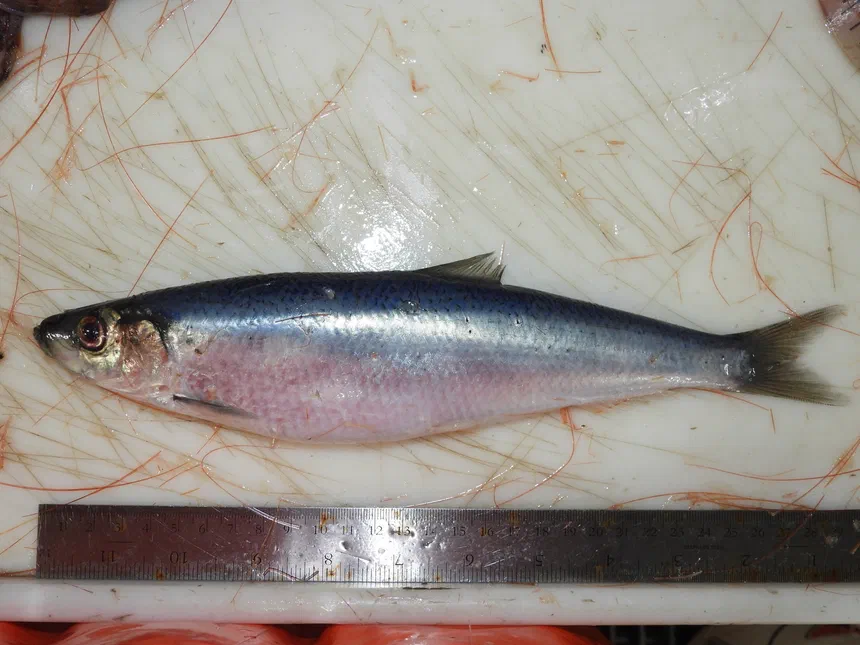
What Is a Atlantic Herring?
The Atlantic herring (Clupea harengus) is a small, schooling ray-finned fish that ranges across the cold waters of the North Atlantic. It is one of the most abundant fish in the world and a keystone species in marine food webs, supporting predators from cod and tuna to seabirds, seals, and whales.
Appearance and Identification
Atlantic herring have a slender, streamlined body that is laterally compressed. The back is a deep steel- or greenish-blue that shades into brilliant, mirror-like silver along the flanks and belly, a coloration that helps camouflage the fish in open water. The scales are large and loose, shedding easily when the fish is handled. A single soft-rayed dorsal fin sits near the middle of the back, and a deeply forked tail powers rapid, sustained swimming. Unlike some relatives, herring lack spines in their fins and have no lateral line visible along the flank. Most adults measure between 20 and 38 centimeters, though the largest individuals can approach 45 centimeters.
Habitat and Range
The species occupies both sides of the North Atlantic, from the coastal shelves of eastern North America down to the Carolinas and across to the waters around Iceland, the British Isles, Scandinavia, and into the Baltic and Barents Seas. Herring are pelagic, spending most of their lives in the open water column rather than on the seabed. They prefer cool, well-oxygenated water and undertake large seasonal migrations, moving between offshore feeding grounds, overwintering areas, and shallower spawning banks. Depth use shifts with the daily vertical movement of their planktonic prey.
Diet
Atlantic herring are filter and particulate feeders that hunt small drifting animals. Their diet is dominated by zooplankton, especially copepods, along with krill, fish eggs, larvae, and other tiny invertebrates. Juveniles rely heavily on the smallest plankton, while larger fish take bigger prey and can switch between filtering water through their fine gill rakers and picking out individual items. Feeding is often concentrated in productive surface layers during the warmer months, when plankton blooms are richest.
Behavior
Herring are famously social, forming enormous schools that can contain millions of individuals moving in tight coordination. Schooling offers protection: a shimmering, shifting mass confuses predators and lowers any single fish’s odds of being caught. The fish communicate spacing and direction through vision and their sensitive lateral-line system, and they perform daily vertical migrations, rising toward the surface at dusk to feed and sinking to deeper water by day. This constant movement makes herring both an elusive prey and a reliable target for commercial fisheries.
Life Cycle and Reproduction
Atlantic herring are highly fecund, with a female releasing tens of thousands of eggs in a single season. Unlike many marine fish, they are demersal spawners: instead of scattering floating eggs, they deposit sticky eggs onto gravel, rock, or vegetation on the sea floor, where the eggs form dense carpets. Different populations spawn at different times of year, a staggering that spreads reproduction across seasons. The eggs hatch into transparent, thread-like larvae that drift with currents before developing into juveniles. Growth is relatively slow, and fish typically mature at three to five years of age. Individuals may live well over a decade.
Conservation Status
The Atlantic herring is listed as Least Concern by the IUCN, reflecting its vast overall numbers and wide distribution. However, the species has a long history of boom-and-bust fisheries, and some regional stocks have collapsed under heavy fishing before recovering under stricter quotas. Because herring are so central to the food web, careful, science-based management of catch limits is important not only for the fishery but for the many predators that depend on them.
Frequently Asked Questions
Are Atlantic herring the same as sardines? No, though they are close relatives in the same family (Clupeidae). “Sardine” is a market name applied to several small clupeid species, while the Atlantic herring is its own distinct species.
Why do herring form such large schools? Schooling is a defense strategy. A dense, synchronized group makes it hard for a predator to single out one fish and can overwhelm attackers with sheer numbers and motion.
Are Atlantic herring important to people? Yes. They are one of the most heavily fished species in the world, used for food, canning, bait, and fish oil, and have supported major coastal economies for centuries.