Fish Guide
Harlequin Rasbora
What Is a Harlequin Rasbora? The harlequin rasbora (Trigonostigma heteromorpha) is a small, brightly colored freshwater fish native to Southeast Asia. It belongs to the family Danionidae and is one of the most popular …
At a glance
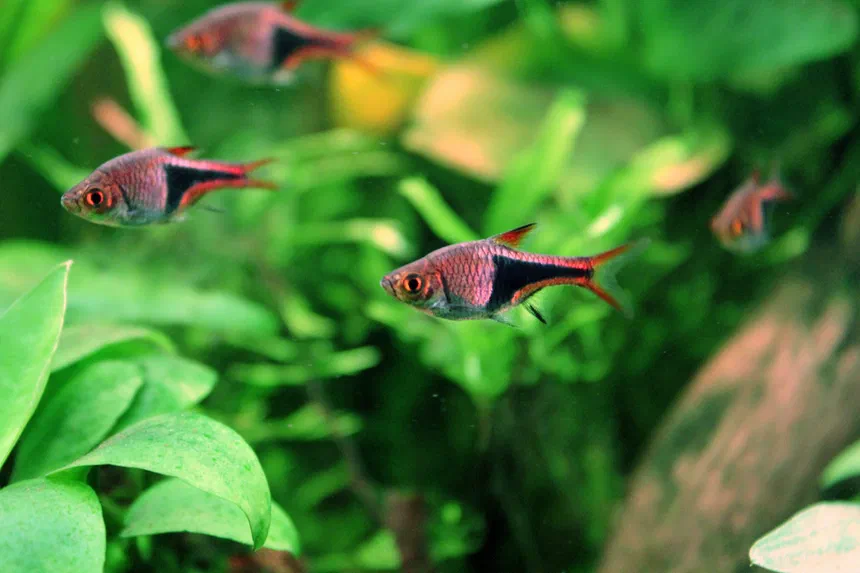
Image: Juan R. Lascorz — CC BY-SA 3.0 · source
What Is a Harlequin Rasbora?
The harlequin rasbora (Trigonostigma heteromorpha) is a small, brightly colored freshwater fish native to Southeast Asia. It belongs to the family Danionidae and is one of the most popular and enduring species in the tropical aquarium hobby, prized for its peaceful nature and the bold black patch that marks its flank.
Appearance and Identification
This is a compact, deep-bodied little fish that usually reaches about 1.5 to 2 inches (4 to 5 centimeters) in length. Its body is a warm coppery pink, rose, or orange, and its most distinctive feature is a solid black triangular or wedge-shaped patch that covers the rear half of the body, tapering to a point near the base of the tail. This “hatchet” mark gives the fish its harlequin name. The fins often carry a reddish tint, and males tend to be slightly slimmer and more intensely colored than the rounder-bodied females. The similar-looking lambchop rasbora and glowlight rasbora are close relatives that are sometimes confused with it.
Habitat and Range
Harlequin rasboras occur across the Malay Peninsula, parts of Thailand, Sumatra, and Borneo. They favor slow-moving, shaded blackwater environments such as forest streams, swamps, and peat-swamp pools. These waters are typically soft, acidic, and stained brown by tannins leached from decaying leaves and vegetation, giving them a tea-colored appearance. Dense aquatic and marginal plants provide cover, and the fish tend to gather in loose shoals in the calmer stretches.
Diet
In the wild, harlequin rasboras are opportunistic omnivores. They feed mainly on tiny invertebrates, insect larvae, zooplankton, and small crustaceans, supplemented by algae and bits of plant matter drifting in the water column. Their small upturned mouths are well suited to picking food from the surface and mid-water. In aquariums they readily accept flake and micro-pellet foods along with live or frozen items such as daphnia, brine shrimp, and bloodworms.
Behavior
These are gentle, social fish that live in groups and feel most secure when kept in numbers. A shoal moves and feeds together, and individuals kept alone or in very small groups often become shy and stressed. They are active swimmers that occupy the middle and upper levels of the water, darting among plants and open spaces. Their peaceful temperament makes them poor competitors against aggressive tankmates but excellent companions for other calm, similarly sized species.
Life Cycle and Reproduction
Harlequin rasboras have an unusual spawning habit for a small cyprinid-like fish. Rather than scattering eggs freely, a female typically turns upside down beneath the broad underside of a plant leaf, where the male wraps around her and eggs are deposited and fertilized against the leaf surface. A female may lay several dozen eggs across multiple leaves in a single spawning session. The adhesive eggs hatch in roughly a day, and the young become free-swimming a few days later. The parents provide no care and may eat the eggs. In good conditions these fish can live around four to six years.
Conservation Status
The harlequin rasbora is listed as Least Concern by the IUCN. It remains widespread and locally common across much of its range, and the aquarium trade is largely supplied by captive breeding rather than wild collection. Nonetheless, the peat swamps and blackwater forests it depends on are under pressure from deforestation, drainage, and development, which could affect local populations over time.
Frequently Asked Questions
How many harlequin rasboras should be kept together? Because they are shoaling fish, they do best in groups of at least six to eight, and larger groups bring out their best color and most confident behavior.
Are harlequin rasboras aggressive? No. They are among the most peaceful community fish and coexist well with other small, gentle species.
What makes their black marking special? The bold black wedge on the rear body is the feature that gives the species its “harlequin” name and makes it easy to identify at a glance.