Fish Guide
Great Hammerhead Shark
What Is a Great Hammerhead Shark? The great hammerhead (Sphyrna mokarran) is the largest of the hammerhead sharks, instantly recognized by its broad, flattened, hammer-shaped head. A powerful apex predator of warm …
At a glance
What Is a Great Hammerhead Shark?
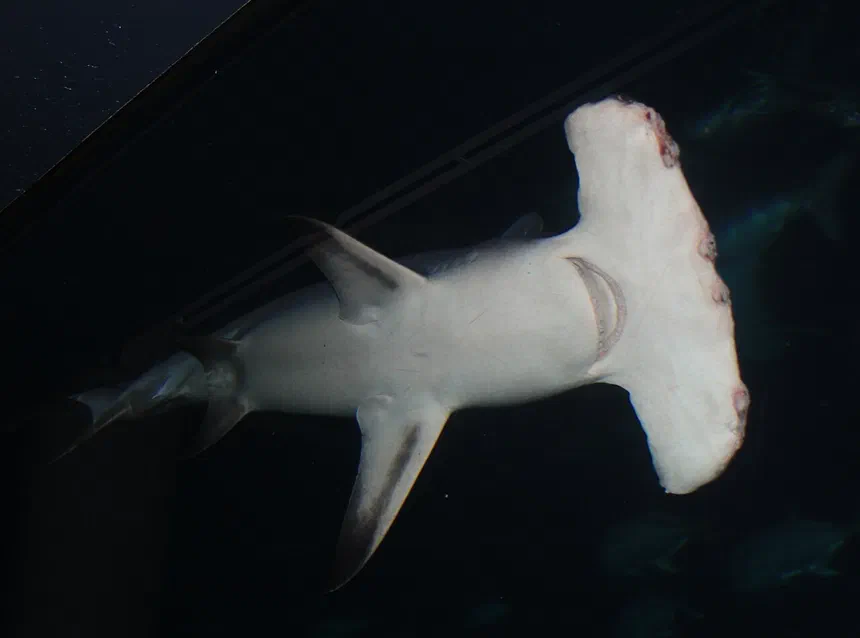
The great hammerhead (Sphyrna mokarran) is the largest of the hammerhead sharks, instantly recognized by its broad, flattened, hammer-shaped head. A powerful apex predator of warm oceans, it belongs to the family Sphyrnidae and stands out even among its relatives for its size and its tall, sickle-shaped dorsal fin.
Appearance and Identification
The great hammerhead’s most distinctive feature is its wide, mallet-like head, known as a cephalofoil. Unlike other hammerheads, the leading edge of its head is nearly straight with a slight central notch, rather than curved. Adults are typically gray-brown to olive on top and pale or white underneath, coloring that helps them blend into both the seafloor and the sunlit water above. Most individuals measure around 3.5 to 4 meters, though large females can reach 6 meters or more and weigh several hundred kilograms. The exceptionally tall, curved first dorsal fin is another reliable identifying trait. The eyes and nostrils sit at the far ends of the head, spacing that improves the shark’s sensory range.
Habitat and Range
Great hammerheads live in tropical and warm-temperate waters around the world, from coastal shallows to the open ocean. They are found near coral reefs, over continental shelves, in lagoons, and along drop-offs, usually at depths ranging from the surface down to about 80 meters, though they can venture deeper. This species is highly migratory, and populations in cooler regions often move toward the poles in summer and back toward the equator as waters cool.
Diet
As a carnivore near the top of the food chain, the great hammerhead preys on a wide variety of animals. Stingrays are a favorite food, and the shark seems well adapted to hunting them; it is often seen with stingray barbs embedded in its mouth, apparently unbothered by the venom. It also eats other sharks and rays, bony fish, squid, octopus, and crustaceans. Hunting mostly at dawn and dusk, the shark uses its wide head both to pin rays against the seafloor and to sweep it across the bottom, scanning for hidden prey with electroreceptors called ampullae of Lorenzini.
Behavior
Great hammerheads are generally solitary and roam widely as they hunt. The broad head is thought to aid maneuverability, letting the shark make sharp, quick turns to chase agile prey, and its wide spacing of eyes may grant a broader field of vision. These sharks are strong, active swimmers. Though large and capable, they are not considered a significant danger to people and typically avoid divers, but their size warrants respectful caution.
Life Cycle and Reproduction
Like many large sharks, the great hammerhead is viviparous, meaning females give birth to live young that develop internally nourished through a placental connection. After a gestation period of roughly 11 months, a female produces a litter that can range from around 6 to more than 40 pups, depending on her size. Newborns are typically 50 to 70 centimeters long and are independent from birth. Great hammerheads grow slowly, mature late, and reproduce only every couple of years, which makes their populations especially slow to recover from losses.
Conservation Status
The great hammerhead is listed as Critically Endangered on the IUCN Red List. Its fins are highly valued in the shark-fin trade, and the species is heavily affected by both targeted fishing and accidental capture as bycatch. Because great hammerheads are fragile and often die quickly once caught, even catch-and-release fishing can be lethal. Their slow reproductive rate compounds these pressures, and international trade protections along with fishing regulations are now central to efforts to conserve the species.
Frequently Asked Questions
Why does the great hammerhead have a hammer-shaped head? The wide head, or cephalofoil, spreads out the shark’s sensory organs, improving its ability to detect prey through electroreception and possibly widening its field of vision, while also helping it pin down stingrays.
Are great hammerheads dangerous to humans? Although they are large predators, great hammerheads rarely interact with people and are not considered a major threat. Unprovoked attacks are very uncommon.
How big can a great hammerhead get? Most reach about 3.5 to 4 meters, but exceptional individuals, usually females, can grow to 6 meters or longer and weigh several hundred kilograms.