Fish Guide
Atlantic Halibut
What Is a Atlantic Halibut? The Atlantic halibut (Hippoglossus hippoglossus) is the largest of the flatfishes, a group of bottom-dwelling fish whose bodies lie flat against the seafloor. Native to the cold, deep waters …
At a glance
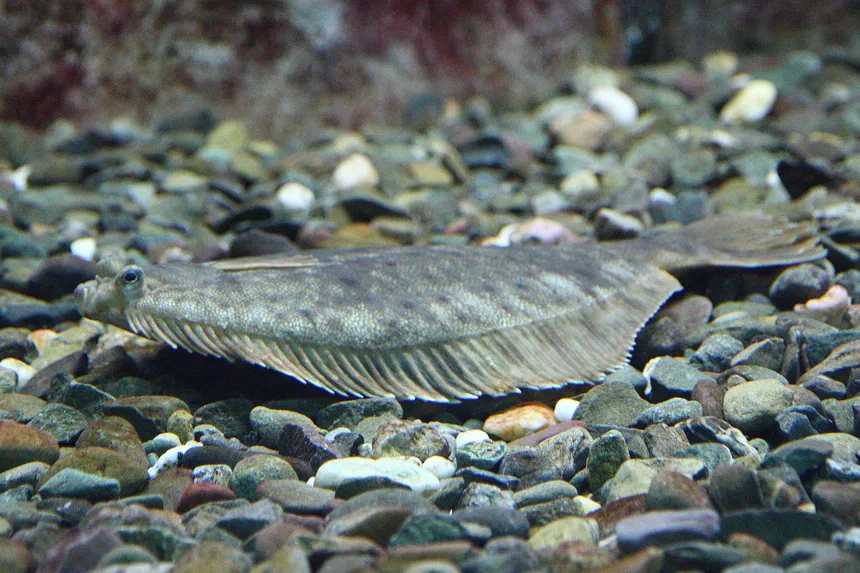
Image: Cephas — CC BY-SA 3.0 · source
What Is a Atlantic Halibut?
The Atlantic halibut (Hippoglossus hippoglossus) is the largest of the flatfishes, a group of bottom-dwelling fish whose bodies lie flat against the seafloor. Native to the cold, deep waters of the North Atlantic, it is a powerful predator prized by commercial and recreational fisheries. Despite its flattened shape, it is a fast, muscular swimmer capable of chasing down prey well above the bottom.
Appearance and Identification
Like all flatfish, the Atlantic halibut begins life with an eye on each side of its head but develops both eyes on one side as it matures. In this species both eyes shift to the right side, so the fish rests on its left side against the bottom. The upper (eyed) surface is dark, ranging from chocolate brown to olive or nearly black, which camouflages it against the seabed, while the underside is pale white. The body is thick, elongated, and diamond-shaped, with a large mouth, sharp teeth, and a broad, slightly forked tail. Mature fish are enormous by fish standards, commonly reaching 3 to 5 feet, with record specimens exceeding 8 feet and weighing several hundred pounds. Females grow considerably larger than males.
Habitat and Range
Atlantic halibut inhabit the cold waters of the North Atlantic on both the eastern and western sides. In the west they range from Greenland and the Canadian Maritimes south to the waters off New England and Virginia, and in the east from Iceland and the Barents Sea down to the Bay of Biscay. They favor the continental shelf and upper slope, typically over sand, gravel, or clay bottoms at depths of roughly 300 to 6,500 feet. Adults tend to occupy deeper, colder water, while younger fish are often found in shallower coastal zones. They tolerate a narrow range of cold temperatures and generally avoid warmer surface waters.
Diet
The Atlantic halibut is an aggressive carnivore that sits near the top of the seafloor food web. Younger fish feed heavily on crustaceans and small bottom invertebrates, while larger adults become primarily fish-eaters. Their prey includes cod, haddock, herring, sand lance, redfish, and other flatfishes, along with squid, octopus, crabs, and occasionally lobsters. Unlike many flatfishes that ambush prey while buried, large halibut actively pursue schooling fish through the water column, using bursts of speed to overtake them.
Behavior
Adult halibut are strong, active swimmers rather than sedentary bottom-huggers. Although they rest on the seafloor, they will rise well off the bottom to hunt and can undertake long seasonal migrations tied to feeding and spawning. Individuals have been recorded moving hundreds of miles between feeding grounds and spawning areas. They are largely solitary and, given their size and speed, have few natural predators as adults aside from large sharks, marine mammals, and humans.
Life Cycle and Reproduction
Atlantic halibut are slow-growing and late-maturing, with males typically maturing around 7 to 8 years and females later, often at 10 to 12 years. Spawning occurs in deep water during late winter and spring, when a large female may release from hundreds of thousands to a few million buoyant eggs. The eggs and newly hatched larvae drift in the water column for several weeks. During this larval stage the fish undergo their dramatic transformation, with the left eye migrating to the right side of the head before the young fish settle to the bottom in shallow nursery grounds. This slow maturation and long lifespan of up to 50 years make the species especially vulnerable to overfishing.
Conservation Status
The Atlantic halibut is currently listed as Least Concern on the IUCN Red List at the global level, but this masks serious regional declines. Centuries of intensive fishing sharply reduced many populations, and some stocks, particularly in parts of the western Atlantic, remain severely depleted and slow to recover because of the fish’s late maturity and low reproductive turnover. Management measures such as catch limits, minimum sizes, and rebuilding plans are in place in several regions, and halibut aquaculture has developed as an alternative to wild capture.
Frequently Asked Questions
How big can an Atlantic halibut get? They are the largest flatfish, commonly reaching 3 to 5 feet, with exceptional individuals surpassing 8 feet and several hundred pounds.
Why are both of the halibut’s eyes on one side? Halibut hatch with an eye on each side, but during the larval stage the left eye migrates to the right side so the fish can lie flat on the seabed while keeping both eyes facing upward.
Are Atlantic halibut endangered? Globally the species is listed as Least Concern, but several regional stocks have been heavily overfished and remain depleted, so fisheries are carefully managed.