Fish Guide
Guppy
What Is a Guppy? The guppy (Poecilia reticulata) is a small, hardy freshwater fish in the family Poeciliidae, the livebearers. Native to the warm waters of northeastern South America and nearby Caribbean islands, it has …
At a glance
What Is a Guppy?
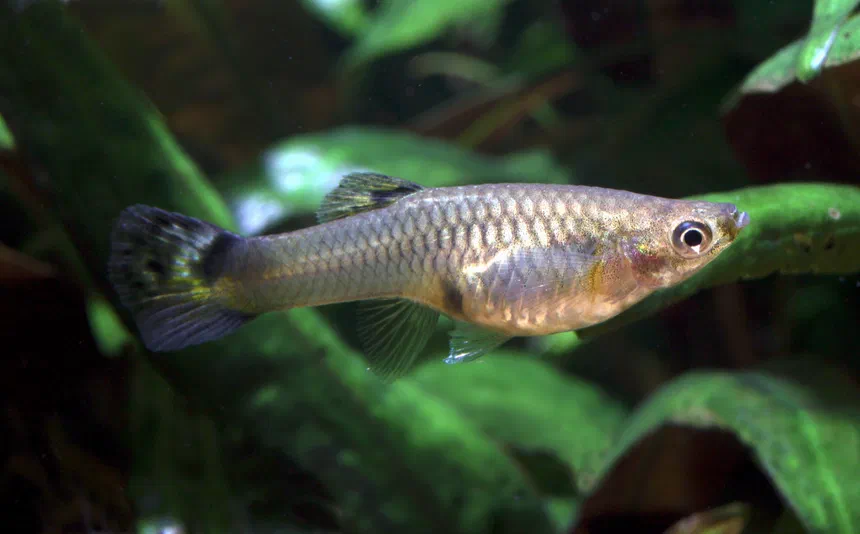
The guppy (Poecilia reticulata) is a small, hardy freshwater fish in the family Poeciliidae, the livebearers. Native to the warm waters of northeastern South America and nearby Caribbean islands, it has become one of the most familiar aquarium fish in the world and one of the most widely introduced freshwater species on the planet.
Appearance and Identification
Guppies are strongly sexually dimorphic. Males are the smaller sex, typically about 1.5 to 3.5 centimeters long, and are famous for their bright, endlessly variable coloration, spots, and long ornamental fins. Females are noticeably larger, usually around 3 to 6 centimeters, with a plainer gray-olive body and much more modest finnage. Both sexes weigh well under a gram. The species name reticulata refers to the net-like pattern on the body of wild individuals. Decades of selective breeding have produced hundreds of domestic strains with exaggerated tails and dazzling colors, but wild guppies remain comparatively subdued.
Habitat and Range
The guppy is native to Venezuela, Guyana, Suriname, Brazil, Trinidad and Tobago, and other parts of northeastern South America. It thrives in warm, slow-moving fresh water such as streams, ponds, ditches, and pools, and it tolerates a wide range of conditions, including brackish water, low oxygen, and turbid or degraded habitats. Because of this adaptability, guppies have been introduced to dozens of countries, often deliberately for mosquito control, and now occur on every continent except Antarctica. In many places these introduced populations are considered invasive, competing with and preying on native fish and invertebrates.
Diet
Guppies are opportunistic omnivores. In the wild they graze on algae and organic detritus and feed on small invertebrates such as insect larvae, including mosquito larvae, tiny crustaceans, and zooplankton. This broad, flexible diet is one reason the species survives so well in disturbed and nutrient-poor waters. In aquariums they readily accept flake food, small live and frozen foods, and other prepared diets.
Behavior
Guppies are active, social fish that generally move about in loose groups. Males spend much of their time displaying to females, flaring their fins and performing courtship movements, and they compete constantly for mating opportunities. The species is a favorite subject of biological research, particularly on predation, coloration, and evolution: studies in Trinidad have shown that guppy populations exposed to heavy predation tend to be drabber and mature earlier, while those in predator-free waters evolve brighter colors and larger ornaments. This makes the guppy a textbook example of natural and sexual selection acting in the wild.
Life Cycle and Reproduction
Guppies are livebearers, meaning females give birth to free-swimming young rather than laying eggs. After internal fertilization, a female can store sperm and produce several broods from a single mating. Gestation lasts roughly three to four weeks, and a brood may range from a handful to more than fifty fry depending on the female’s size and condition. The young are independent at birth and can swim and feed immediately, though they are vulnerable to predation, including from adult guppies. Females can reproduce again within weeks, allowing populations to grow rapidly. Guppies reach sexual maturity quickly, often within a few months, and typically live one to three years.
Conservation Status
The guppy is listed as Least Concern by the IUCN. It is abundant across its native range and, thanks to introductions and the aquarium trade, is one of the most widespread freshwater fish in the world. There are no significant conservation concerns for the species itself. The greater conservation issue runs the other way: introduced guppies can harm native aquatic communities, so releasing them into the wild is discouraged.
Frequently Asked Questions
Do guppies lay eggs? No. Guppies are livebearers; females give birth to fully formed, free-swimming young rather than laying eggs.
Why are male guppies so colorful? Bright colors and large fins help males attract females. Where predators are scarce, sexual selection favors flashier males; where predators are common, drabber males tend to survive better.
Are guppies good for mosquito control? They do eat mosquito larvae and have been introduced widely for that purpose, but those introductions have often harmed native species, so the practice is now controversial.