Fish Guide
Great White Shark
What Is a Great White Shark? The great white shark (Carcharodon carcharias) is a large, powerful predatory fish and the world’s biggest predatory shark. It belongs to the mackerel shark family, Lamnidae, and is famous …
At a glance
What Is a Great White Shark?
The great white shark (Carcharodon carcharias) is a large, powerful predatory fish and the world’s biggest predatory shark. It belongs to the mackerel shark family, Lamnidae, and is famous for its size, torpedo-shaped body, and rows of serrated, triangular teeth. As an apex predator, it plays an important role in keeping ocean ecosystems in balance.
Appearance and Identification
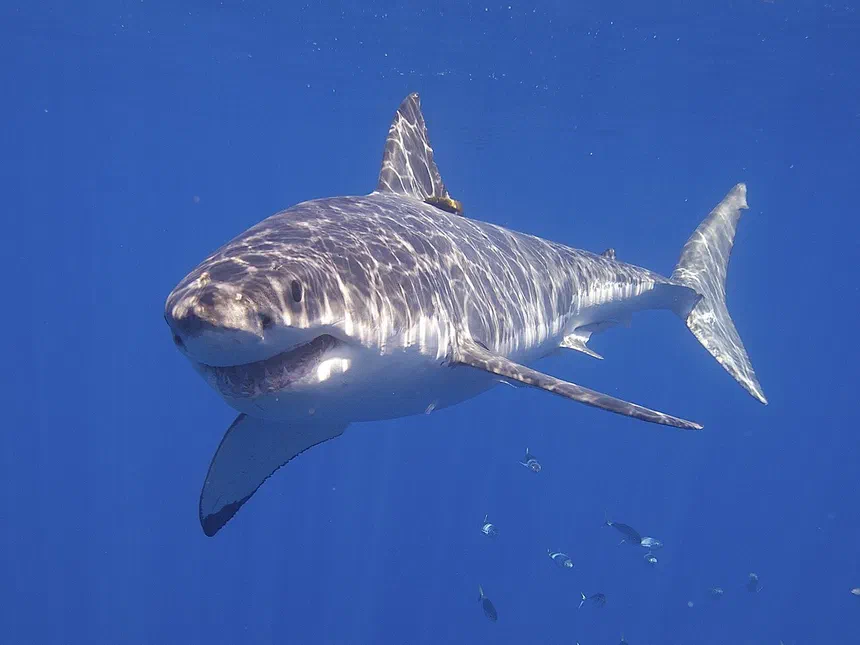
Great whites are unmistakable for their countershaded coloring: a slate-gray, bluish, or brownish back that fades sharply to a bright white belly. This pattern helps camouflage them from both above and below. The body is heavy and spindle-shaped, tapering to a powerful crescent-shaped tail that drives fast bursts of speed. The snout is conical, and the mouth holds several rows of large, serrated teeth that are continually replaced throughout life. Adults typically measure 11 to 16 feet long, and large females can approach or exceed 18 to 20 feet. Sharp black eyes, pointed pectoral fins, and prominent gill slits complete the profile.
Habitat and Range
This species lives in cool and temperate coastal and offshore waters around the globe. Notable populations occur off South Africa, southern Australia and New Zealand, the northeastern United States, California, and the Mediterranean. Great whites favor water temperatures roughly between 54 and 75 degrees Fahrenheit and are often found near seal and sea lion colonies, rocky reefs, and continental shelves. They are highly migratory, and satellite tagging has shown individuals crossing entire ocean basins and diving to depths of several hundred to over 1,000 meters.
Diet
Great white sharks are carnivores whose diet shifts with age. Younger sharks feed mainly on fish, rays, and smaller sharks, while larger adults increasingly target marine mammals such as seals, sea lions, and small dolphins and porpoises. They also scavenge on whale carcasses, which offer a rich, energy-dense meal. Their hunting relies on stealth: a shark often approaches from below and strikes with a sudden, powerful upward rush, sometimes launching clear out of the water in a behavior called breaching.
Behavior
Despite a fearsome reputation, great whites are curious and generally cautious animals. They possess acute senses, including a strong sense of smell, sharp eyesight, and specialized organs called ampullae of Lorenzini that detect the faint electrical fields given off by prey. Like other lamnid sharks, they are regionally endothermic, keeping parts of their body warmer than the surrounding water, which supports powerful, sustained swimming. They may travel alone or gather loosely at productive feeding sites, where individuals appear to follow subtle size-based social hierarchies. Bites on humans are rare and are widely thought to result from investigation or mistaken identity rather than deliberate predation.
Life Cycle and Reproduction
Great whites are slow to mature and reproduce, which makes their populations sensitive to disturbance. Females may not breed until their early teens and males somewhat sooner. The species is ovoviviparous: eggs hatch inside the mother, and developing pups are nourished in part by eating unfertilized eggs, a process known as oophagy. After a gestation thought to last around a year, females give birth to a small litter of well-developed pups, each already several feet long and fully independent from birth. This slow reproductive pace means lost individuals are replaced only gradually.
Conservation Status
The great white shark is listed as Vulnerable on the IUCN Red List. Its numbers have declined in many regions due to accidental capture in fishing gear, targeted fishing, the trade in jaws and teeth, and historically from culling near beaches. Because the species grows slowly and produces few young, populations recover only over long periods. Great whites are now legally protected in many countries and are covered by international agreements that restrict trade, though enforcement and monitoring remain ongoing challenges.
Frequently Asked Questions
Are great white sharks dangerous to people? Attacks on humans are very rare, and most bites are thought to be exploratory rather than predatory. People are not a natural prey item for great whites.
How long do great white sharks live? Research suggests they can live around 40 to 70 years, making them one of the longer-lived shark species.
How big can a great white shark get? Most adults are 11 to 16 feet long, but exceptionally large females can approach or exceed 18 to 20 feet and weigh over two tons.