Fish Guide
Goliath Grouper
What Is a Goliath Grouper? The goliath grouper (Epinephelus itajara) is one of the largest bony fishes found on Atlantic coral reefs, a heavyset predator famous for its enormous mouth and curious, unafraid nature. It …
At a glance
What Is a Goliath Grouper?
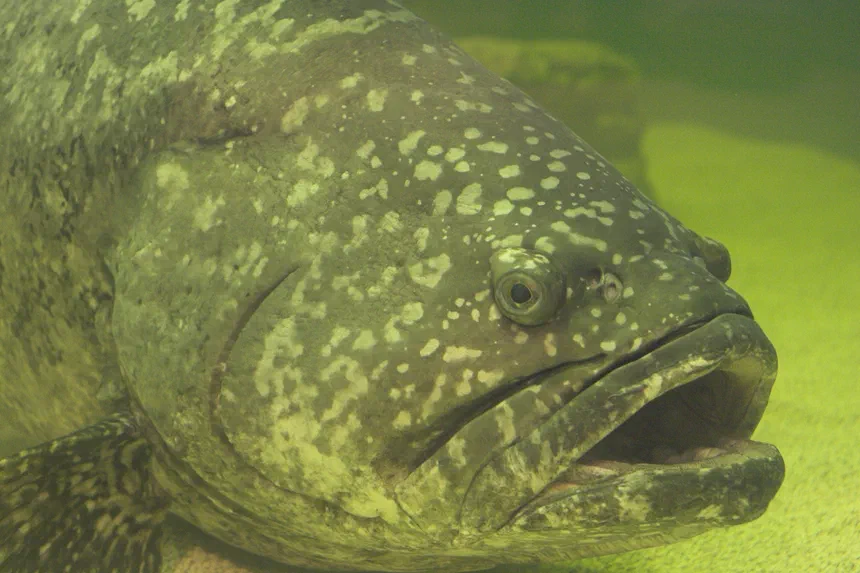
The goliath grouper (Epinephelus itajara) is one of the largest bony fishes found on Atlantic coral reefs, a heavyset predator famous for its enormous mouth and curious, unafraid nature. It belongs to the sea bass and grouper family Serranidae and can grow to the size of an adult human.
Appearance and Identification
The goliath grouper has a stout, barrel-shaped body, a broad flattened head, and a wide mouth lined with several rows of small teeth used for gripping rather than tearing. Its coloring is a muted mix of olive, brown, and gray, overlaid with small dark spots and, on younger fish, irregular darker bars that help break up its outline. The eyes are notably small relative to the massive head, and the rounded fins give the fish a blocky, sturdy profile. Individuals can reach lengths well over six feet and weights that make them unmistakable among reef fishes.
Habitat and Range
This species favors warm, shallow coastal waters, typically at depths of less than 150 feet. Adults are strongly associated with structure, gathering around rocky ledges, coral reefs, artificial reefs, bridge pilings, and shipwrecks that offer shelter and ambush cover. Juveniles depend heavily on mangrove shorelines and estuaries, where tangled roots provide protection and abundant prey during the first several years of life. The best-known populations live in the tropical western Atlantic, from Florida and the Gulf of Mexico through the Caribbean to Brazil, with related populations in the eastern Pacific and off West Africa.
Diet
The goliath grouper is a carnivore that feeds mainly on slow-moving, bottom-dwelling prey. Crustaceans such as crabs, lobsters, and shrimp make up a large part of its diet, supplemented by fish, octopus, and the occasional stingray or young sea turtle. Rather than chasing prey, it relies on a sudden, powerful suction strike, opening its cavernous mouth to engulf a target in a fraction of a second. Its blunt teeth are suited to holding prey while it is swallowed whole.
Behavior
Despite its imposing size, the goliath grouper is generally slow-moving and territorial, often lingering near a favored ledge or wreck. It is known for a deep, booming sound produced by contracting muscles against its swim bladder, a call used to warn off intruders and sometimes directed at divers. These fish are typically solitary for much of the year but come together in large spawning aggregations at predictable times and locations, which historically made them highly vulnerable to fishing.
Life Cycle and Reproduction
Goliath groupers are slow to mature, often taking five to seven years to reach breeding age. Like many groupers, some individuals are thought to change sex during their lives, though the details vary. Spawning occurs during warmer months, when dozens of adults gather at reef and wreck sites to release eggs and sperm into the water column. The fertilized eggs drift as plankton, and the tiny larvae eventually settle into mangrove and estuarine nurseries. Growth is steady over many years, and the species is long-lived, commonly reaching around 40 years of age.
Conservation Status
Because they mature slowly, aggregate to spawn, and show little fear of divers, goliath groupers were heavily overfished through the twentieth century, and populations collapsed across much of their range. The IUCN lists the species as Vulnerable following earlier assessments as Critically Endangered. A long-standing harvest ban in United States waters has allowed a notable recovery in Florida, though numbers elsewhere remain fragile. Habitat loss, particularly the destruction of mangrove nurseries, continues to threaten young fish.
Frequently Asked Questions
Are goliath groupers dangerous to people? They are large and curious and may approach divers closely, but they are not considered a threat to humans and attacks are extremely rare.
How big can a goliath grouper get? Large adults commonly weigh several hundred pounds, and exceptional individuals have been recorded at close to 800 pounds and over eight feet long.
Why is fishing for them restricted? Their slow growth and habit of gathering in the same spots to spawn make them easy to overfish, so protective regulations were introduced to help populations rebuild.