Fish Guide
Goblin Shark
What Is a Goblin Shark? The goblin shark (Mitsukurina owstoni) is a rare, deep-dwelling shark often described as a “living fossil” because it is the only surviving member of the family Mitsukurinidae, a lineage …
At a glance
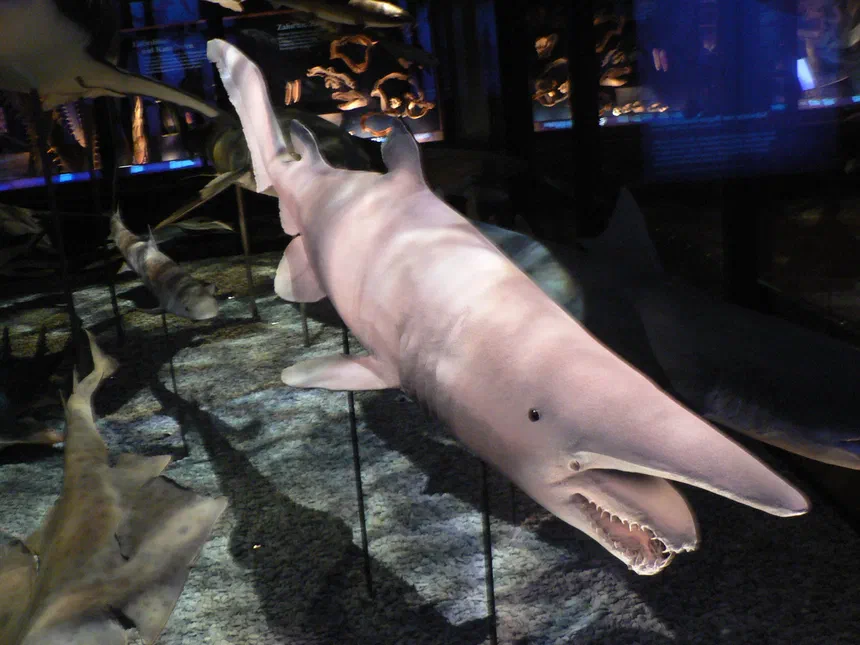
Image: Pengo — CC BY-SA 3.0 · source
What Is a Goblin Shark?
The goblin shark (Mitsukurina owstoni) is a rare, deep-dwelling shark often described as a “living fossil” because it is the only surviving member of the family Mitsukurinidae, a lineage stretching back roughly 125 million years. It is instantly recognizable by its long, flattened snout and pale, almost pinkish body. Because it lives far below the surface, it is seldom encountered and remains one of the least understood sharks in the ocean.
Appearance and Identification
Few animals look quite like the goblin shark. Its most striking feature is an elongated, blade-like snout, or rostrum, that projects well beyond the mouth. Beneath it sit protrusible jaws that can shoot forward dramatically to seize prey, then retract against the head. The skin is soft, flabby, and semi-translucent, giving the shark a distinctive pinkish-gray color caused by blood vessels showing through. Its fins are rounded and low, and the tail has a long upper lobe. Most adults measure roughly 10 to 13 feet (3 to 4 meters), though a few unusually large individuals may exceed this. The small eyes and slender teeth reflect a life spent hunting in near-total darkness.
Habitat and Range
Goblin sharks live in the deep sea, typically along continental slopes, submarine canyons, and seamounts. They are most often recorded at depths between about 800 and 3,300 feet (250 to 1,000 meters), and occasionally far deeper. Their distribution is patchy but nearly worldwide, with records from the western Pacific around Japan, the eastern and western Atlantic, the Indian Ocean, and off Australia and New Zealand. Japan, particularly around Tokyo Submarine Canyon, has yielded more specimens than anywhere else, largely because of local deep-water fishing.
Diet
As a carnivore, the goblin shark preys on animals of the deep. Its diet includes bony fishes such as rattails and dragonfishes, along with squid and crustaceans like deep-sea shrimp. Its slingshot jaws are a specialized adaptation for capturing prey in the dark: sensory pores along the long snout are thought to help detect the faint electrical fields given off by nearby animals. When a target is close, the jaws rapidly extend to snatch it, a mechanism that helps compensate for the shark’s slow, seemingly sluggish body.
Behavior
Little is known about how goblin sharks behave in the wild, since almost all information comes from dead or dying specimens caught by deep-sea fisheries. Their flabby bodies and poorly calcified skeletons suggest they are slow, low-energy swimmers that drift through the water column rather than pursuing prey at speed. The long snout, packed with electroreceptive organs, likely acts as a probe for locating hidden animals. They appear to be solitary and are not known to form schools.
Life Cycle and Reproduction
The reproduction of the goblin shark has never been directly observed, and no pregnant female has been thoroughly documented. Based on related sharks, it is believed to be ovoviviparous, meaning the young develop inside eggs that hatch within the mother’s body before live birth. Litter sizes, gestation length, and growth rates remain unknown. As with many deep-sea sharks, it is thought to grow slowly and mature late, but firm figures are lacking.
Conservation Status
The IUCN lists the goblin shark as Least Concern. Although it is rarely seen, it has a wide global distribution and lives in deep waters that are not heavily fished, so it faces relatively little direct pressure. Some individuals are taken as accidental bycatch in deep-sea fisheries, but there is no evidence of significant population decline. Its remote habitat offers a degree of natural protection from most human activity.
Frequently Asked Questions
Is the goblin shark dangerous to people? No. It lives in deep water far from swimmers and divers, and there are no records of it posing any threat to humans.
Why is it pink? Its skin is thin and semi-translucent, so blood vessels close to the surface show through, giving the body a pinkish tone. This coloring fades quickly after death.
How rare is it? Sightings are very uncommon. Most known specimens have been caught accidentally in deep-sea fishing gear, and much of the species’ biology is still a mystery.