Fish Guide
Giant Trevally
What Is a Giant Trevally? The giant trevally (Caranx ignobilis) is a large, powerfully built member of the jack family (Carangidae) found throughout the tropical and subtropical Indo-Pacific. Prized by anglers and …
At a glance
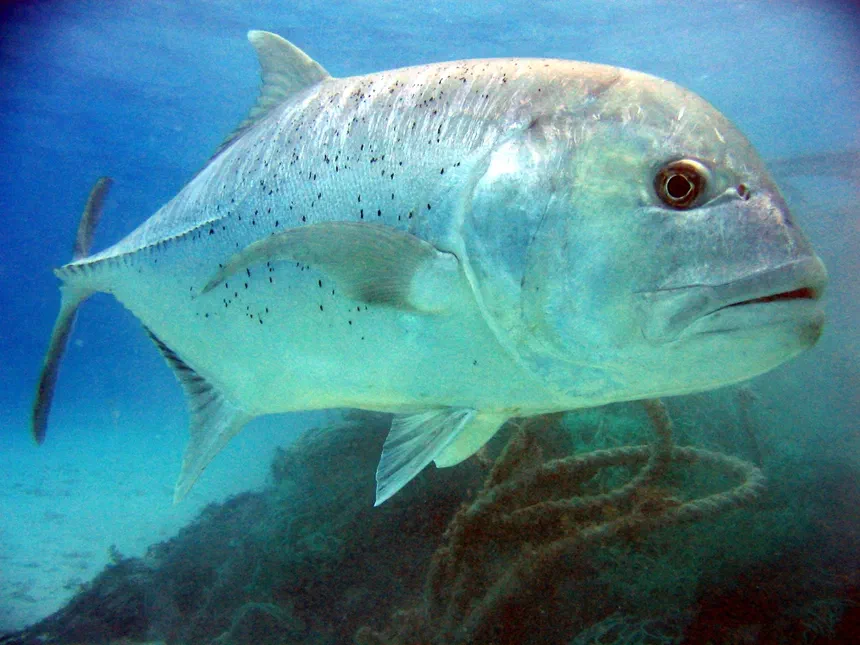
Image: Dr. Dwayne Meadows, NOAA/NMFS/OPR — Public domain · source
What Is a Giant Trevally?
The giant trevally (Caranx ignobilis) is a large, powerfully built member of the jack family (Carangidae) found throughout the tropical and subtropical Indo-Pacific. Prized by anglers and respected by divers, it is one of the largest and most formidable predators on shallow coral reefs, known for explosive bursts of speed and aggressive hunting. Locally it is often called the “GT.”
Appearance and Identification
The giant trevally has a deep, laterally compressed body with a steep, blunt head that gives it a distinctive stocky profile. Coloration ranges from silvery gray in younger fish to darker gray, and large dominant males frequently turn nearly black, earning the nickname “black trevally.” The species has a strongly forked tail and a lateral line studded toward the rear with hardened bony plates called scutes, a hallmark of the jacks. Adults commonly measure 60 to 100 centimeters, though exceptional individuals approach 170 centimeters and roughly 80 kilograms. Its heavy jaws and muscular build make it easily distinguished from the more slender trevally species that share its range.
Habitat and Range
This species occupies a broad swath of the Indo-Pacific, from the coasts of East Africa and the Red Sea eastward across the Indian and Pacific Oceans to Hawaii, and from southern Japan south to northern Australia. Giant trevally use a wide variety of habitats over their lives. Juveniles often shelter in estuaries, mangroves, and turbid coastal waters, sometimes tolerating brackish or even fresh water. Adults move offshore to coral reefs, lagoons, seaward drop-offs, and sandy flats, ranging from the surface down to depths of around 80 to 100 meters. They are most abundant in clear reef environments where prey is plentiful.
Diet
The giant trevally is an apex reef predator with a varied carnivorous diet. It feeds mainly on other fishes but also takes crustaceans, cephalopods such as squid and octopus, and occasionally other invertebrates. Its hunting is opportunistic and often spectacular: giant trevally are known to ambush prey in fast rushes, work in loose groups to herd baitfish, and even leap partly clear of the water to seize seabirds resting on or flying just above the surface. This adaptability lets them exploit prey from the reef, the water column, and the air-water boundary alike.
Behavior
Giant trevally are strong, fast swimmers that may be encountered alone or in small groups, and they can gather in larger aggregations at feeding sites or during spawning. Larger adults tend to be territorial and solitary, patrolling favored stretches of reef. They are diurnal, doing most of their hunting during daylight, and are noted for their curiosity and boldness, sometimes investigating divers. Their combination of power, speed, and intelligence in coordinating attacks has made them a benchmark quarry for sport fishers.
Life Cycle and Reproduction
Giant trevally reach sexual maturity at a fairly large size, generally around 60 centimeters, which corresponds to several years of age. Spawning is seasonal and often linked to specific lunar phases and water temperatures, with adults congregating at particular reef and offshore sites to release eggs and sperm into the water column. Fertilization is external, and the buoyant eggs drift as plankton before hatching into larvae. Young fish settle in sheltered inshore nurseries such as estuaries before gradually moving to reef habitats as they grow. Individuals are thought to live roughly 20 to 25 years.
Conservation Status
The giant trevally is currently listed as Least Concern on the IUCN Red List, reflecting its wide distribution and large overall population. Even so, it faces pressure from commercial and recreational fishing, and slow-growing large predators of this kind can be locally depleted where fishing is intense. In parts of its range there are also health advisories because large individuals may accumulate ciguatera toxins. Sustainable catch limits and habitat protection for nursery estuaries and reefs help keep populations healthy.
Frequently Asked Questions
How big can a giant trevally get? Most adults are between 60 and 100 centimeters, but the largest recorded fish approach 170 centimeters and around 80 kilograms, making it one of the biggest jacks.
Are giant trevally dangerous to people? They are not a threat to humans in the way sharks can be, though large individuals are powerful and bold, and anglers handle them with care because of their strength and sharp scutes.
Do giant trevally really eat birds? Yes. They are famous for lunging from the water to catch seabirds near the surface, one of many hunting tactics that show their remarkable adaptability.