Fish Guide
Alligator Gar
What Is a Alligator Gar? The alligator gar (Atractosteus spatula) is the largest of the gar family and one of the biggest freshwater fishes in North America. Named for its broad, tooth-studded snout that resembles an …
At a glance
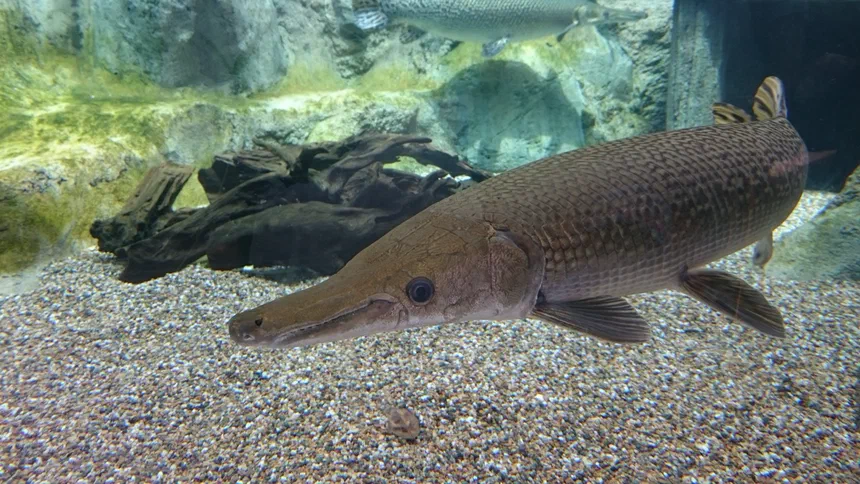
Image: ProjectManhattan — CC BY-SA 4.0 · source
What Is a Alligator Gar?
The alligator gar (Atractosteus spatula) is the largest of the gar family and one of the biggest freshwater fishes in North America. Named for its broad, tooth-studded snout that resembles an American alligator’s, it is a slow-growing, long-lived predator often described as a “living fossil” because its lineage has changed little over tens of millions of years.
Appearance and Identification
The alligator gar has a long, torpedo-shaped body armored with hard, diamond-shaped ganoid scales that interlock like chainmail. Its coloring is typically olive-brown to grayish on the back, fading to a pale cream or yellow belly, which helps it blend into murky water. The most distinctive feature is its short, broad snout lined with two rows of large teeth in the upper jaw, unlike the single row and slender snout of other gar species. Adults are commonly 4 to 6 feet long, though exceptional individuals surpass 8 feet and weigh well over 100 pounds. The dorsal and anal fins sit far back near the tail, giving the fish a powerful, ambush-ready profile.
Habitat and Range
Alligator gar favor large, slow-moving rivers, oxbow lakes, backwaters, reservoirs, and coastal bayous. They tolerate a wide range of conditions, including warm, low-oxygen water and brackish estuaries, thanks to a specialized swim bladder that lets them gulp air at the surface. Their range centers on the lower Mississippi River basin and the Gulf Coast drainages, extending across the southern United States from Texas and Oklahoma east to Florida, and southward into northern Mexico. Historically they occurred farther north, but habitat changes and past eradication efforts reduced parts of their range.
Diet
This species is an opportunistic ambush predator. Adults feed primarily on other fish, including shad, buffalo, carp, and catfish, but they also take waterfowl, small mammals, turtles, crabs, and crayfish when available. Rather than actively chasing prey, an alligator gar typically hangs motionless near the surface or among vegetation, then lunges sideways with a sudden snap of its toothy jaws. Despite fearsome looks, they pose essentially no danger to people and are not known to attack humans.
Behavior
Alligator gar are generally solitary and sluggish, conserving energy for much of the day. Their ability to breathe air allows them to survive in stagnant water where other large fish cannot, and they are frequently seen rolling at the surface to take a breath. They are most active in warmer months and become far less active as water temperatures drop in winter. Though large and strong, they are usually shy and slow to react unless hunting.
Life Cycle and Reproduction
Alligator gar are slow to mature, with males often reaching breeding age around 6 years and females closer to 11. Spawning occurs in spring and early summer, triggered by rising water temperatures and, importantly, flooding that inundates vegetated floodplains. Females release large numbers of eggs over flooded grasses and brush, where several males fertilize them. The bright green, sticky eggs are toxic if eaten by birds or mammals, which helps protect the clutch. Hatchlings shelter among submerged plants, growing quickly at first before settling into a long, slow life span that can reach several decades, with large females occasionally living well beyond 50 years.
Conservation Status
The IUCN lists the alligator gar as Least Concern, but the species remains vulnerable in parts of its range. Its dependence on natural flood cycles for spawning makes it sensitive to dams, levees, and altered river flow, while slow maturation means overharvest can quickly deplete local populations. Decades of being labeled a “trash fish” led to deliberate removal in some areas. Today many states manage the species more carefully, with harvest limits and restoration efforts recognizing its ecological role as a top predator.
Frequently Asked Questions
Are alligator gar dangerous to humans? No. Although their teeth and size look intimidating, there are no reliable records of alligator gar attacking people. Their eggs, however, are toxic if eaten.
How big can an alligator gar get? Most adults are 4 to 6 feet long, but confirmed individuals have exceeded 8 feet and 300 pounds, making them one of North America’s largest freshwater fishes.
Why are they called “living fossils”? Gars belong to an ancient lineage that has changed relatively little over tens of millions of years, retaining primitive features such as armored ganoid scales and an air-breathing swim bladder.