Fish Guide
Fugu
What Is a Fugu? Fugu is the Japanese name for the tiger pufferfish, Takifugu rubripes, a stout marine fish of the northwest Pacific. It belongs to the pufferfish family (Tetraodontidae), a group famous for the ability to …
At a glance
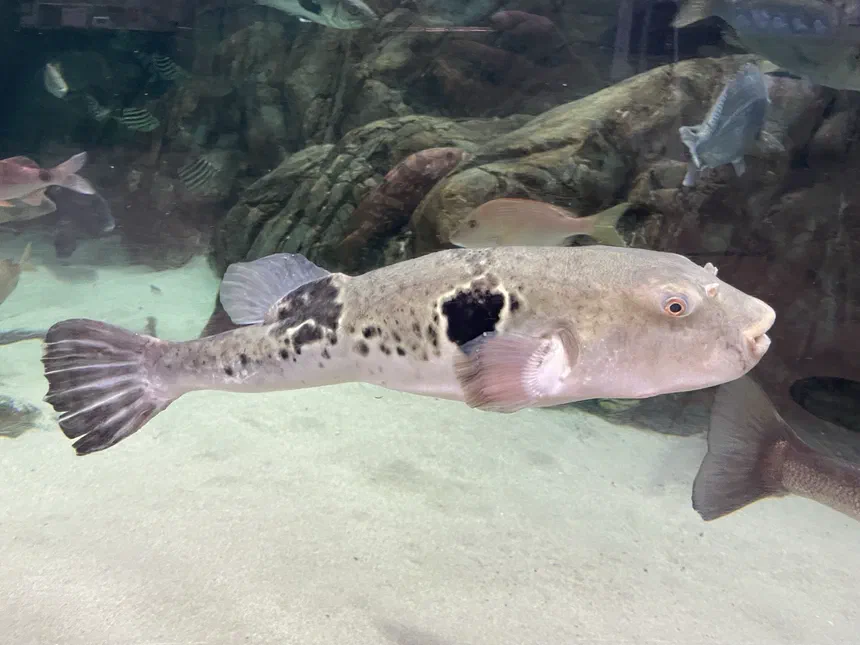
Image: Totti — CC BY-SA 4.0 · source
What Is a Fugu?
Fugu is the Japanese name for the tiger pufferfish, Takifugu rubripes, a stout marine fish of the northwest Pacific. It belongs to the pufferfish family (Tetraodontidae), a group famous for the ability to inflate the body and for carrying the potent neurotoxin tetrodotoxin. In Japan it is both a prized (and tightly regulated) culinary delicacy and an important species in aquaculture research.
Appearance and Identification
The tiger pufferfish has a heavy, rounded body that tapers toward a small tail. The back and upper flanks are typically olive-brown to grayish and marked with scattered dark blotches, while the belly is pale white. Rather than ordinary scales, the skin bears small prickle-like spinules that can feel rough to the touch. The fish has a beak-like mouth formed from four fused teeth (the origin of the family name Tetraodontidae), small pectoral fins set behind the gill openings, and no pelvic fins. When threatened, it can gulp water to swell into a rounded, difficult-to-swallow ball. Adults commonly reach 40-60 cm, and large individuals may approach 70-80 cm.
Habitat and Range
Takifugu rubripes lives in temperate coastal waters of the northwest Pacific, ranging along the coasts of Japan, the Korean Peninsula, and the East China and Yellow Seas off China. It favors relatively shallow continental-shelf waters, sandy and muddy bottoms, bays, and estuaries, though it also moves into deeper water seasonally. Juveniles often use sheltered, brackish estuarine areas as nurseries before moving offshore as they mature. The species tolerates a range of salinities but is fundamentally a marine and coastal fish.
Diet
The tiger pufferfish is a carnivore that feeds mainly on hard-shelled and bottom-dwelling prey. Its powerful fused beak is well suited to crushing mollusks, crustaceans, and other invertebrates such as crabs, shrimp, and shellfish, and it will also take small fish and worms. Interestingly, the tetrodotoxin that makes these fish dangerous is not manufactured by the fish itself; it is thought to accumulate through the diet and associated bacteria, concentrating in the liver, ovaries, and skin.
Behavior
Adults are generally solitary or loosely aggregating bottom-oriented fish that forage over sand and mud. The pufferfish’s signature defense is inflation: by rapidly swallowing water (or air if removed from the sea), it expands its highly elastic stomach into a globe several times its normal girth, making it hard for predators to bite or swallow. This visual bluff is reinforced by the chemical defense of tetrodotoxin, which deters most would-be predators. The species undertakes seasonal movements between deeper wintering grounds and shallower coastal areas.
Life Cycle and Reproduction
Spawning takes place in spring, when mature adults migrate toward specific coastal and estuarine sites, often over gravel or rocky bottoms in tidal channels. Females release large numbers of sticky, demersal eggs that adhere to the substrate, and after external fertilization the eggs are left to develop without parental care. Larvae hatch and drift as plankton before settling into shallow nursery habitats. Growth is relatively fast in the first years, with fish reaching sexual maturity after a few years and living on the order of a decade in the wild. Because of its economic value, the species is also raised in hatcheries and coastal farms.
Conservation Status
Takifugu rubripes has not been formally assessed with a specific IUCN Red List category, so its status is best described as not evaluated at the species level. It is nonetheless a heavily exploited fish: wild stocks support important fisheries and have shown signs of pressure, prompting extensive aquaculture and stock-enhancement (hatchery release) programs, particularly in Japan. Sustainable management of spawning grounds and juvenile nursery habitat is considered key to maintaining populations.
Frequently Asked Questions
Is fugu really poisonous? Yes. The tiger pufferfish carries tetrodotoxin, a powerful neurotoxin concentrated in organs such as the liver and ovaries. In Japan, only specially licensed chefs are permitted to prepare it for consumption.
Why is it called a pufferfish? When alarmed, it swallows water to inflate its elastic stomach into a rounded ball. This makes the fish larger and harder for predators to eat.
How big does a tiger pufferfish get? Most adults are around 40-60 cm long, though the largest individuals can approach 70-80 cm and weigh several kilograms.