Fish Guide
Frilled Shark
What Is a Frilled Shark? The frilled shark (Chlamydoselachus anguineus) is a rarely seen, deep-water shark whose slender, eel-like body has earned it a reputation as a “living fossil.” It belongs to an ancient lineage …
At a glance
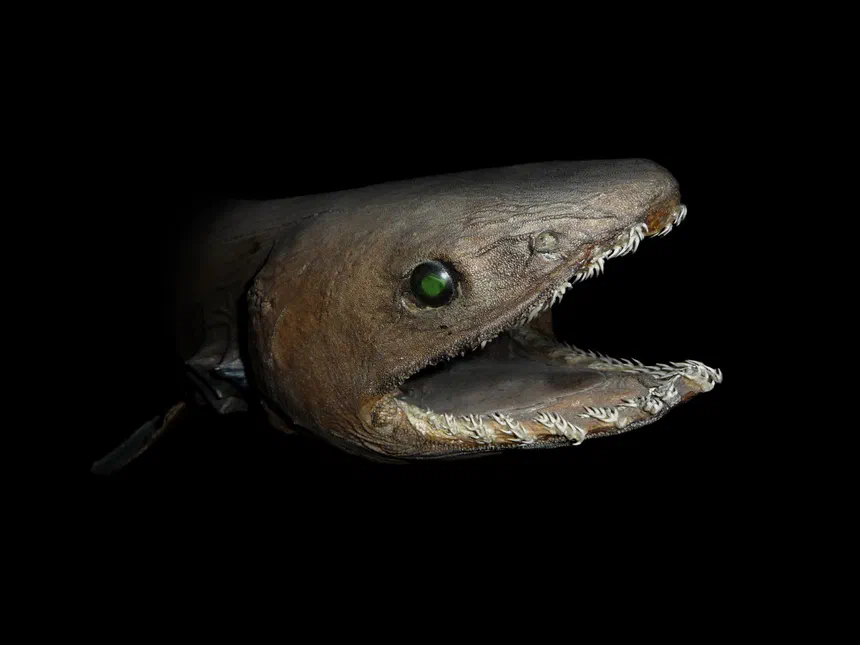
Image: Citron — CC BY-SA 3.0 · source
What Is a Frilled Shark?
The frilled shark (Chlamydoselachus anguineus) is a rarely seen, deep-water shark whose slender, eel-like body has earned it a reputation as a “living fossil.” It belongs to an ancient lineage and retains several primitive features that set it apart from most modern sharks, making it a subject of great interest to biologists.
Appearance and Identification
This shark has an unusually elongated, serpentine body colored dark brown to grayish, giving it more the look of an eel than a typical shark. Its most distinctive feature is the set of six pairs of gill slits along the throat, the first of which stretches across the underside like a frilly collar and gives the animal its name. The head is broad and flattened with a terminal mouth positioned at the very front of the snout rather than underneath. Inside are rows of small, three-pronged, trident-shaped teeth, numbering in the hundreds, that are well suited to gripping soft-bodied prey. The dorsal, pelvic, and anal fins are set far back near the long tail. Adults typically reach about 4.5 to 6.5 feet (1.4 to 2 meters), with females generally growing larger than males.
Habitat and Range
The frilled shark lives in deep, cold ocean water, usually along the outer continental shelves and upper continental slopes. It is most often recorded at depths of a few hundred to well over a thousand meters, though it may occasionally venture nearer the surface. Its distribution is patchy but nearly worldwide, with scattered records from the Atlantic, Pacific, and other ocean basins, including waters off Japan, Norway, and southern Africa. Because it inhabits such remote depths, sightings are uncommon, and much of what is known comes from specimens caught accidentally in deep-sea fishing gear.
Diet
The frilled shark is a carnivore that preys mainly on soft-bodied animals of the deep. Squid appear to make up a large part of its diet, along with bony fish and smaller sharks. Its many needle-like, backward-curving teeth are ideal for snagging slippery prey and preventing escape once seized. Researchers believe it may strike by lunging forward and possibly bending its flexible body like a striking snake to capture fast-moving squid, though its exact hunting method remains poorly understood.
Behavior
Little is known about the day-to-day behavior of this elusive shark because it is so seldom observed alive. Its slender build and reduced, poorly calcified skeleton suggest it is not a strong, sustained swimmer, and it may rely on ambush or slow, deliberate movements to conserve energy in the food-poor deep sea. It is thought to spend most of its life in darkness far below the reach of sunlight, only rarely encountered by humans.
Life Cycle and Reproduction
The frilled shark is ovoviviparous, meaning the young develop inside eggs that are retained within the mother’s body until they hatch and are born live. Litters are small, typically ranging from a few to around a dozen pups. The gestation period is believed to be exceptionally long, possibly one of the longest of any vertebrate, with some estimates stretching well beyond a year. Newborns emerge as miniature versions of the adults, already equipped for life in the deep, and there is no known parental care after birth.
Conservation Status
The IUCN currently lists the frilled shark as Least Concern, largely because it ranges across a wide area and lives at depths that shield it from most fishing pressure. Even so, it is sometimes taken as bycatch in deep-water trawls and gillnets, and its slow reproduction means populations could be vulnerable to sustained pressure. Its scarcity makes accurate assessment difficult, and scientists continue to monitor deep-sea fisheries for their impact on such little-known species.
Frequently Asked Questions
Why is it called a “living fossil”? The frilled shark retains many primitive anatomical traits shared with sharks from millions of years ago, so it offers a glimpse of an ancient evolutionary lineage that has changed relatively little.
Is the frilled shark dangerous to people? No. It lives far too deep to encounter swimmers, and its small size and soft-bodied prey preferences make it no threat to humans.
How often do people see one? Very rarely. Most records come from accidental catches in deep-sea fishing gear or from the occasional individual that drifts into shallower water, usually when sick or dying.