Fish Guide
Flying Fish
What Is a Flying Fish? Flying fish are marine ray-finned fishes of the family Exocoetidae, famous for their ability to glide through the air above the ocean surface. There are roughly 60 to 70 species spread across about …
At a glance
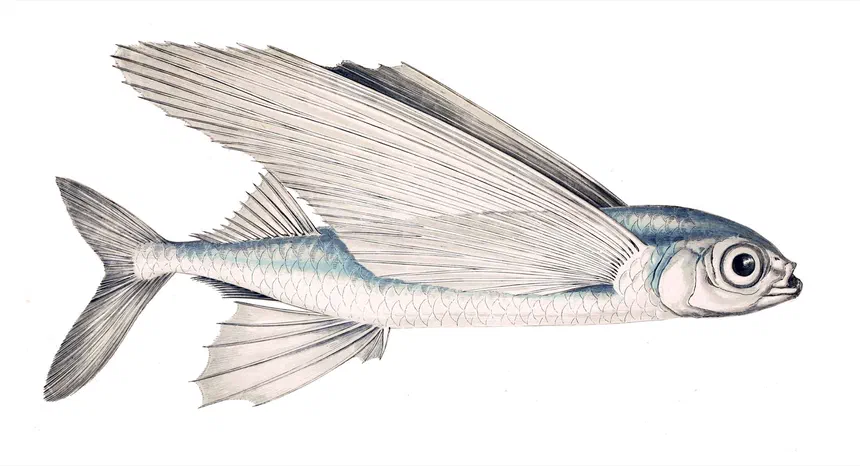
Image: Gervais et Boulart — Public domain · source
What Is a Flying Fish?
Flying fish are marine ray-finned fishes of the family Exocoetidae, famous for their ability to glide through the air above the ocean surface. There are roughly 60 to 70 species spread across about seven or eight genera, all sharing greatly enlarged, wing-like pectoral fins. Despite their name, they do not truly fly by flapping; instead they build up speed underwater and launch into extended glides to escape predators.
Appearance and Identification
Flying fish have a streamlined, torpedo-shaped body that is typically dark or silvery-blue above and pale silver below, a countershading pattern that helps camouflage them in open water. Their most distinctive feature is a pair of unusually long, stiff pectoral fins that fold against the body underwater and spread wide like wings during a glide. “Four-winged” species also have enlarged pelvic fins, giving them extra lift. The tail fin is deeply forked, with a longer lower lobe that the fish beats rapidly against the water to gain takeoff speed. Most species measure roughly 7 to 18 inches (18 to 45 cm) in length, and the large eyes and low-set mouth are adaptations for surface feeding.
Habitat and Range
Flying fish live in the warm surface layers of tropical and subtropical seas throughout the world, including the Atlantic, Pacific, and Indian Oceans as well as warm marginal waters like the Caribbean and Mediterranean. They are epipelagic, meaning they inhabit the sunlit upper zone of the open ocean rather than the seafloor or coastal reefs. Warm currents strongly influence their distribution, and they are often abundant in areas where surface temperatures stay above about 68 degrees Fahrenheit (20 degrees Celsius).
Diet
These fish are carnivorous plankton feeders. Their diet consists mainly of tiny drifting animals such as copepods and other small crustaceans, along with fish larvae and other zooplankton near the surface. Because they feed in the well-lit upper water column, they in turn become an important food source for many larger predators, linking plankton to the wider open-ocean food web.
Behavior
The gliding behavior that gives flying fish their name is primarily a predator-escape response. To launch, a fish accelerates toward the surface at high speed, breaks through with fins folded, then spreads its pectoral fins and taxis along the surface by vibrating the elongated lower lobe of its tail, which can beat many times per second. Once airborne it glides on outstretched fins, typically covering distances of around 100 to 160 feet (30 to 50 meters), though gifted individuals and consecutive glides can extend a single flight much farther. Glides usually last a few seconds and reach heights of several feet above the waves. At night flying fish are strongly attracted to lights, and they sometimes leap onto the decks of boats.
Life Cycle and Reproduction
Flying fish reproduce by laying eggs, and many species time their spawning to seasonal peaks in warm surface waters. The eggs are typically equipped with fine, thread-like filaments that tangle around floating seaweed, debris, or other drifting material, anchoring them near the surface until they hatch. This reliance on floating substrates means large numbers of eggs often accumulate around patches of sargassum and flotsam. Newly hatched young may carry whisker-like appendages that are thought to aid camouflage, and juveniles often differ in appearance from adults before developing full-sized wing fins. Most flying fish are relatively short-lived, generally surviving only a few years in the wild.
Conservation Status
The family as a whole has not been assessed as threatened, and flying fish remain widespread and locally abundant across the world’s warm oceans. Many species are caught commercially or artisanally for food, and they are a cultural and culinary staple in places such as Barbados and parts of Japan. Because they are numerous and reproduce prolifically, most populations are not considered at risk, though localized fisheries pressure and broad shifts in ocean temperature could affect regional abundance over time.
Frequently Asked Questions
Do flying fish actually fly? Not in the way birds do. They glide rather than fly, using rigid, wing-like fins to ride the air after launching themselves from the water at speed. They cannot flap their fins to generate powered flight.
How far can a flying fish glide? A typical glide covers roughly 100 to 160 feet (30 to 50 meters), but by dipping the tail back into the water to re-accelerate, some individuals string together glides that carry them several hundred feet in a single escape.
Why do flying fish glide at all? Gliding is mainly a way to escape underwater predators such as tuna, dolphinfish, and marlin. Leaving the water briefly lets them slip beyond a chasing predator’s reach.