Fish Guide
Summer Flounder
What Is a Summer Flounder? The summer flounder (Paralichthys dentatus) is a large, flat-bodied fish of the western Atlantic, prized by anglers and commercial fisheries alike and often called “fluke.” Like all flatfish, …
At a glance
What Is a Summer Flounder?
The summer flounder (Paralichthys dentatus) is a large, flat-bodied fish of the western Atlantic, prized by anglers and commercial fisheries alike and often called “fluke.” Like all flatfish, it begins life with an eye on each side of its head but undergoes a remarkable transformation, ending up with both eyes on its left side as it settles onto the seafloor.
Appearance and Identification
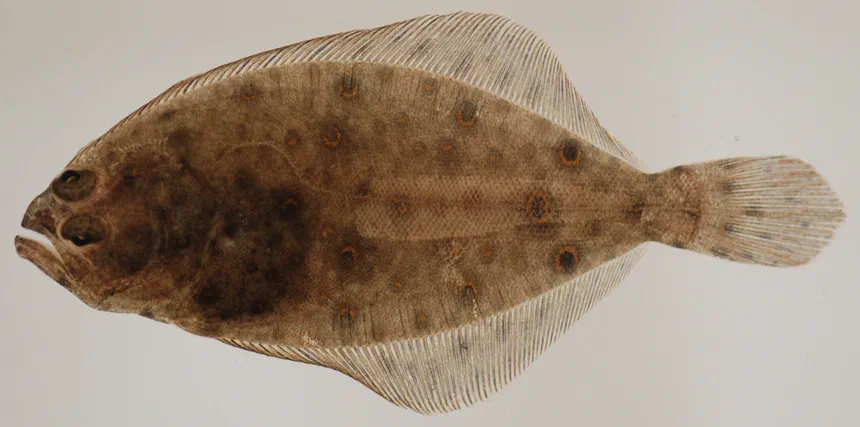
The summer flounder has a broad, oval, strongly compressed body that lies flat against the bottom. It is a “left-eyed” flounder, meaning both eyes sit on the left side of the head when the fish is viewed with its dorsal fin uppermost. The upward-facing (eyed) side is a mottled brown that the fish can lighten or darken to match the surrounding sand or mud, while the blind, downward-facing side is plain white. A hallmark of the species is a scattering of roughly a dozen or so dark, ocellated (eye-like) spots across the upper side. Its large, oblique mouth is armed with sharp, well-developed teeth, reflecting an aggressive predatory habit. Long dorsal and anal fins run nearly the length of the body.
Habitat and Range
Summer flounder occupy the coastal waters and continental shelf of the western Atlantic, ranging from around Nova Scotia and the Gulf of Maine south to Florida, with the greatest abundance between Cape Cod and Cape Hatteras. They are strongly associated with soft bottoms of sand and mud, where their camouflage and flat profile let them lie partly buried and nearly invisible. The species makes seasonal movements tied to water temperature: in warmer months it occupies shallow inshore waters, bays, and estuaries, then moves offshore to deeper, more stable waters over the continental shelf in fall and winter.
Diet
The summer flounder is an active, opportunistic carnivore rather than a passive bottom-feeder. Its diet is dominated by small fish such as anchovies, silversides, sand lance, and juvenile menhaden, along with squid, shrimp, crabs, and other invertebrates. Unlike many flatfish that simply wait for prey to pass, the fluke is a capable ambush hunter that will lunge upward off the bottom and even chase prey through the water column. Its sharp teeth and large mouth allow it to seize surprisingly large victims.
Behavior
This is a solitary, bottom-dwelling fish that relies on camouflage and stillness. By flicking sand over its body and adjusting its skin color, a summer flounder can disappear almost completely against the seabed, both to avoid predators and to ambush passing prey. It is most active during daylight, using its raised eyes to scan the water above for movement. When threatened, it can bury deeper or dart away in a quick burst before settling again. Its distribution and activity are governed largely by temperature, driving the inshore-offshore migrations seen through the year.
Life Cycle and Reproduction
Summer flounder spawn in the open ocean during their fall and early-winter offshore migration. Females are highly fecund, releasing hundreds of thousands to millions of buoyant eggs that drift with the currents. The tiny hatched larvae float in the plankton and look like ordinary upright fish, with one eye on each side. As a larva develops, one eye gradually migrates across the top of the skull to join the other on the left side, and the young fish tilts over to begin bottom life. These transforming juveniles ride currents toward coastal estuaries and bays, which serve as nurseries. Summer flounder grow relatively quickly, with females tending to grow larger and live longer than males, reaching ages of well over a decade.
Conservation Status
The summer flounder has not been assessed on the IUCN Red List, but it is one of the most closely managed fishes on the U.S. Atlantic coast because of its importance to recreational and commercial fisheries. Its populations are regulated through coordinated catch limits, size restrictions, and seasonal rules, and management has helped rebuild the stock from earlier periods of overfishing. Continued monitoring addresses fishing pressure and the influence of shifting ocean temperatures on where the fish are found.
Frequently Asked Questions
Why are both of a flounder’s eyes on one side? Summer flounder start life with one eye on each side, but during larval development one eye migrates over the top of the head so both end up on the left side, suiting a life spent lying flat on the seafloor.
What is the difference between “fluke” and summer flounder? They are the same fish; “fluke” is a common regional name for the summer flounder, especially among anglers.
How big do summer flounder get? Most caught fish are one to five pounds and roughly 15 to 24 inches long, though large individuals can exceed 20 pounds and approach three feet in length.