Fish Guide
Flathead Catfish
What Is a Flathead Catfish? The flathead catfish (Pylodictis olivaris) is a large, solitary freshwater predator native to the river systems of the central and southern United States and northern Mexico. It is the only …
At a glance
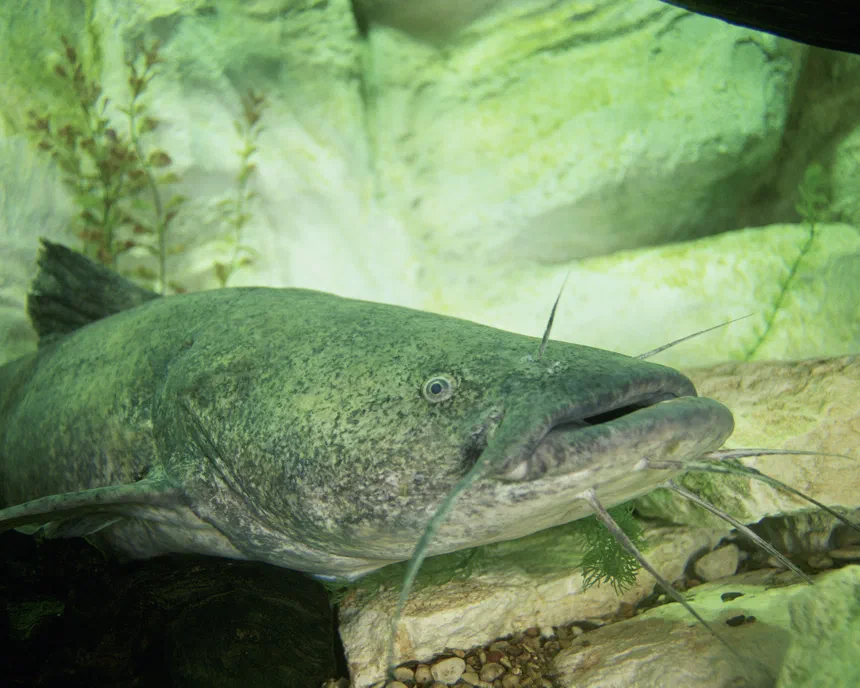
Image: Eric Engbretson / U.S. Fish and Wildlife Service — Public domain · source
What Is a Flathead Catfish?
The flathead catfish (Pylodictis olivaris) is a large, solitary freshwater predator native to the river systems of the central and southern United States and northern Mexico. It is the only member of its genus and is easily recognized by its broad, flattened head, protruding lower jaw, and heavily mottled coloring. Prized by anglers for its size and fighting strength, it is one of North America’s largest catfish species.
Appearance and Identification
The flathead is named for its distinctly flattened, wedge-shaped head. Unlike the deeply forked tail of the channel catfish, its tail fin is only slightly notched or nearly squared off. The body is typically mottled yellow to olive-brown along the back and sides, fading to a pale cream or yellowish belly, which lends it regional nicknames such as “yellow cat” or “mud cat.” Its lower jaw juts out past the upper jaw, and four pairs of sensory barbels frame the mouth. Young fish tend to be darker and more strongly patterned, while very large adults may appear more uniformly brown. Like all catfish, it lacks scales and has smooth, tough skin.
Habitat and Range
Flathead catfish favor large, slow-moving rivers, deep pools, reservoirs, and the tailwaters below dams. They gravitate toward structure such as submerged logs, undercut banks, root wads, and rock ledges, which offer cover during the day. The species is native to the broad Mississippi, Missouri, and Ohio River basins, the Gulf drainages from Mobile Bay westward, and the Rio Grande. Widespread introductions for sport fishing have established populations in the Atlantic coastal states and parts of the West, where the species is often considered invasive because it preys heavily on native fish.
Diet
Adult flatheads are almost exclusively carnivorous and, unlike many catfish, strongly prefer live prey over carrion. Their diet centers on other fish, including sunfish, shad, carp, and smaller catfish, along with crayfish, aquatic insects, and other invertebrates. Juveniles begin by feeding on insect larvae and crayfish before shifting to fish as they grow. Flatheads are largely nocturnal feeders, using their barbels and keen sense of smell and taste to locate prey in dark or turbid water.
Behavior
The flathead is a solitary, ambush-oriented predator. During daylight it typically holds tight to cover in deep water, becoming active at dusk and moving into shallower areas to hunt through the night. Adults are territorial and tend to keep to favored lairs. Because they hunt by ambush and rely on live prey, their movements are generally more deliberate than those of schooling fish, though they can be surprisingly powerful when hooked or defending a nest.
Life Cycle and Reproduction
Spawning takes place in late spring and early summer as water temperatures climb into the mid-70s Fahrenheit (around 24 C). The male selects and clears a sheltered nesting site, such as a hollow log, undercut bank, or submerged cavity. After the female deposits a large gelatinous mass of eggs, the male guards the nest and fans the eggs with his fins to keep them oxygenated. He continues to protect the young for a short period after they hatch. Flatheads grow slowly but steadily and can live roughly two decades or more, reaching very large sizes over their lifespan.
Conservation Status
The flathead catfish is listed as Least Concern by the IUCN, with stable and abundant populations across its native range. It faces no significant conservation threat as a species. The greater concern is ecological: where flatheads have been introduced outside their native waters, they can substantially reduce populations of native fish, and wildlife agencies in some regions actively manage or discourage their spread.
Frequently Asked Questions
How big do flathead catfish get? Most caught fish weigh 20 to 50 pounds, but the species can exceed 100 pounds, making it one of the largest freshwater fish in North America.
What do flathead catfish eat? They are live-prey predators, feeding mainly on fish such as sunfish and shad, plus crayfish and other invertebrates. They rarely scavenge dead food.
Are flathead catfish invasive? Within their native central and southern U.S. range they are a natural part of the ecosystem, but where introduced, such as in Atlantic coastal rivers, they are considered invasive and harmful to native fish.