Fish Guide
Firemouth Cichlid
What Is a Firemouth Cichlid? The firemouth cichlid (Thorichthys meeki) is a small, colorful freshwater fish in the cichlid family, named for the vivid red coloring that washes over its throat and lower body. Native to …
At a glance
What Is a Firemouth Cichlid?
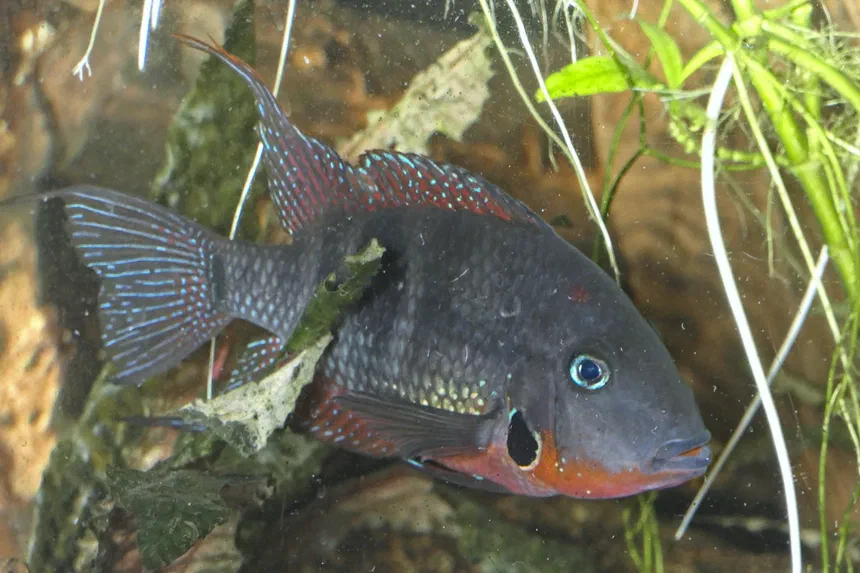
The firemouth cichlid (Thorichthys meeki) is a small, colorful freshwater fish in the cichlid family, named for the vivid red coloring that washes over its throat and lower body. Native to Central America, it is one of the most popular cichlids in the home aquarium hobby, prized for its striking looks and bold personality.
Appearance and Identification
Firemouth cichlids have a compact, oval body that is somewhat flattened side to side, a shape typical of many cichlids. The base color is a pearly gray-blue, often marked with several faint dark bars along the flanks and a dark blotch near the middle of the body and on the gill cover. The species’ signature feature is the fiery red-orange that colors the throat, chin, and belly. This color intensifies dramatically during breeding and territorial displays. Adults typically reach about 6 inches (15 cm) in length, with males growing slightly larger than females and developing more pointed, elongated dorsal and anal fins. When threatened, a firemouth flares its gill covers and extends its bright red throat to appear larger and more intimidating to rivals.
Habitat and Range
This cichlid is native to the Atlantic slope of southern Mexico, Guatemala, and Belize, centered on the Yucatan Peninsula and the Usumacinta River basin. It favors warm, slow-moving or still waters, including rivers, streams, canals, pools, and lagoons. Firemouths tend to stay near the bottom over soft substrates of sand and mud, often among sunken wood, rocks, and leaf litter where they can forage and find shelter. They tolerate a range of water conditions and are adaptable enough to have established populations outside their native range in a few warm regions.
Diet
Firemouth cichlids are omnivores with a strong tendency toward feeding on small animals. In the wild they sift mouthfuls of sand and sediment, straining out insect larvae, worms, tiny crustaceans, and other small invertebrates, then expelling the substrate through their gills. They also graze on algae and consume plant material and detritus. This flexible, opportunistic diet helps them thrive across varied habitats and seasons.
Behavior
Compared with many larger cichlids, the firemouth is relatively peaceful for much of the year, but it becomes assertive and territorial when breeding. Much of its aggression is bluff rather than outright combat: rivals face off with flared gills and puffed-out red throats, and the fish that manages the more impressive display usually wins without a fight. Firemouths spend a lot of time patrolling and defending a chosen patch of the bottom, and they readily dig and rearrange sand while foraging or preparing a nesting site.
Life Cycle and Reproduction
Firemouth cichlids are substrate spawners and devoted parents. A pair forms a bond and selects a flat surface, such as a rock or a cleared patch of ground, which they clean carefully before the female lays several hundred eggs in neat rows. Both parents guard the eggs, fanning them with their fins to keep them oxygenated and free of debris. The eggs hatch in a few days, and the parents move the tiny larvae to pits dug in the substrate. Once the young are free-swimming, the pair continues to shepherd and defend the school of fry for several weeks. In good conditions, firemouths can live roughly 8 to 13 years.
Conservation Status
The firemouth cichlid is listed as Least Concern by the IUCN. It has a fairly wide range, tolerates a variety of conditions, and remains common throughout much of its native waters. It is also bred in large numbers for the aquarium trade, which reduces collection pressure on wild populations. As with many freshwater fish, localized threats such as habitat alteration and pollution can affect specific populations, but the species as a whole is not considered at risk.
Frequently Asked Questions
Why is it called a firemouth? The name comes from the brilliant red-orange coloring on its throat and belly, which flushes especially bright when the fish displays to rivals or mates, giving the impression of a fiery mouth.
Are firemouth cichlids aggressive? They are moderately territorial, particularly while breeding, but much of their aggression is display rather than real fighting. Outside of spawning they are among the more manageable cichlids.
How big do firemouth cichlids get? Most adults reach about 6 inches (15 cm) in length, with males typically a bit larger than females.