Fish Guide
Fangtooth
What Is a Fangtooth? The fangtooth is a small but fearsome-looking deep-sea fish named for the oversized teeth that crowd its jaws. The common species, Anoplogaster cornuta, belongs to the family Anoplogastridae and …
At a glance
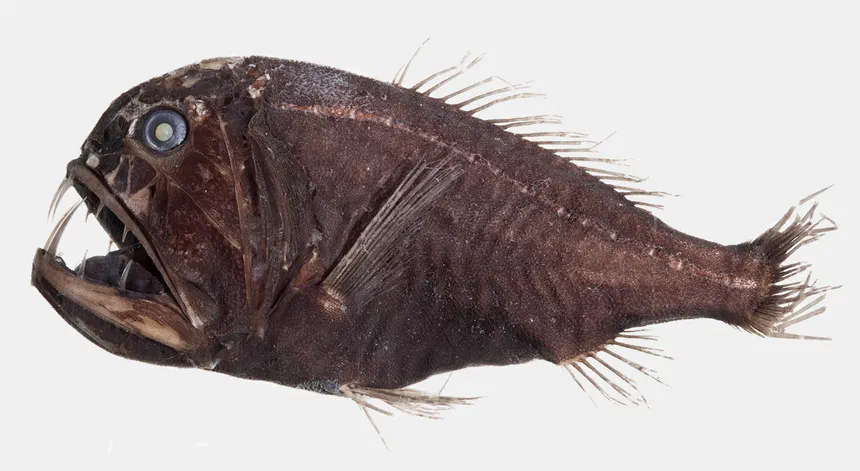
Image: Sandra Raredon/Smithsonian Institution — Public domain · source
What Is a Fangtooth?
The fangtooth is a small but fearsome-looking deep-sea fish named for the oversized teeth that crowd its jaws. The common species, Anoplogaster cornuta, belongs to the family Anoplogastridae and ranks among the deepest-living fishes known, drifting through the cold, dark waters far below the sunlit surface.
Appearance and Identification
Despite its intimidating reputation, the fangtooth is a modest creature, reaching only around 6 inches (16 centimeters) in length. It has a short, deep body, a large head, and skin that ranges from dark brown to nearly black, helping it vanish into the gloom. Its most striking feature is its dentition: the lower jaw carries a pair of fangs so long that the fish has evolved paired sockets on either side of its brain to accommodate them when the mouth closes. Relative to body size, these are among the largest teeth of any fish in the ocean. The eyes are relatively small, while the head bears prominent sensory canals and a rough, scaleless texture. Juveniles look so different from adults, with lighter coloring, longer spines, and smaller teeth, that they were once described as a separate species.
Habitat and Range
Fangtooth are found in tropical and temperate seas around the world, making them one of the more cosmopolitan of deep-ocean fishes. Adults typically live in the bathypelagic zone, often between roughly 1,600 and 6,500 feet (500 to 2,000 meters), though they have been recorded far deeper, past 16,000 feet (5,000 meters). This is an environment of perpetual darkness, near-freezing temperatures, and crushing pressure. Younger fish tend to occupy shallower water than adults, and the species is thought to migrate vertically at night, rising toward the surface layers to feed before descending again by day.
Diet
The fangtooth is an active predator that feeds on fishes and crustaceans, and it will take whatever prey it can catch in a food-poor environment. Its long teeth and wide gape allow it to seize animals nearly its own size, an advantage where meals are scarce and unpredictable. Rather than ambushing prey, it appears to hunt by cruising and using its sensitive lateral-line system to detect movement in the water. Larger individuals rely more heavily on fish, while smaller fangtooth take proportionally more crustaceans, filtering prey from the water as they encounter it.
Behavior
Little is known about the day-to-day life of the fangtooth because of the extreme depths it inhabits. It is generally regarded as a solitary wanderer rather than a schooling fish. Its small eyes suggest that vision plays a limited role in the lightless deep; instead, it likely depends on pressure-sensitive lateral-line organs to sense nearby movement. The nightly upward migration many deep-sea animals undertake helps the fangtooth reach the richer feeding grounds of the upper ocean without exposing it to daytime predators.
Life Cycle and Reproduction
Reproduction in the fangtooth is not well documented, but like most open-ocean fishes it is believed to be a broadcast spawner, releasing eggs and sperm into the water where fertilization occurs. The eggs and larvae are planktonic, drifting in the upper water column. Larvae and juveniles differ dramatically from adults in shape, color, and the length of their head spines, and they gradually transform as they mature and move into deeper water. Growth is thought to be slow, as is typical of animals in cold, resource-limited deep-sea habitats.
Conservation Status
The fangtooth has not been formally assessed by the IUCN and carries no special conservation designation. Because it lives at great depth and holds little commercial value, it faces minimal direct pressure from fishing, though it is occasionally caught as bycatch in deep trawls. Broad threats to the deep ocean, such as climate change and potential future seabed exploitation, could affect its habitat, but at present the species is not considered to be at risk.
Frequently Asked Questions
Is the fangtooth dangerous to humans? No. Despite its menacing appearance, the fangtooth is only a few inches long and lives thousands of feet below the surface, far from any contact with people.
Why does it have such huge teeth? Its long fangs help it grip and swallow large prey in an environment where food is scarce, so it can take advantage of nearly any meal it encounters.
How deep does the fangtooth live? Adults usually live between about 1,600 and 6,500 feet, but they have been found far deeper, making them one of the deepest-dwelling fishes recorded.