Fish Guide
European Eel
What Is a European Eel? The European eel (Anguilla anguilla) is a long, snake-like fish famous for one of the most extraordinary life journeys in the animal kingdom. It spends most of its life in fresh and brackish water …
At a glance
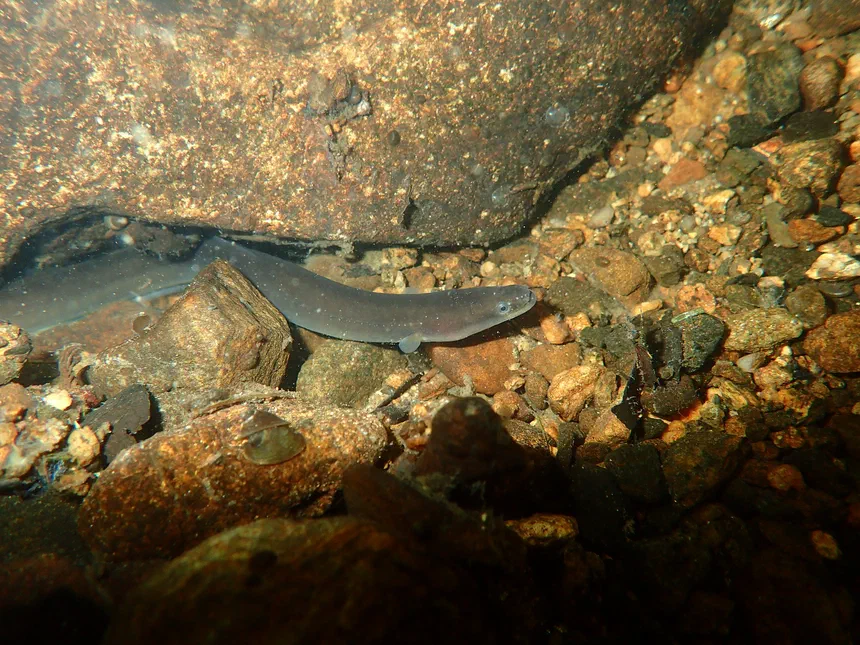
What Is a European Eel?
The European eel (Anguilla anguilla) is a long, snake-like fish famous for one of the most extraordinary life journeys in the animal kingdom. It spends most of its life in fresh and brackish water across Europe yet is born and dies far out in the Atlantic Ocean. Once a common food fish, it is now considered critically endangered.
Appearance and Identification
The European eel has an elongated, cylindrical body that tapers toward the tail, with a single long fin running along the back, around the tail, and forward along the underside. There are no pelvic fins, and the small pectoral fins sit just behind the gill openings. The skin appears smooth and slippery because tiny scales are embedded beneath a heavy coat of mucus. Coloration changes with life stage: growing “yellow eels” are yellow-brown to olive on the back and paler below, while maturing “silver eels” turn dark on top with a bright silvery belly and enlarged eyes. Adults typically measure 60 to 80 centimeters, though large females can exceed a meter.
Habitat and Range
European eels occupy an enormous range that spans the coasts and inland waters of Europe, extending into North Africa and parts of the Mediterranean and Baltic basins. They are remarkably adaptable, thriving in rivers, streams, lakes, ponds, estuaries, and coastal lagoons. Because they tolerate a wide range of salinity, individuals may live entirely in fresh water, entirely in brackish estuaries, or move between the two. They favor soft-bottomed habitats with cover such as rocks, roots, and vegetation, where they can hide by day. The species is capable of wriggling short distances over wet land to reach isolated ponds.
Diet
The European eel is a carnivore and an opportunistic predator. Younger and smaller eels feed heavily on aquatic insect larvae, worms, snails, and small crustaceans. As they grow, larger eels take bigger prey, including small fish, amphibians, and crayfish, and will scavenge carrion when available. Eels hunt mostly at night and rely strongly on a keen sense of smell to locate food in murky water or darkness. Feeding slows or stops during cold winter months and ceases entirely once an eel begins its final migration to spawn.
Behavior
Eels are secretive, mostly nocturnal animals that spend daylight hours hidden in burrows, under stones, or buried in soft sediment. They are solitary for most of their lives and can be highly territorial over good hiding spots. Their ability to breathe partly through their skin allows them to survive in low-oxygen water and to travel overland in damp conditions. During cold spells, eels become sluggish and may bury themselves in mud until temperatures rise. This combination of hardiness and secrecy long made the species mysterious to naturalists, who for centuries could not explain where eels came from.
Life Cycle and Reproduction
The eel’s life cycle is one of the great puzzles of natural history. Adults are believed to spawn in the Sargasso Sea, a region of the western North Atlantic, after a migration of thousands of kilometers. The transparent, leaf-shaped larvae, called leptocephali, drift back toward Europe on ocean currents over a journey that can take a year or more. Near the coast they transform into slender, see-through “glass eels,” which enter estuaries and rivers. There they develop into pigmented yellow eels and grow for many years, sometimes decades. When mature, they transform into silver eels and make the long return trip to the ocean to spawn once and then die.
Conservation Status
The European eel is classified as Critically Endangered by the IUCN, and its numbers have fallen dramatically over recent decades. The species faces many pressures at once, including dams and barriers that block migration, habitat loss, pollution, parasites, changes in ocean currents, and heavy fishing of glass eels, which are prized as a delicacy. Because eels reproduce only at the very end of a long life and in a single distant location, the population is slow to recover. International trade is now regulated, and many countries have restored river passages and set fishing limits to help stocks rebound.
Frequently Asked Questions
Where do European eels reproduce? They are thought to spawn in the Sargasso Sea in the western Atlantic, far from the rivers where they spend most of their lives.
Are European eels dangerous to people? No. They are not venomous and pose no real threat, though they are slippery and may bite if handled roughly.
Why are European eels endangered? Migration barriers, habitat loss, pollution, and intense fishing of young glass eels have caused steep population declines, and their slow, once-in-a-lifetime breeding makes recovery difficult.