Fish Guide
Emperor Angelfish
What Is a Emperor Angelfish? The emperor angelfish (Pomacanthus imperator) is a strikingly patterned marine fish of the family Pomacanthidae, prized by divers and aquarists for its bold coloration. It is a widespread …
At a glance
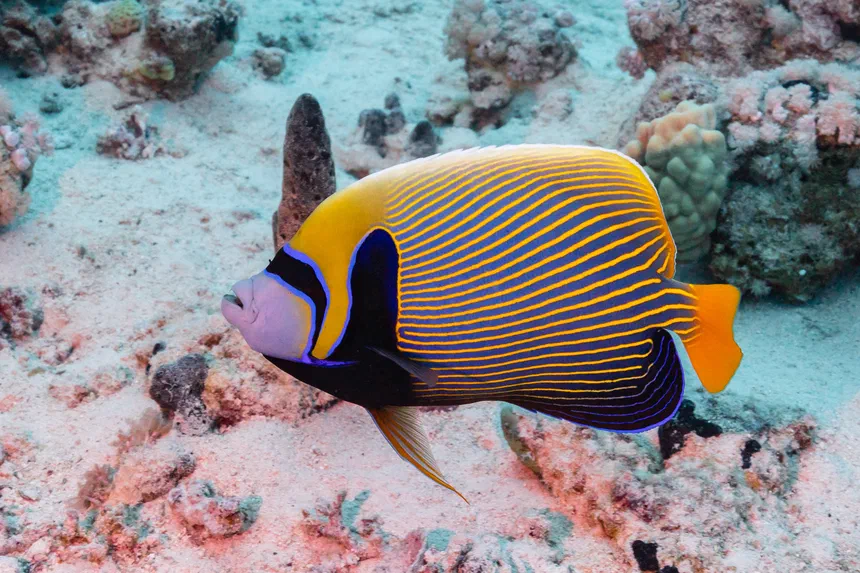
Image: Diego Delso — CC BY-SA 4.0 · source
What Is a Emperor Angelfish?
The emperor angelfish (Pomacanthus imperator) is a strikingly patterned marine fish of the family Pomacanthidae, prized by divers and aquarists for its bold coloration. It is a widespread reef dweller across the warm waters of the Indo-Pacific. Adults are unmistakable, wearing a suit of alternating blue and yellow stripes.
Appearance and Identification
Adult emperor angelfish carry a series of narrow, horizontal blue and yellow stripes running the length of a deep, laterally compressed body. A dark, blue-edged mask crosses the eyes, and a separate dark patch sits behind the gill, giving the face a distinctive banded look. The mouth is small and pale, and the tail fin is a solid golden-orange. Mature fish typically reach around 30 to 40 cm (12 to 16 inches) in length.
Juveniles look so different that they were once thought to be a separate species. Young fish are dark blue to black, patterned with concentric white and electric-blue rings and curves. The transition to adult coloration is gradual and can take a couple of years, during which the ringed pattern breaks up and the horizontal stripes emerge.
Habitat and Range
This species occupies coral-rich reefs, lagoons, and channels, generally at depths from the shallows down to about 70 meters (roughly 230 feet). Its range spans much of the tropical Indo-Pacific, from the Red Sea and East African coast eastward through the Indian Ocean to the western Pacific, reaching the waters around Japan, Micronesia, and the Great Barrier Reef. Adults favor areas with plenty of caves, ledges, and crevices for shelter, while juveniles tend to stay hidden in protected reef pockets and holes.
Diet
The emperor angelfish is an omnivore with a specialized appetite. Sponges and encrusting tunicates make up a large part of its diet, supplemented by algae and various small invertebrates. Its tough mouth and teeth are well suited to scraping and nipping these attached organisms from reef surfaces. By grazing on sponges, the species plays a role in shaping the community of organisms competing for space on the reef.
Behavior
Adults are usually solitary or found in loose pairs, and they defend a home territory on the reef. The species is known for producing a distinct thumping or knocking sound when disturbed, a behavior thought to startle would-be predators or signal alarm. Emperor angelfish are diurnal, foraging during daylight and retreating to familiar shelters at night. Juveniles sometimes operate small cleaning stations, picking parasites and debris from larger fish.
Life Cycle and Reproduction
Like many angelfish, this species is a protogynous hermaphrodite, meaning individuals typically mature first as females and some later change into males. Spawning generally occurs as a pair rises together into the water column and releases eggs and sperm, a broadcast-spawning strategy timed with dusk and tidal cycles. Fertilized eggs are buoyant and drift as plankton, and the hatched larvae remain in the open water before settling onto a reef and beginning the long juvenile-to-adult color change.
Conservation Status
The emperor angelfish is listed as Least Concern by the IUCN, reflecting its broad distribution and generally stable populations. It is collected for the marine aquarium trade, and localized pressure can occur where harvesting is intense, but this is not currently considered a threat across its range. As a reef-dependent species, its long-term outlook is tied to the health of coral ecosystems, which face stresses from warming seas, bleaching, and habitat degradation.
Frequently Asked Questions
Why do young emperor angelfish look so different from adults? Juveniles wear dark blue bodies marked with white and blue rings, a pattern completely unlike the striped adult. The colors shift gradually over one to two years as the fish matures.
Are emperor angelfish dangerous to people? No. They are not venomous or aggressive toward humans, though they may defend their territory from other fish. Divers can usually observe them at close range.
Can emperor angelfish make sounds? Yes. When alarmed they can produce an audible knocking or thumping noise, which is believed to help deter predators.