Fish Guide
Elephantnose Fish
What Is a Elephantnose Fish? The elephantnose fish (Gnathonemus petersii) is a freshwater fish native to the rivers of tropical West and Central Africa. It belongs to the family Mormyridae, the African weakly electric …
At a glance
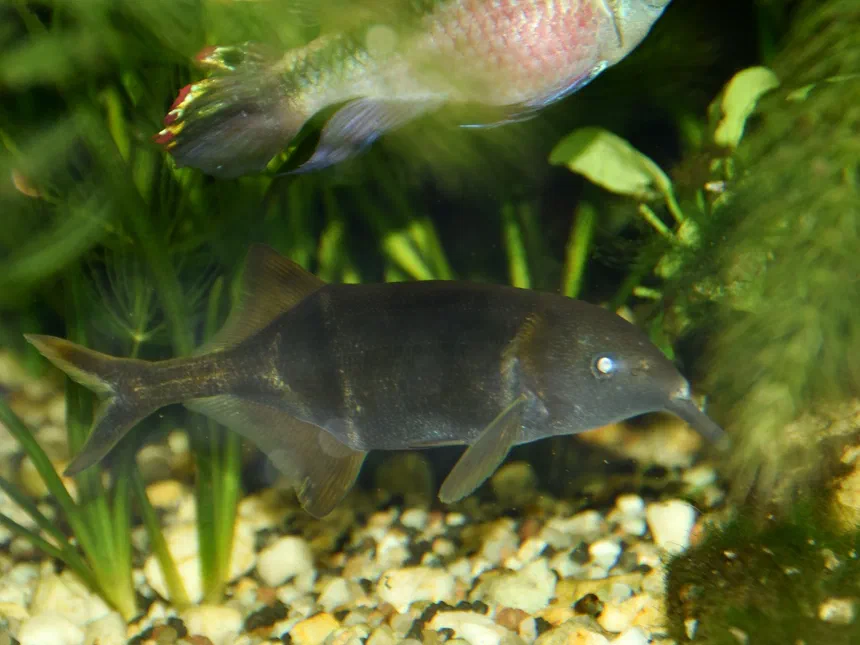
Image: NasserHalaweh — CC BY-SA 4.0 · source
What Is a Elephantnose Fish?
The elephantnose fish (Gnathonemus petersii) is a freshwater fish native to the rivers of tropical West and Central Africa. It belongs to the family Mormyridae, the African weakly electric fishes, and is named for the long, trunk-like extension beneath its mouth. Despite the name, this appendage is not a nose at all but a flexible, sensory chin.
Appearance and Identification
This fish has a laterally compressed, dark brown to nearly black body that reaches roughly 9 to 14 inches (23 to 35 cm) in length, though most aquarium individuals stay toward the smaller end of that range. The most striking feature is the finger-like extension of the lower lip, called the Schnauzenorgan, which is covered in touch and electrical sensors. Two pale, curved bands often mark the rear of the body near the dorsal and anal fins, which sit opposite one another and taper toward a slender, forked tail.
Habitat and Range
Elephantnose fish live in slow-moving, often turbid waters across countries such as Nigeria, Cameroon, Chad, and the Democratic Republic of the Congo. They favor muddy river bottoms, quiet pools, backwaters, and seasonally flooded areas where the water is dim and heavily shaded. The murky conditions of these habitats suit a fish that relies far more on electrical sensing than on eyesight to find its way.
Diet
This species is a carnivore that feeds mainly on small aquatic invertebrates. Its diet includes insect larvae, aquatic worms, tiny crustaceans, and other soft-bodied prey hidden in the substrate. Using its mobile chin appendage and its electrical sense, the fish probes soft mud and leaf litter to detect buried food that other fishes would overlook.
Behavior
The elephantnose fish is best known for producing weak electric fields from an organ near its tail. It reads distortions in these fields to navigate, locate prey, and communicate with others of its kind, a sense called electrolocation that works well in dark, cloudy water. The species is largely nocturnal and tends to be shy, seeking shelter among roots, plants, and crevices during the day. It can be territorial toward other elephantnose fish, and it is considered to have an unusually large brain relative to its body, linked to the heavy processing demands of its electric sense.
Life Cycle and Reproduction
Reproduction in the wild is tied to the rainy season, when rising, flooded waters provide sheltered spawning areas. Breeding is rarely achieved in home aquariums and is not fully documented, but males are thought to establish territories and use electrical signals during courtship. Eggs are released among vegetation or submerged cover, and the young develop without notable parental care once hatched. Individuals commonly live about 6 to 10 years in captivity, and possibly longer under ideal conditions.
Conservation Status
The elephantnose fish is listed as Least Concern by the IUCN, reflecting a broad range and no evidence of major population decline. It is collected for the aquarium trade, but habitat degradation and water pollution remain the more general threats to the river systems it depends on. Maintaining clean, well-oxygenated waterways is important for the long-term health of its populations.
Frequently Asked Questions
Is the “nose” actually a nose? No. The trunk-like extension is a sensitive projection of the lower jaw and chin, packed with touch and electrical receptors used to find food, not to smell or breathe.
How does it navigate in murky water? It generates weak electrical pulses and senses disturbances in that field, allowing it to detect objects, prey, and other fish even in near-total darkness.
Can elephantnose fish be kept as pets? Yes, but they are considered a challenge. They need soft substrate, dim lighting, hiding places, and excellent water quality, and they can be sensitive to poor conditions and aggressive tankmates.