Fish Guide
Electric Ray
What Is a Electric Ray? The electric ray, Torpedo torpedo, is a flattened, disk-shaped cartilaginous fish belonging to the family Torpedinidae. It is best known for its ability to generate powerful electric discharges, …
At a glance
What Is a Electric Ray?
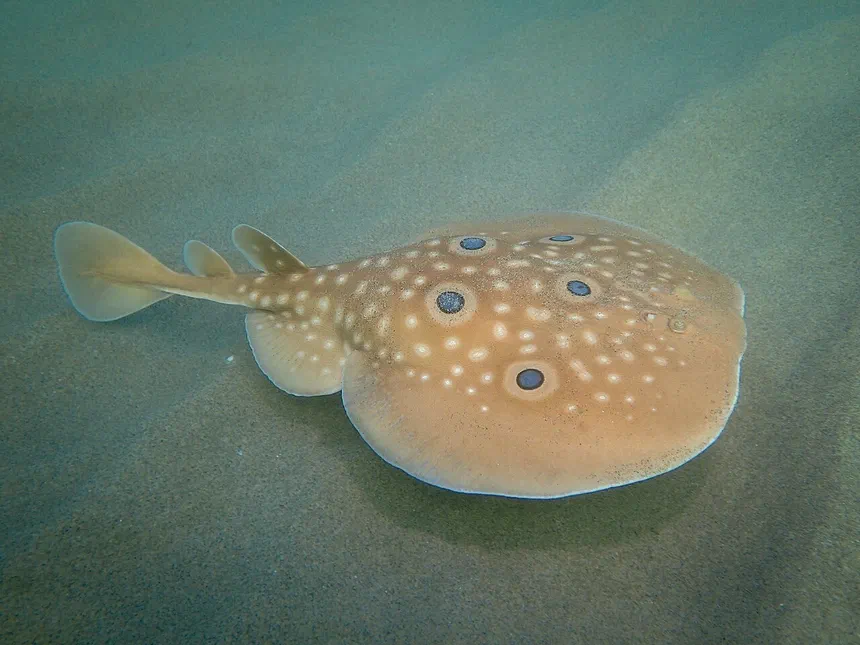
The electric ray, Torpedo torpedo, is a flattened, disk-shaped cartilaginous fish belonging to the family Torpedinidae. It is best known for its ability to generate powerful electric discharges, which it uses to stun prey and deter predators. Also called the common torpedo or eyed electric ray, it inhabits the warmer coastal waters of the eastern Atlantic and Mediterranean.
Appearance and Identification
This species has a rounded, almost circular body disk formed by broad pectoral fins fused to the head, giving it a smooth, pancake-like profile. The upper surface is typically sandy, tan, or reddish-brown, and one of its most distinctive features is a set of dark, blue-ringed spots (usually five) arranged across the back. The underside is plain and pale. It has a short, muscular tail bearing two dorsal fins and a triangular caudal fin. Adults commonly reach lengths of around 30 to 60 cm (12 to 24 in). The paired kidney-shaped electric organs, located on either side of the head between the disk and the gills, are visible as slightly bulging areas and are capable of producing shocks of several dozen volts.
Habitat and Range
The electric ray favors soft bottoms of sand and mud, where it can partially bury itself and lie in wait. It is most common in relatively shallow coastal zones but can occur at depths ranging from just a few meters down to around 200 meters or more. Its range spans the eastern Atlantic Ocean, from the Bay of Biscay southward along the coasts of West Africa, and it is widespread throughout the Mediterranean Sea. It tolerates a range of temperatures but tends to concentrate in temperate to subtropical waters.
Diet
As an ambush predator, the electric ray feeds mainly on small bony fish, along with crustaceans and other bottom-dwelling invertebrates. It relies heavily on its electric organs to hunt: when a suitable prey animal comes within reach, the ray releases a strong electric discharge that stuns or immobilizes the target. It then maneuvers the prey toward its mouth on the underside of the disk. This strategy allows a relatively slow-moving fish to capture surprisingly agile prey.
Behavior
Electric rays are largely nocturnal and spend much of the day buried in sediment with only their eyes and spiracles exposed. They are sluggish swimmers, propelling themselves with gentle undulations of the tail and pectoral disk rather than the flapping motion seen in stingrays. The electric discharge serves both offensive and defensive purposes; a startled or handled ray can deliver a jolt strong enough to be felt by a human, though it is not considered dangerous to people under normal circumstances. Otherwise, they are solitary and secretive animals.
Life Cycle and Reproduction
Like many cartilaginous fishes, the electric ray is ovoviviparous, also described as aplacental viviparous. The eggs develop and hatch inside the female’s body, and the young are nourished first by a yolk sac and later by uterine secretions before being born live. Litters typically number from a handful up to a dozen or so pups, each a miniature version of the adult and capable of producing weak electric discharges soon after birth. Gestation is thought to last several months, and reproduction is generally seasonal.
Conservation Status
The IUCN has assessed the electric ray as Data Deficient in some evaluations, reflecting gaps in knowledge about its population trends, though it is often regarded as reasonably common across parts of its range. It is frequently caught as bycatch in trawl and other bottom-fishing operations, and because it has little commercial value it is usually discarded. Continued fishing pressure on coastal habitats remains the main concern for the species.
Frequently Asked Questions
Is the electric ray dangerous to humans? Its shock can be startling and uncomfortable, but for a healthy person it is not life-threatening. Divers and fishers are advised to avoid handling one.
How strong is its electric shock? The discharge is typically in the range of a few dozen volts, strong enough to stun small prey and to give a person a noticeable jolt.
How does it differ from a stingray? Unlike stingrays, electric rays lack a venomous tail spine and instead defend themselves with electricity. They also have a softer, more rounded body and swim using the tail rather than flapping their fins.