Fish Guide
Electric Eel
What Is a Electric Eel? The electric eel (Electrophorus electricus) is a freshwater fish famous for its ability to generate powerful electric shocks. Despite its name and snake-like shape, it is not a true eel but a …
At a glance
What Is a Electric Eel?
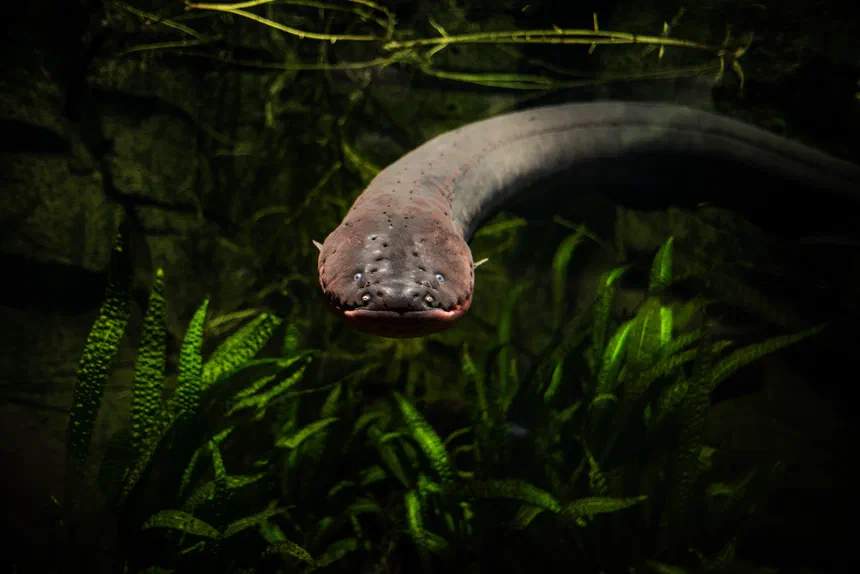
The electric eel (Electrophorus electricus) is a freshwater fish famous for its ability to generate powerful electric shocks. Despite its name and snake-like shape, it is not a true eel but a member of the knifefish group, more closely related to catfish and carp. It lives in the murky rivers and floodplains of northern South America.
Appearance and Identification
Electric eels have a long, cylindrical, scaleless body that can reach roughly 6 to 8 feet in length, with large individuals weighing around 40 to 45 pounds. The coloring is typically dark gray to olive-brown on the back, fading to a paler orange or yellow on the throat and belly. There is no true dorsal fin; instead, a long undulating anal fin runs most of the length of the underside and provides the fish’s smooth, rippling swimming motion. The head is flattened and blunt, with small eyes and a wide mouth.
Habitat and Range
This species is native to the Amazon and Orinoco river basins and surrounding freshwater systems in countries such as Brazil, Venezuela, Colombia, Peru, and the Guianas. It favors slow-moving or still waters, including swamps, creeks, floodplain pools, and muddy river margins where oxygen levels are often low. Because these waters can be poorly oxygenated, the electric eel is an obligate air-breather: it rises to the surface roughly every few minutes to gulp air through its highly vascularized mouth.
Diet
Electric eels are carnivores. Juveniles feed largely on invertebrates such as insects and crustaceans, while adults take fish, small amphibians, and occasionally small mammals or birds that enter the water. Their eyesight is poor in the turbid water they inhabit, so they rely heavily on weak electric fields to sense prey. To capture a meal, an eel can discharge a strong pulse that stuns or immobilizes the target before swallowing it whole.
Behavior
The electric eel is best known for its electric organs, which make up much of its body and are composed of thousands of specialized cells called electrocytes stacked like tiny batteries. It produces two kinds of discharge: low-voltage pulses used for navigation and communication, and high-voltage bursts, which can exceed 600 volts, used for hunting and defense. Researchers have observed eels curling their bodies to concentrate the electric field around larger prey, and even leaping partly out of the water to deliver shocks directly to a perceived threat. Adults are largely solitary and most active at night.
Life Cycle and Reproduction
Breeding takes place during the dry season. The male builds a nest from his saliva, into which the female lays her eggs. The male guards the nest and the developing young, and a single nest can contain over a thousand larvae. The early-hatching larvae may even consume later-laid eggs. Juveniles grow quickly once they begin feeding, and the species is thought to live around 10 to 15 years in the wild, sometimes longer in captivity.
Conservation Status
The electric eel is currently listed as Least Concern by the IUCN, reflecting its wide distribution and large population across South American freshwater systems. It faces no major species-wide threats, though local populations can be affected by habitat degradation, pollution, and dam construction. Recent research has revealed that what was long treated as a single species may in fact include more than one distinct species within the genus.
Frequently Asked Questions
Is the electric eel a true eel? No. Despite its shape and name, it is a knifefish, more closely related to catfish and carp than to true eels.
Can an electric eel’s shock be dangerous to people? A single discharge is rarely fatal to a healthy adult, but repeated shocks can cause pain, muscle spasms, and, in rare cases, drowning if a person is disabled in the water.
How does it breathe? It is an air-breather and must surface regularly to gulp air, since it obtains most of its oxygen from the atmosphere rather than from the water.