Fish Guide
Dover Sole
What Is a Dover Sole? The Dover sole (Solea solea) is a flatfish of the family Soleidae, prized in European kitchens for its firm, delicately flavored flesh. Despite its name, it is unrelated to the Pacific “Dover sole” …
At a glance
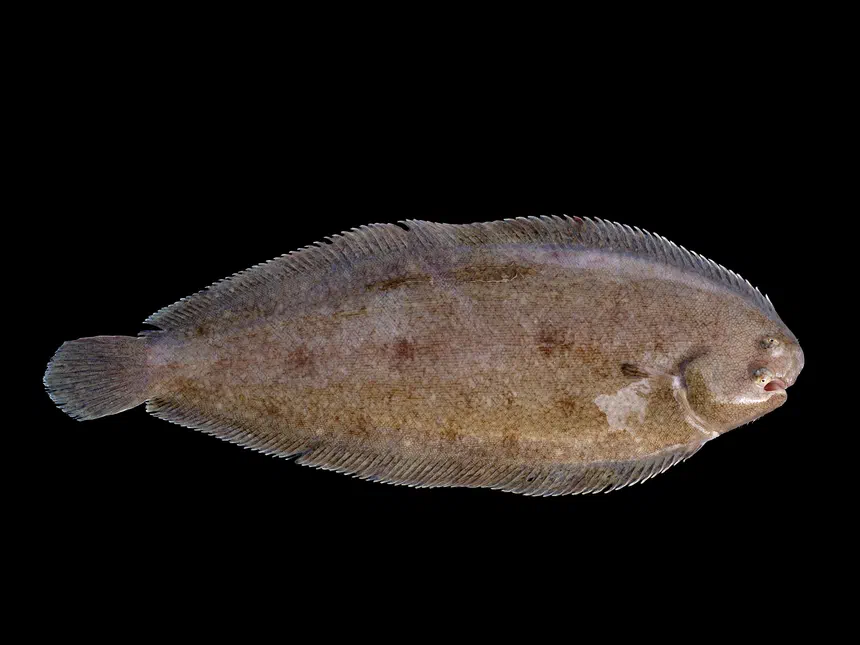
Image: Hans Hillewaert — CC BY-SA 4.0 · source
What Is a Dover Sole?
The Dover sole (Solea solea) is a flatfish of the family Soleidae, prized in European kitchens for its firm, delicately flavored flesh. Despite its name, it is unrelated to the Pacific “Dover sole” sold in North America, and it lives across the eastern Atlantic and adjoining seas.
Appearance and Identification
Like other flatfish, the Dover sole has a flattened, oval body that lies on one side. It begins life with an eye on each side of its head, but during development one eye migrates so that both end up on the right (upper) side of the body. The upper surface is grayish-brown to olive, often mottled to blend with the seabed, while the underside is pale cream or white. The mouth is small and curved, set toward the underside, and the body is edged by long, continuous dorsal and anal fins. Adults typically measure about 30 to 60 centimeters (12 to 24 inches) and weigh a few hundred grams, though exceptional individuals grow larger.
Habitat and Range
The Dover sole is a bottom-dwelling species found on soft sandy and muddy substrates over the continental shelf, generally in waters from a few meters down to around 150 meters deep. Its range extends through the eastern Atlantic from Norway and the North Sea south to Senegal, and includes the Mediterranean Sea. Juveniles tend to favor shallow coastal nurseries, including estuaries and inshore flats, while adults move into somewhat deeper water. The fish often makes seasonal movements, retreating to deeper, more stable water during cold winter months.
Diet
Dover sole are nocturnal carnivores that forage over the seabed after dark. Their diet consists mainly of small bottom-living invertebrates such as marine worms (polychaetes), small mollusks, and crustaceans. Rather than chasing prey, the sole relies on chemical and touch senses to detect food hidden in the sediment, using small sensory structures around the head. During daylight hours it usually rests partly buried in sand or mud, remaining still and well camouflaged.
Behavior
This species is largely solitary and secretive, spending the day concealed on or within the seabed and becoming active at night. Its coloration and habit of burying itself provide effective protection from predators and help it ambush passing prey. Dover sole are relatively slow swimmers, moving with an undulating, wave-like motion of the body and fins close to the bottom. Their sensitivity to light means feeding activity peaks in low-light conditions.
Life Cycle and Reproduction
Spawning generally takes place in spring, when adults gather over particular grounds and release eggs and sperm into the water. The eggs are buoyant and drift in the plankton, as do the newly hatched larvae, which at first are symmetrical like ordinary fish. As a larva develops, one eye migrates across the head and the young fish settles to the bottom to take up the flattened, seabed-dwelling life of an adult. Growth is comparatively slow, and Dover sole can be long-lived, reaching ages of about 20 to 25 years. Females typically grow larger and live longer than males.
Conservation Status
The Dover sole is assessed by the IUCN as Least Concern, reflecting its wide distribution and large overall population. It is, however, a valuable commercial food fish, and several regional stocks are intensively harvested by trawl and net fisheries. Because of this economic importance, catches in areas such as the North Sea are managed with quotas and other measures intended to keep fishing at sustainable levels. Continued monitoring is important, as localized stocks can be vulnerable to overfishing and to the loss of the shallow coastal habitats that young fish depend on.
Frequently Asked Questions
Is the Dover sole the same fish sold as “Dover sole” in the United States? No. The true Dover sole is a European Atlantic species. In North America, the name is often applied to an unrelated Pacific flatfish, so the two should not be confused.
Why do both eyes end up on one side of the head? Dover sole hatch as symmetrical larvae with one eye on each side. As they mature and shift to life on the seabed, one eye gradually migrates to the other side so both face upward.
How long do Dover sole live? They are relatively long-lived flatfish, commonly reaching about 20 to 25 years in the wild, with females typically outliving males.