Fish Guide
Discus
What Is a Discus? The discus (Symphysodon discus) is a strikingly round, laterally flattened cichlid native to the Amazon Basin of South America. Often called the “king of the aquarium,” it is prized among hobbyists for …
At a glance
What Is a Discus?
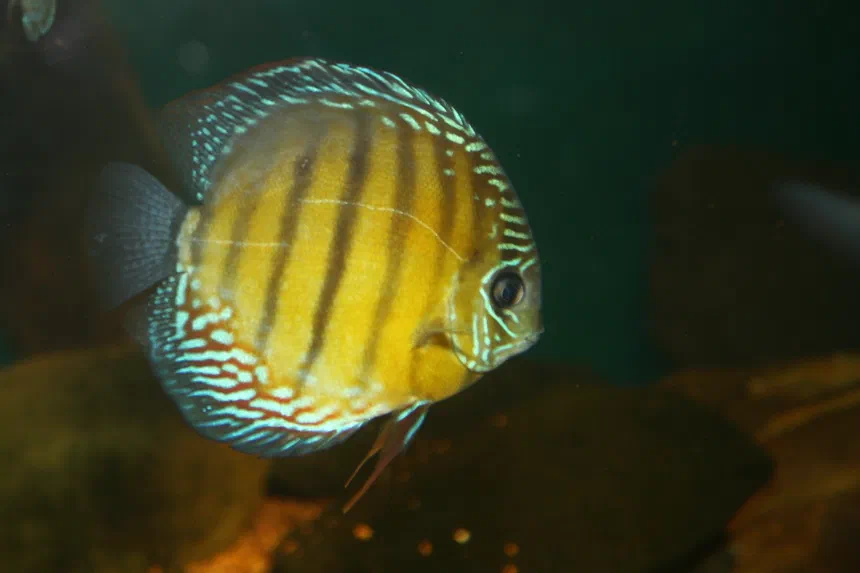
The discus (Symphysodon discus) is a strikingly round, laterally flattened cichlid native to the Amazon Basin of South America. Often called the “king of the aquarium,” it is prized among hobbyists for its disc-shaped body and shimmering patterns. In the wild it lives a quiet, social life in the warm, tannin-stained waters of slow tropical rivers.
Appearance and Identification
The most distinctive feature of the discus is its body shape: a nearly circular, coin-like profile that is strongly compressed from side to side. Adults typically measure about 6 to 8 inches (15 to 20 cm) across and weigh in the range of 5 to 8 ounces (150 to 250 g). Base coloration ranges from reddish-brown to olive or tan, overlaid with wavy blue to blue-green horizontal lines, most prominent on the head and fins. A series of nine faint dark vertical bars crosses the body, with the first and last bars usually the boldest. The eyes are often ringed in red. Captive breeding has produced many vivid color strains, but wild fish tend toward more subdued, camouflaging tones.
Habitat and Range
Discus are found throughout the central and lower Amazon Basin, including tributaries and seasonally flooded forests. They favor slow-moving or still blackwater and clearwater habitats where the water is warm, soft, and acidic, typically shaded by overhanging vegetation. Submerged roots, leaf litter, and fallen branches provide cover, and fish often gather near these structures. Water temperatures in their range commonly sit between about 82 and 88 degrees Fahrenheit (28 to 31 degrees Celsius). During the flood season they move into inundated forest to feed and shelter.
Diet
The discus is an omnivore with a preference for small animal prey. Its natural diet includes aquatic insect larvae, small crustaceans, worms, and other invertebrates picked from the substrate and among plant matter. It also grazes on algae, plant material, and organic detritus. The fish has a small mouth suited to precise, deliberate feeding rather than aggressive predation, and it tends to browse slowly along the bottom and among submerged debris.
Behavior
Discus are generally peaceful, shy fish that live in loose groups. Grouping offers protection from predators and reduces stress, and isolated individuals often become nervous. Within a group a subtle social hierarchy forms, communicated through color changes, body posture, and gentle displays rather than serious fighting. They are most active in dim, filtered light and retreat toward cover when startled. Their laterally flattened bodies let them slip easily between roots and stems, and their coloration helps them blend into the dappled, tannin-tinted water.
Life Cycle and Reproduction
Breeding pairs form from within a group and defend a small territory, typically a firm vertical surface such as a broad leaf, root, or submerged wood. The female deposits a cluster of eggs on the chosen surface, and the male fertilizes them; both parents fan and guard the clutch. The eggs hatch after a few days, and the newly free-swimming fry perform a remarkable behavior: they feed on a nutritious mucus secreted from the skin of both parents, remaining close to the adults’ bodies for their first days of life. As the young grow, they gradually shift to hunting small prey on their own. Discus reach maturity at roughly one to two years of age.
Conservation Status
Symphysodon discus has not been formally assessed by the IUCN. Across much of its range it remains reasonably widespread, but it faces pressures from habitat alteration, deforestation, pollution, and collection for the ornamental fish trade. Because the species depends on specific soft, warm, low-oxygen blackwater conditions, changes to river chemistry and flow can affect local populations. Sustainable collection practices and protection of Amazon floodplain forests are important to its long-term outlook.
Frequently Asked Questions
Why are discus called the “king of the aquarium”? Their round shape, elegant swimming, and richly patterned coloration made them a centerpiece species among aquarists, earning the nickname despite their reputation for being demanding to keep.
Do discus really feed their young from their skin? Yes. Both parents produce a mucus-like secretion on their body surface that the newly hatched fry graze on during their first days, an unusual form of parental care among fish.
How big do discus get? Adults typically reach about 6 to 8 inches (15 to 20 cm) across the body, with their disc-like profile making them appear larger than their weight suggests.