Fish Guide
Devil Ray
What Is a Devil Ray? The devil ray (Mobula mobular), also called the giant devil ray or Mediterranean mobula, is a large filter-feeding ray closely related to manta rays. It belongs to the family Mobulidae and is one of …
At a glance
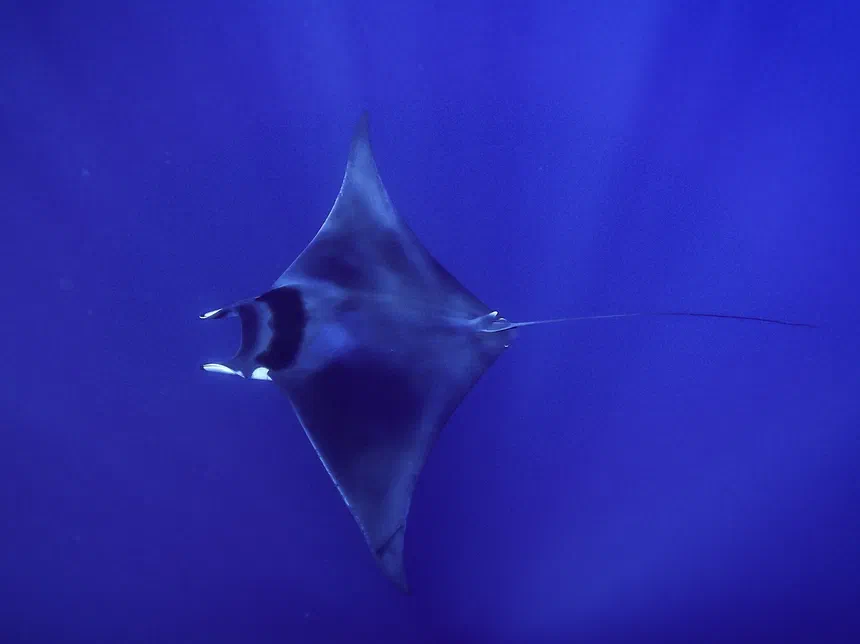
What Is a Devil Ray?
The devil ray (Mobula mobular), also called the giant devil ray or Mediterranean mobula, is a large filter-feeding ray closely related to manta rays. It belongs to the family Mobulidae and is one of the largest members of its genus, gliding through open ocean waters with slow, graceful beats of its broad, wing-like pectoral fins.
Appearance and Identification
Devil rays have a flattened, diamond-shaped body with long, pointed pectoral fins that resemble wings. The upper surface is typically dark blue to black, while the underside is pale white, an example of countershading that helps camouflage the animal in open water. A pair of fleshy, horn-like cephalic lobes projects forward from either side of the head, giving the group its “devil” nickname; these lobes help funnel food toward the mouth. Adults can reach a disc width of roughly 3 to 3.4 meters (about 10 to 11 feet). Unlike some relatives, the devil ray carries a slender, whip-like tail that may bear a small spine near its base.
Habitat and Range
This species inhabits the open ocean as well as coastal pelagic zones, generally staying in the upper layers of the water column but capable of diving to considerable depths in search of food. It is best known from the Mediterranean Sea, where it is the only mobulid species regularly recorded, but populations occur across temperate and tropical waters of the Atlantic, Indian, and Pacific oceans. Devil rays are highly mobile and may travel long distances, following seasonal concentrations of plankton.
Diet
Devil rays are filter feeders that consume enormous quantities of tiny prey. Their diet is dominated by zooplankton, especially small crustaceans such as krill and copepods, along with small schooling fish and larval invertebrates. As the ray swims with its mouth open, water passes over specialized gill plates that strain out food particles while allowing water to escape through the gills. The forward-facing cephalic lobes channel plankton-rich water into the mouth, improving feeding efficiency during large aggregations of prey.
Behavior
Often observed alone or in small loose groups, devil rays sometimes gather in larger numbers where food is abundant. They are strong, efficient swimmers, using their broad pectoral fins in a flapping motion much like a bird in flight. Devil rays are famous for occasionally breaching, leaping clear of the surface and landing with a loud slap, though the reason for this behavior is not fully understood and may relate to communication, courtship, or dislodging parasites. They typically remain wary of divers and boats.
Life Cycle and Reproduction
Like other mobulid rays, the devil ray is ovoviviparous, meaning the young develop inside the mother and are born live rather than hatching from eggs laid outside the body. Females usually carry a single embryo (rarely two) at a time, and gestation is thought to last around a year or longer. Newborn pups are already sizable, emerging as miniature versions of the adults and independent from birth. This slow reproductive rate, with few offspring produced over a long lifespan, makes the species especially vulnerable to population decline.
Conservation Status
The devil ray is listed as Endangered on the IUCN Red List. Its low reproductive output leaves it slow to recover from losses, and it faces significant threats from fisheries. Individuals are frequently caught as bycatch in nets and longlines, and in some regions they are targeted for their gill plates, which are used in certain traditional remedies. International agreements, including protections under CITES and various regional fishing regulations, aim to reduce trade and accidental capture, but ongoing monitoring and enforcement remain essential to the species’ survival.
Frequently Asked Questions
Are devil rays dangerous to humans? No. Despite their name and menacing appearance, devil rays are gentle filter feeders that pose no threat to people. They lack the ability to harm swimmers and generally avoid close contact.
How are devil rays different from manta rays? Devil rays and manta rays are close relatives in the same family, but devil rays are generally smaller and have their mouth positioned on the underside of the head, whereas manta rays have a wider, terminal mouth at the front. Devil rays also tend to have a more slender tail.
Why do devil rays leap out of the water? Devil rays sometimes breach spectacularly, launching into the air and slapping down on the surface. Scientists are not certain why, but proposed explanations include courtship displays, communication, and shedding parasites.