Fish Guide
Damselfish
What Is a Damselfish? Damselfish are small, active reef fishes that make up the family Pomacentridae, one of the most diverse groups of fishes on tropical coral reefs. The family contains hundreds of species, including …
At a glance
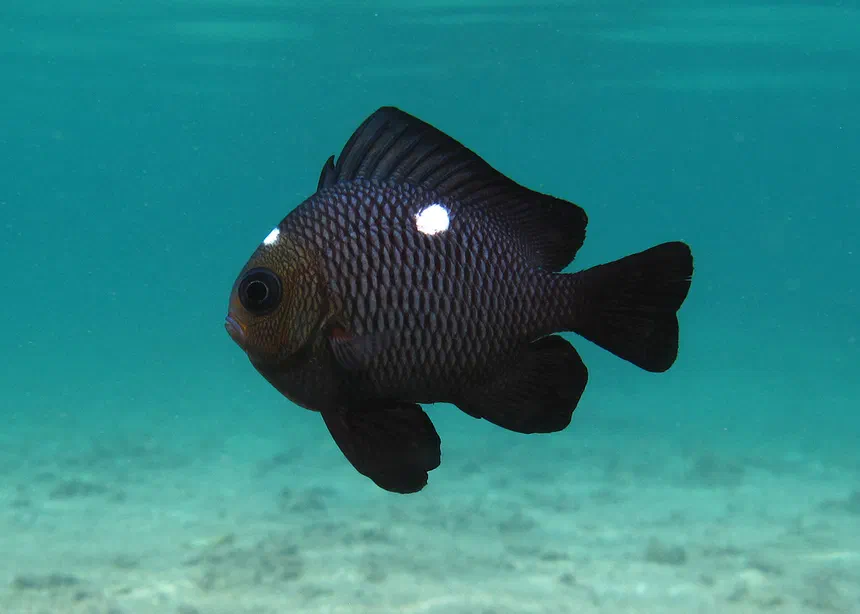
Image: Philippe Bourjon — CC BY-SA 4.0 · source
What Is a Damselfish?
Damselfish are small, active reef fishes that make up the family Pomacentridae, one of the most diverse groups of fishes on tropical coral reefs. The family contains hundreds of species, including the familiar anemonefishes (clownfishes), and its members are famous for their bright colors and feisty, territorial personalities.
Appearance and Identification
Most damselfish are compact, oval-bodied fish with a single continuous dorsal fin and a forked or notched tail. Body length ranges widely across the family, from tiny species barely 2 inches (5 cm) long to larger forms reaching 12-14 inches (30-35 cm), though the great majority stay under 6 inches (15 cm). Coloration is spectacularly varied: some are electric blue or neon yellow, others wear bold black-and-white bars, and many change hue as they mature. Juveniles frequently sport different, brighter patterns than adults, which can make identification tricky. Their small terminal mouths are lined with fine teeth suited to nipping algae and picking small prey.
Habitat and Range
Damselfish live throughout the world’s tropical and warm-temperate oceans, with the greatest diversity in the Indo-Pacific. They are strongly associated with shallow, sunlit habitats — coral reefs, rocky reefs, seagrass beds, and tide pools — usually within the top 30-100 feet (10-30 m) of water. Many species are tightly bound to a specific patch of reef or a single coral head, which they defend and rarely stray far from. Anemonefishes take this a step further, living among the stinging tentacles of sea anemones that shelter them from predators.
Diet
The family as a whole is omnivorous, but individual species lean in different directions. Many are herbivores that graze filamentous algae, while others are planktivores that hover in the water column snapping up drifting zooplankton, fish larvae, and small crustaceans. Some pick tiny invertebrates directly from the reef. Certain “farmer” damselfish actively cultivate patches of algae, weeding out unwanted species and aggressively chasing off intruders — including much larger fish and even divers.
Behavior
For their size, damselfish are remarkably bold and territorial. A resident will dart out to nip at, chase, and harass fish many times its size that wander into its claimed space. This pugnacity helps them protect food, shelter, and nesting sites. Damselfish are also highly social in some contexts, forming loose aggregations that feed together over the reef by day and retreat into crevices at night. Anemonefishes are notable for their intimate, mutually beneficial partnership with host anemones.
Life Cycle and Reproduction
Damselfish reproduction centers on the male, who prepares and guards a nest. He typically clears an algae patch or a flat surface on rock or dead coral, then courts females to deposit their eggs there. A single nest may hold thousands of adhesive eggs from one or several females. The male fiercely guards the clutch, fanning it with his fins to keep it oxygenated and clean until the larvae hatch, often within a few days. The tiny larvae drift as plankton before settling onto a reef and taking up the bottom-oriented life of an adult. Anemonefishes are famous sequential hermaphrodites, capable of changing sex as their social group shifts.
Conservation Status
As a family, damselfish are abundant and widespread, and most assessed species are listed as Least Concern by the IUCN; some smaller-ranged species have not yet been evaluated. The primary threats are indirect: coral reef degradation from warming seas, bleaching, pollution, and destructive fishing all reduce the habitat damselfish depend on. Popular aquarium species, including several anemonefishes, also face collection pressure, though captive breeding has eased demand for some.
Frequently Asked Questions
Are clownfish really damselfish? Yes. Anemonefishes (clownfishes) are members of the family Pomacentridae, so they are a specialized type of damselfish.
Why are damselfish so aggressive? Their bold, territorial behavior protects limited reef resources — food, shelter, and nesting sites — which is why even a small damselfish will chase off much larger animals.
Are damselfish good aquarium fish? Many are hardy and popular, but their territorial nature means they can bully smaller or more timid tankmates, so they need to be stocked with care.