Fish Guide
Cutthroat Trout
What Is a Cutthroat Trout? The cutthroat trout (Oncorhynchus clarkii) is a freshwater and sometimes anadromous fish native to the cold waters of western North America. It belongs to the salmon family (Salmonidae) and is …
At a glance
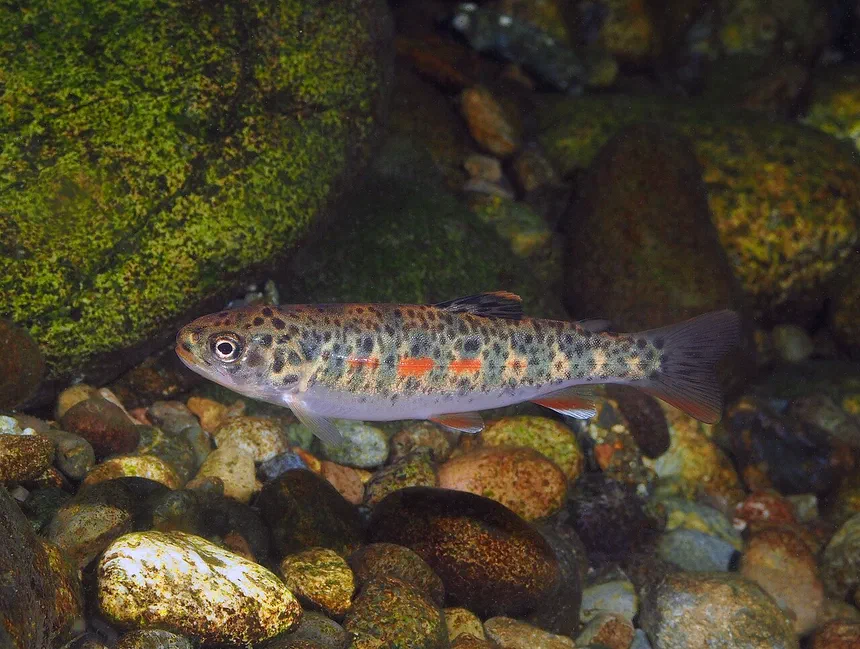
Image: USFWS - Pacific Region — Public domain · source
What Is a Cutthroat Trout?
The cutthroat trout (Oncorhynchus clarkii) is a freshwater and sometimes anadromous fish native to the cold waters of western North America. It belongs to the salmon family (Salmonidae) and is named for the distinctive red or orange slash marks that run along the underside of its lower jaw. Highly variable across its range, the species is divided into more than a dozen subspecies adapted to particular river basins.
Appearance and Identification
Cutthroat trout are torpedo-shaped fish with coloration that shifts with habitat, subspecies, and life stage. Body tones range from olive and brassy gold to steel-blue and silver, usually marked with scattered dark spots that grow denser toward the tail. The signature feature is a pair of red, orange, or pink slashes tucked beneath the jaw, which give the fish its common name. Spawning males often develop especially vivid coloring. Adults commonly measure between about 6 and 24 inches (15-60 cm), though sea-run and large lake forms can approach 40 inches (100 cm). They closely resemble rainbow trout and readily hybridize with them, producing so-called “cutbows.”
Habitat and Range
The species is spread across a wide swath of western North America, from coastal Alaska and British Columbia south through the Pacific Northwest and into the Rocky Mountains, the Great Basin, and the southern Rockies. Different subspecies occupy strikingly different environments: some live in small, clear headwater streams, others in large interior rivers and cold mountain lakes, and coastal populations move between fresh water and the sea. Across all of these settings, cutthroat trout depend on cool, clean, well-oxygenated water and are sensitive to warming and pollution.
Diet
Cutthroat trout are opportunistic carnivores whose diet changes with age and location. Young fish and stream-dwelling adults feed heavily on aquatic and terrestrial insects, along with their larvae. Larger individuals broaden their menu to include crustaceans, mollusks, fish eggs, and smaller fish. Coastal, sea-run trout take advantage of rich marine prey such as small fishes and shrimp. Their willingness to strike drifting insects makes them a favorite target of fly anglers.
Behavior
These trout are generally most active in cooler parts of the day and hold in areas offering cover and steady food, such as undercut banks, riffles, and pools. Many populations are relatively sedentary, while others undertake seasonal migrations between feeding and spawning waters; coastal fish migrate to sea and return. Cutthroat trout can be aggressive feeders but are also considered comparatively easy to catch, a trait that has made some populations vulnerable to overfishing.
Life Cycle and Reproduction
Spawning typically occurs in spring, often triggered by rising water temperatures and flows fed by snowmelt. Females excavate shallow gravel nests called redds in flowing water, where they deposit eggs that are then fertilized by males. Unlike Pacific salmon, cutthroat trout do not necessarily die after spawning and may reproduce in more than one season. Eggs hatch after several weeks, and the emerging fry shelter among gravel and vegetation before growing into juveniles. Individuals commonly live around 4 to 10 years, with lifespan varying by subspecies and environment.
Conservation Status
As a whole species, the cutthroat trout is currently assessed as Least Concern, but this masks serious trouble at the subspecies level. Several forms have declined sharply or become locally extinct because of habitat loss, dams, water diversion, warming streams, and competition and hybridization with introduced rainbow trout and other non-native fishes. Some subspecies are protected and the focus of active restoration, including efforts to secure isolated headwater refuges and reestablish native populations.
Frequently Asked Questions
Why is it called a cutthroat trout? The name comes from the bright red-orange slash marks beneath the fish’s lower jaw, which look a bit like a cut across the throat.
Are cutthroat and rainbow trout related? Yes. Both are closely related members of the genus Oncorhynchus, and where they overlap they can interbreed to produce hybrids known as cutbows.
Do cutthroat trout live in the ocean? Some do. Coastal populations are anadromous, spending part of their lives in salt water before returning to fresh water to spawn, while many inland populations stay in rivers and lakes their whole lives.