Fish Guide
Convict Cichlid
What Is a Convict Cichlid? The convict cichlid (Amatitlania nigrofasciata) is a small, hardy freshwater fish from the cichlid family, native to the rivers and lakes of Central America. It takes its name from the bold …
At a glance
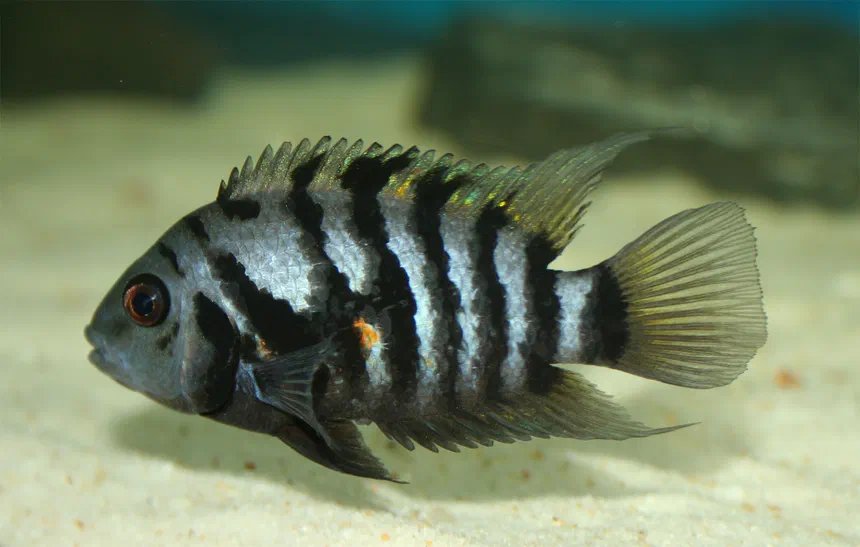
What Is a Convict Cichlid?
The convict cichlid (Amatitlania nigrofasciata) is a small, hardy freshwater fish from the cichlid family, native to the rivers and lakes of Central America. It takes its name from the bold pattern of dark vertical bars across a pale body, which recalls old-fashioned prison stripes. Popular in the aquarium hobby, it is prized for its toughness and its dramatic parenting behavior.
Appearance and Identification
Convict cichlids have a stocky, oval body with a slightly compressed profile typical of cichlids. The base color is a pale grayish-blue, crossed by roughly eight to nine dark vertical bands that give the species its common name. Adults usually reach about 8 to 12 centimeters (3 to 5 inches) in length, with males growing larger and developing longer, more pointed dorsal and anal fins. Females are smaller but often show an orange or pinkish flush on the belly, especially when in breeding condition. A widely bred domesticated “pink” or leucistic form lacks the dark bars and appears pale cream to white.
Habitat and Range
The species is native to the Pacific slope of Central America, ranging through parts of Guatemala, El Salvador, Honduras, and neighboring areas. It favors warm, moving water and is found in streams, small rivers, and lakes, often near rocky bottoms and submerged debris that provide cover and spawning surfaces. Convict cichlids tolerate a broad range of water conditions and temperatures, which partly explains their success both in the wild and in captivity. Escaped or released aquarium fish have established feral populations in several warm regions outside their native range.
Diet
Convict cichlids are opportunistic omnivores. In the wild they feed on aquatic insects and their larvae, small worms and crustaceans, bits of plant material, and algae grazed from rocks and surfaces. Their willingness to eat almost anything of appropriate size makes them easy to feed in captivity, where they accept flakes, pellets, and live or frozen foods. This dietary flexibility helps them thrive in variable and sometimes harsh environments.
Behavior
These fish are notably bold and territorial, particularly around spawning sites. Even at a small size, a breeding pair will defend a chosen crevice or cave against much larger fish. Outside of breeding, they remain active and inquisitive, spending time sifting substrate and patrolling their territory. Their assertive temperament makes them a frequent subject of study on cichlid aggression and pair bonding, and it is also why aquarists often keep them in dedicated tanks.
Life Cycle and Reproduction
Convict cichlids are substrate spawners that form monogamous pairs, at least for a given breeding cycle. The female lays a cluster of eggs on a flat rock, cave wall, or similar surface, and both parents guard the clutch intensively. Eggs typically hatch within a few days, and the parents continue to protect the free-swimming fry, herding them and fending off intruders. This strong biparental care allows a high survival rate for the young and can result in frequent, prolific breeding. Sexual maturity is reached within several months, contributing to rapid population growth under good conditions.
Conservation Status
The convict cichlid is widespread, adaptable, and abundant across its native range, and it is generally regarded as a species of Least Concern. It faces no major threats and is not considered at risk. Ironically, its hardiness raises a different concern: as an introduced species it can compete with and disrupt native fish communities in regions where aquarium specimens have been released.
Frequently Asked Questions
Why is it called a convict cichlid? The name comes from the pattern of dark vertical bars running down its pale body, which resembles the striped uniforms once associated with prison inmates.
Are convict cichlids aggressive? Yes. They are highly territorial, especially when guarding eggs or fry, and a small breeding pair will readily defend its territory against much larger fish.
How long do convict cichlids live? With good conditions they commonly live around 8 to 10 years, and some individuals may live longer in well-maintained aquariums.