Fish Guide
Common Carp
What Is a Common Carp? The common carp (Cyprinus carpio) is a large freshwater fish in the family Cyprinidae, the same group that includes minnows and goldfish. Native to the rivers and lakes of Europe and Asia, it has …
At a glance
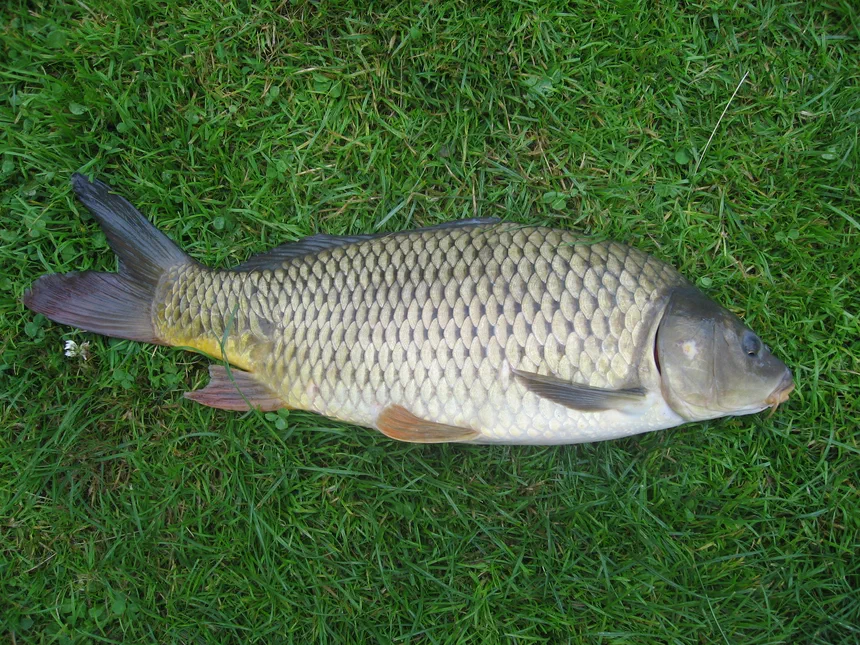
Image: Dezidor — CC BY-SA 3.0 · source
What Is a Common Carp?
The common carp (Cyprinus carpio) is a large freshwater fish in the family Cyprinidae, the same group that includes minnows and goldfish. Native to the rivers and lakes of Europe and Asia, it has been raised and moved by people for thousands of years and is now one of the most widely distributed freshwater fishes on Earth.
Appearance and Identification
The common carp has a deep, heavy body that is somewhat compressed from side to side, topped by a long dorsal fin. Coloration ranges from olive-green and brassy bronze on the back and sides to a paler, yellowish belly. A defining feature is the pair of fleshy barbels at each corner of the mouth, used to taste and feel for food in the sediment. Wild fish are fully covered in large, thick scales, while selectively bred forms show reduced scaling: “mirror carp” carry a few oversized scales, and “leather carp” appear nearly scaleless. Adults commonly reach 16 to 31 inches (40 to 80 cm) and weigh a few pounds to well over ten, though exceptional individuals grow considerably heavier.
Habitat and Range
Carp favor warm, slow-moving or still waters with soft, muddy bottoms and abundant vegetation. They thrive in lowland rivers, lakes, ponds, canals, and reservoirs, and tolerate conditions that many other fish cannot, including murky water, low oxygen, and a wide range of temperatures. This hardiness has helped the species spread far beyond its native Eurasian range; deliberate introductions for food and sport have established carp across North America, Australia, Africa, and much of the rest of the world, where they are often considered an invasive nuisance.
Diet
The common carp is a true omnivore and an opportunistic bottom feeder. Using its protrusible, toothless jaws, it roots through mud and sediment to sift out insect larvae, worms, snails, small crustaceans, and other invertebrates, along with plant matter, seeds, algae, and organic detritus. This constant rooting stirs up bottom sediments, which can cloud the water and uproot aquatic plants, one reason introduced carp are blamed for degrading wetland habitats.
Behavior
Carp are generally social, often gathering in loose groups, especially as juveniles. They are most active in warmer months and tend to slow down and feed little through cold winter periods, sometimes settling into deeper water. They are famously wary and adaptable, quick to learn and avoid areas of disturbance, which is part of what makes them both a challenge for anglers and a successful colonizer. Feeding activity often peaks in the low light of dawn and dusk.
Life Cycle and Reproduction
Spawning takes place in spring and early summer once water temperatures climb into the range of roughly 63 to 72°F (17 to 22°C). Females are extraordinarily prolific, releasing many hundreds of thousands of sticky eggs that adhere to submerged plants and flooded vegetation in shallow water. The eggs are fertilized externally and hatch within a few days to about a week, depending on temperature. The young grow quickly where food is plentiful, and there is no parental care. Carp are long-lived fish, commonly reaching 15 to 20 years, with some individuals surviving far longer.
Conservation Status
It may seem surprising, but the common carp is listed as Vulnerable on the IUCN Red List. This assessment applies to genuinely wild native populations in Eurasia, which have declined due to habitat loss, river modification, pollution, and genetic mixing with domesticated and introduced stocks. Globally, however, the species is anything but scarce: farmed and feral carp are enormously abundant, and in many introduced regions the fish is managed as an invasive species that harms native ecosystems.
Frequently Asked Questions
Are common carp good to eat? Yes. Carp have been a staple food fish for centuries and remain among the most farmed freshwater fish worldwide, especially in Europe and Asia. They have a soft, sometimes muddy-tasting flesh and numerous small bones, which affects their popularity in some regions.
Why are carp considered invasive in some countries? Where introduced, carp multiply rapidly and stir up bottom sediments while feeding, which muddies the water, uproots plants, and disrupts habitat for native fish and waterfowl. This ecological damage leads many places to treat them as a pest.
How big can a common carp get? Most adults are a few pounds to about ten or more, but well-fed individuals can exceed 30 to 40 pounds (14 to 18 kg) and reach lengths beyond three feet.