Fish Guide
Coelacanth
What Is a Coelacanth? The coelacanth is a large, deep-water fish often called a “living fossil” because it belongs to a lineage once thought to have vanished with the dinosaurs. The West Indian Ocean species, Latimeria …
At a glance
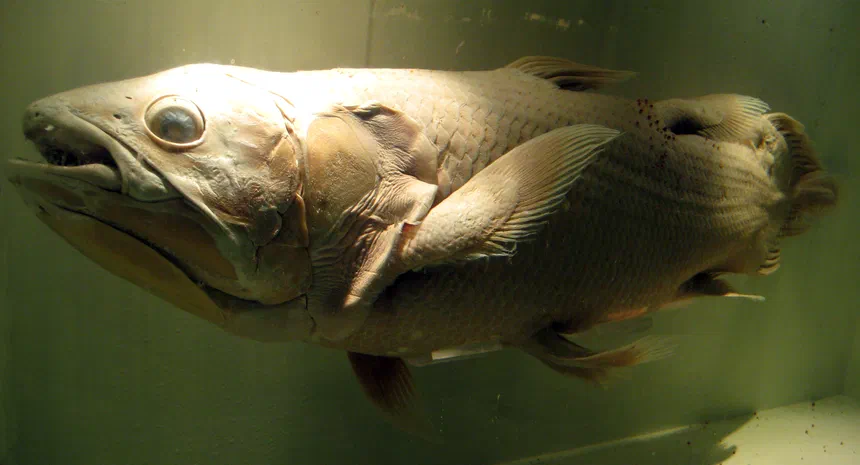
Image: Lokal_Profil — CC BY-SA 2.5 · source
What Is a Coelacanth?
The coelacanth is a large, deep-water fish often called a “living fossil” because it belongs to a lineage once thought to have vanished with the dinosaurs. The West Indian Ocean species, Latimeria chalumnae, was famously rediscovered off South Africa in 1938, stunning scientists who had known coelacanths only from fossils. A second species, Latimeria menadoensis, was later found in Indonesian waters.
Appearance and Identification
Coelacanths are heavy-bodied, robust fish with a distinctive steel-blue to brownish coloration marked by irregular white or pale flecks that help camouflage them against rocky, sponge-covered walls. Their most striking feature is a set of fleshy, lobed pectoral and pelvic fins that extend on muscular stalks and move in an alternating pattern reminiscent of a walking gait. They also possess an unusual three-lobed tail, thick armor-like scales, and a hinged joint in the skull that allows the front of the head to lift when feeding. Adults commonly reach roughly 5 to 6.5 feet (1.5 to 2 meters) and can weigh close to 200 pounds (90 kilograms).
Habitat and Range
The West Indian Ocean coelacanth lives along steep volcanic slopes at depths of roughly 500 to 800 feet (about 150 to 250 meters), where cool, well-oxygenated water suits its slow metabolism. By day the fish shelter in submarine caves and rocky overhangs, often in loose groups. The species is known mainly from the waters around the Comoro Islands, with additional records off Tanzania, Mozambique, Madagascar, Kenya, and South Africa.
Diet
Coelacanths are opportunistic nocturnal predators. They drift near the seafloor at night hunting cuttlefish, squid, and a variety of fishes, including smaller deep-water species. Rather than chasing prey at speed, they use a slow, energy-saving “drift feeding” approach, tilting the body and using the mobile joint in the skull to open the mouth wide and engulf food.
Behavior
These fish are unhurried and largely sedentary, conserving energy in the cold depths. They are thought to use a form of electroreception through a specialized organ in the snout, the rostral organ, to detect prey in the dark. During the day they gather in caves, and at night they disperse to forage, drifting on currents and using their lobed fins for precise, hovering maneuvers rather than fast swimming.
Life Cycle and Reproduction
Coelacanths are ovoviviparous: females retain fertilized eggs internally and give birth to fully formed, live young after an unusually long gestation believed to last around three years. Litters are small, typically a few dozen pups. Growth is slow and maturity comes late, with some studies suggesting individuals may not reproduce until well into adulthood and can live several decades or more.
Conservation Status
The West Indian Ocean coelacanth is listed as Critically Endangered by the IUCN. Its small, localized population, late maturity, and low reproductive output make it highly vulnerable. The main threat is accidental capture in deep-set gill nets and longlines intended for other species. Its restricted range and specialized habitat leave little margin for recovery, and it remains a focus of conservation attention.
Frequently Asked Questions
Is the coelacanth really a living fossil? It is often called one because its body plan closely resembles fossil relatives from over 300 million years ago, but living coelacanths are modern animals that have continued to evolve.
Are coelacanths related to land animals? Their lobe-finned lineage is closely related to the ancestors of tetrapods, making them of great interest for understanding the water-to-land transition.
Can you eat a coelacanth? Their flesh contains oils and compounds that make them unpalatable and even mildly toxic, so they are not valued as food.