Fish Guide
Clownfish
What Is a Clownfish? The clownfish, or common clown anemonefish (Amphiprion ocellaris), is a small, vividly colored reef fish famous for living among the stinging tentacles of sea anemones. It belongs to the damselfish …
At a glance
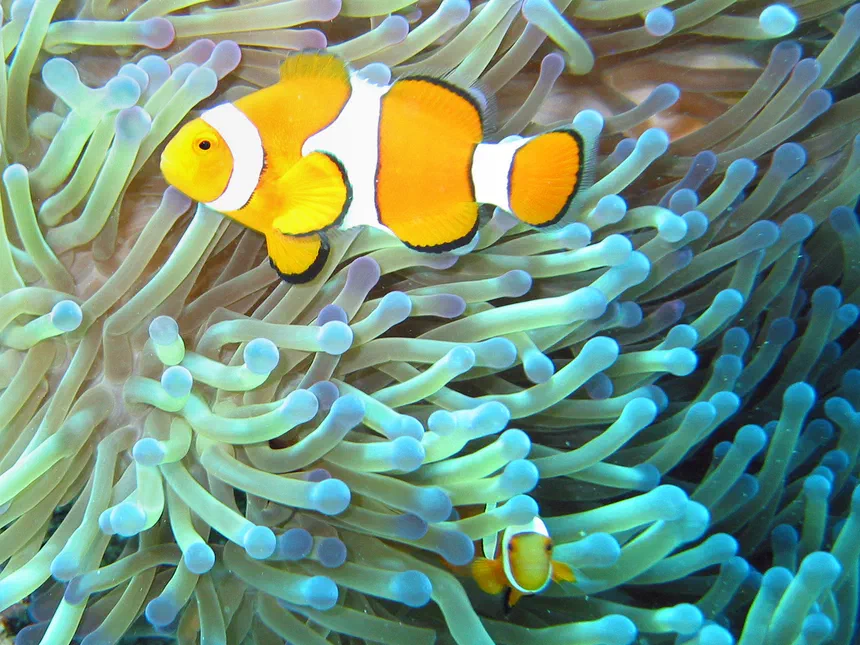
Image: Janderk — Public domain · source
What Is a Clownfish?
The clownfish, or common clown anemonefish (Amphiprion ocellaris), is a small, vividly colored reef fish famous for living among the stinging tentacles of sea anemones. It belongs to the damselfish family and is one of the most recognizable animals on tropical coral reefs, popularized by its starring role in animated film.
Appearance and Identification
Clownfish are compact, oval-bodied fish that typically reach about 3 to 4 inches (8 to 11 cm) in length, with females growing slightly larger than males. Their bright orange bodies are crossed by three white bands, each outlined in thin black lines, and the fins are often tipped with a dark border. This bold coloration makes them easy to distinguish from most other reef fish, though several closely related anemonefish share a similar pattern. Their rounded tail and small size help them dart quickly among anemone tentacles for shelter.
Habitat and Range
This species lives in the warm, shallow waters of the Indo-Pacific, ranging from the eastern Indian Ocean through Southeast Asia to the reefs of northern Australia. Clownfish favor sheltered lagoons and coastal reefs, usually at depths of less than about 50 feet (15 meters). They are almost always found in close association with a host sea anemone, rarely straying far from its protective cover.
Diet
Clownfish are omnivores with a varied diet. They feed largely on tiny drifting animals such as zooplankton and small crustaceans, and they also graze on algae. Undigested food and waste left by the host anemone provide an additional food source, part of the mutual give-and-take between the two partners.
Behavior
One of the clownfish’s most remarkable traits is its symbiotic relationship with sea anemones. A protective layer of mucus on the fish’s skin shields it from the anemone’s stinging cells, allowing it to nestle safely among tentacles that would deter or harm other fish. In return, the clownfish helps defend its host from predators such as butterflyfish, drives water through the tentacles with its movements, and may leave scraps the anemone can absorb. Clownfish are territorial and live in small groups centered on a single anemone, defending their patch of reef against intruders.
Life Cycle and Reproduction
Clownfish have an unusual social structure. Each anemone hosts a dominant breeding pair and several smaller, non-breeding males, arranged in a strict hierarchy by size. All clownfish begin life as males, and the species is a sequential hermaphrodite: if the single dominant female dies, the largest breeding male changes sex to become the new female, and the next male in line moves up to breed. Females lay clutches of hundreds of eggs on a cleaned rock surface close to the anemone, and the male guards and fans them until they hatch after roughly a week. The larvae drift as plankton for a short period before settling onto a reef and seeking out an anemone of their own.
Conservation Status
The common clownfish has not been formally assessed by the IUCN, and wild populations remain widespread across their range. Even so, the species faces pressures from coral reef degradation, warming and acidifying seas, and collection for the aquarium trade. Because clownfish depend so closely on healthy anemones and reefs, protecting these habitats is key to their long-term survival. Captive breeding now supplies a large share of the aquarium market, easing some pressure on wild stocks.
Frequently Asked Questions
Are all clownfish born male? Yes. Clownfish start life as males, and only the dominant individual in a group becomes female. If she dies, the largest male changes sex to take her place.
Why aren’t clownfish stung by anemones? A special mucus coating on their skin prevents the anemone’s stinging cells from firing, letting the fish live safely among the tentacles.
Do clownfish need an anemone to survive? In the wild they rely heavily on anemones for protection, but in aquariums they can live without a host, since the tank shields them from predators.