Fish Guide
Clown Triggerfish
What Is a Clown Triggerfish? The clown triggerfish (Balistoides conspicillum) is one of the most instantly recognizable reef fishes, famous for its bold pattern of large white spots across a dark lower body. A member of …
At a glance
What Is a Clown Triggerfish?
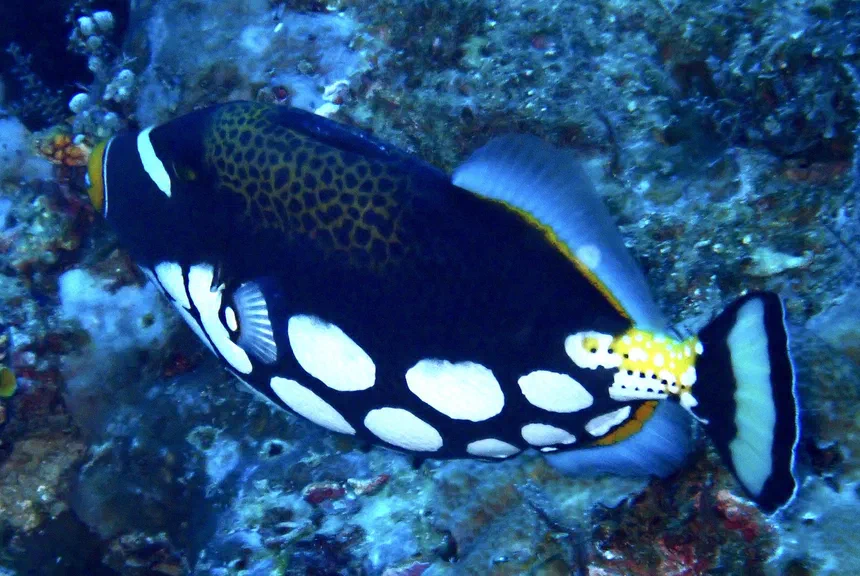
The clown triggerfish (Balistoides conspicillum) is one of the most instantly recognizable reef fishes, famous for its bold pattern of large white spots across a dark lower body. A member of the triggerfish family (Balistidae), it earns its name from a locking dorsal spine that can be raised and “triggered” to wedge the fish into crevices.
Appearance and Identification
Few reef fish are as striking. The lower half of the body is dark and covered with rounded white blotches, while the upper back carries a mottled yellowish saddle and fine reticulated markings. The mouth is ringed by bright yellow-orange lips, and a pale band often crosses the snout. Adults typically reach around 20 inches (50 cm) in length. Like other triggerfish, the body is deep and laterally compressed, the eyes are set high and can rotate independently, and the first dorsal fin holds the characteristic spiny “trigger” mechanism. Juveniles are darker overall with white spots covering much of the body, and the pattern shifts as the fish matures.
Habitat and Range
The clown triggerfish inhabits tropical waters, favoring clear coral reefs and steep outer reef slopes. It is most often seen along drop-offs at depths ranging from just a few meters down to roughly 75 meters (245 feet), though adults tend to stay deeper than juveniles. Its distribution spans much of the Indo-Pacific, from the coast of East Africa and the Red Sea region eastward across to islands of the western Pacific, with populations also reaching parts of the eastern Atlantic off West Africa. Individuals are usually encountered alone rather than in schools.
Diet
This species is a carnivore with a taste for hard-shelled prey. Powerful jaws and stout teeth let it crush and grind invertebrates that many other fish cannot tackle, including sea urchins, mollusks, crustaceans, and other echinoderms. It sometimes flips sea urchins over to attack the less-protected underside, and may blow jets of water to expose buried prey. This durophagous (shell-crushing) diet plays a role in reef ecology by keeping urchin and invertebrate populations in check.
Behavior
Clown triggerfish are solitary, territorial, and generally wary but curious. They swim with an undulating motion of the soft dorsal and anal fins, reserving the tail for quick bursts of speed. When threatened, a triggerfish darts into a hole and erects its first dorsal spine, locking it upright with a smaller second spine so predators cannot easily pull it free. During spawning and nest-guarding, adults can become notably aggressive and will defend their patch of reef against intruders many times their size.
Life Cycle and Reproduction
Like many triggerfish, the clown triggerfish is an egg-laying species that builds and guards a nest on the seafloor. A female deposits eggs in a prepared depression, often in sand or rubble near the reef, and the eggs are fiercely guarded until they hatch. The fanning and tending of the nest by the parent helps keep the eggs oxygenated and free of debris. After hatching, the larvae drift as plankton before settling onto the reef as small juveniles. Growth is gradual, and individuals may live for roughly a decade or more under favorable conditions.
Conservation Status
The clown triggerfish has not been formally assessed on the IUCN Red List, and it is not currently considered threatened across most of its wide range. It is collected for the marine aquarium trade, where its dramatic markings make it a prized display fish, but it is not a major target of food fisheries. As a reef-dependent species, its long-term outlook is tied to the health of coral ecosystems, which face pressure from warming seas, bleaching, and habitat degradation.
Frequently Asked Questions
Is the clown triggerfish dangerous to humans? It is not venomous, but it has strong jaws and can deliver a painful bite. Individuals guarding a nest may charge divers who come too close, so it is best given space during breeding.
How big do clown triggerfish get? Adults commonly reach about 20 inches (50 cm) in length, making them a medium-sized reef fish.
What do clown triggerfish eat? They specialize in hard-shelled invertebrates such as sea urchins, mollusks, and crustaceans, crushing them with powerful teeth.