Fish Guide
Channel Catfish
What Is a Channel Catfish? The channel catfish (Ictalurus punctatus) is a widespread North American freshwater fish and one of the most commonly caught and farmed catfish on the continent. Like other catfish, it is …
At a glance
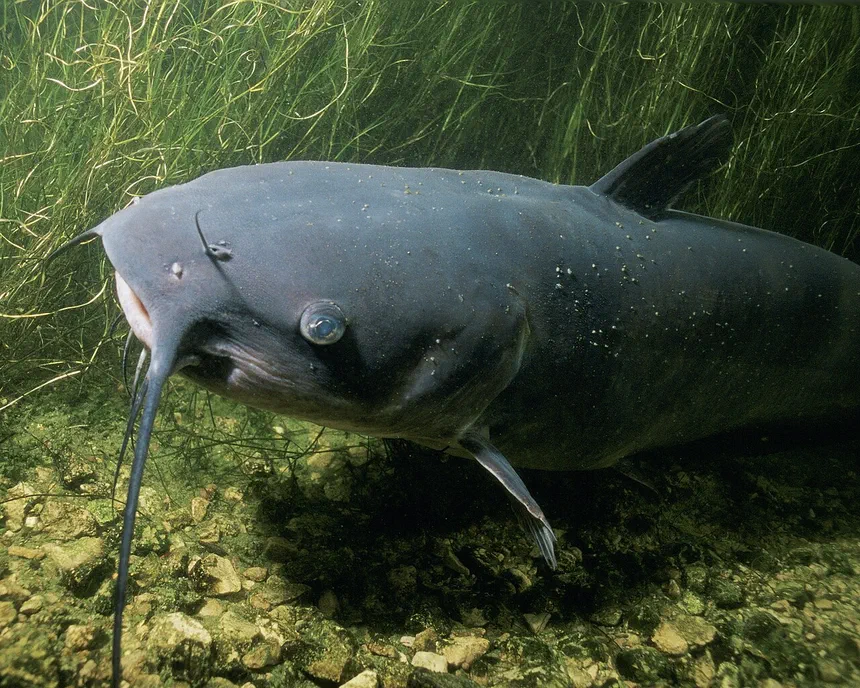
Image: Eric Engbretson, U.S. Fish and Wildlife Service — Public domain · source
What Is a Channel Catfish?
The channel catfish (Ictalurus punctatus) is a widespread North American freshwater fish and one of the most commonly caught and farmed catfish on the continent. Like other catfish, it is scaleless and named for the whisker-like barbels around its mouth. It is prized by anglers and forms the backbone of the U.S. farm-raised catfish industry.
Appearance and Identification
Channel catfish have a smooth, scaleless body that is olive-brown to slate gray or blue-gray on the back and sides, fading to a whitish belly. Younger fish and many adults show scattered dark spots along the flanks, though these often fade in older or larger individuals. The species is easily recognized by its deeply forked tail, which distinguishes it from the flathead and bullhead catfishes, and by four pairs of sensory barbels around a slightly overhanging upper jaw. Sharp, mildly venomous spines guard the leading edges of the dorsal and pectoral fins and can deliver a painful sting if the fish is handled carelessly. Most adults measure roughly 12 to 24 inches (30 to 60 cm), though the largest fish surpass three feet.
Habitat and Range
This adaptable fish occupies a broad range of freshwater environments, including large rivers, streams, reservoirs, ponds, and lakes. It favors clean, moderately flowing waters with sand, gravel, or rubble bottoms but tolerates turbid, warm, and low-oxygen conditions better than many other fish. Native to central and eastern North America, from the Great Plains east through the Mississippi and Great Lakes drainages and south into northeastern Mexico, the channel catfish has been widely introduced elsewhere in the United States and in other countries for sport fishing and aquaculture.
Diet
Channel catfish are opportunistic omnivores that feed largely by smell and taste, using their barbels and keen chemical senses to locate food in murky water or after dark. Their diet shifts with age and season: juveniles rely heavily on aquatic insects and small crustaceans, while adults take a broad mix of fish, crayfish, snails, clams, insects, and plant material, along with seeds and other organic debris. They will scavenge dead animals and are readily caught on both natural and prepared “stink” baits.
Behavior
Largely nocturnal, channel catfish become most active at dusk and through the night, retreating to deeper water, undercut banks, log jams, and other cover during bright daylight. Their extraordinary sense of smell and the taste buds distributed across the skin and barbels make them highly effective foragers in low visibility. They are generally solitary but may gather where food or suitable cover is concentrated. During colder months they become sluggish and feed little, holding in deeper, slower water.
Life Cycle and Reproduction
Spawning takes place in late spring and early summer once water temperatures rise into roughly the 70s Fahrenheit (around 24-29 degrees C). The male selects and defends a secluded nest site such as a hollow log, undercut bank, or cavity, where the female deposits a gelatinous mass that may contain several thousand eggs. The male guards the nest and fans the eggs to keep them oxygenated until they hatch after about a week, then continues to protect the young for a short time. Channel catfish typically mature at two to three years of age and commonly live 10 to 20 years in the wild, with some individuals reaching considerably older ages.
Conservation Status
The channel catfish is abundant and secure across its native range and is listed as Least Concern by the IUCN. It faces no significant conservation threats and is in fact one of the most economically important freshwater fishes in North America, supporting major recreational fisheries and a large aquaculture industry. Because it has been so widely stocked, it is now considered an introduced or invasive species in some regions outside its native range.
Frequently Asked Questions
Are channel catfish dangerous to handle? They are not aggressive, but the stiff spines on their dorsal and pectoral fins carry a mild venom and can inflict a painful puncture, so they should be handled with care.
How big do channel catfish get? Most are one to several pounds, but trophy fish can exceed 30 pounds, and record specimens have topped 50 pounds.
Can channel catfish see well in muddy water? Vision matters less than their exceptional senses of smell and taste; taste buds cover their barbels and skin, letting them find food in dark or murky conditions.