Fish Guide
Bluegill
What Is a Bluegill? The bluegill (Lepomis macrochirus) is a small, deep-bodied freshwater fish in the sunfish family, Centrarchidae. Native to North America, it is one of the continent’s most familiar panfish and a …
At a glance
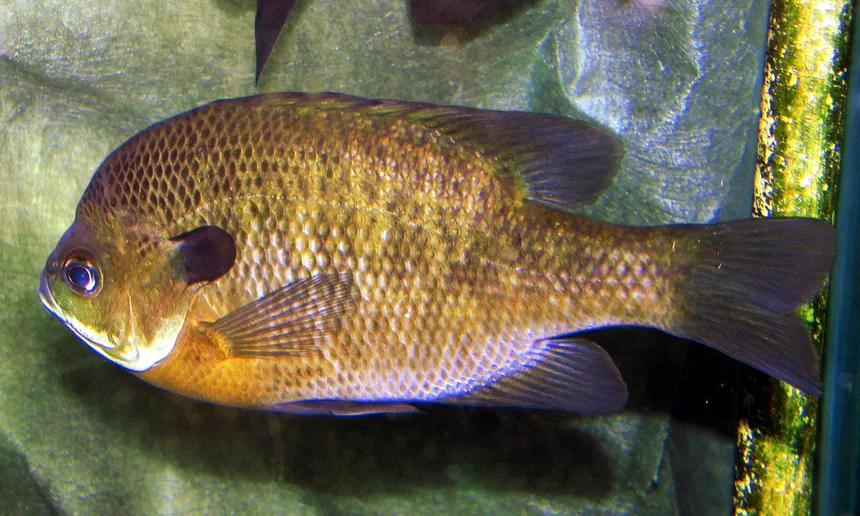
Image: Ltshears — Public domain · source
What Is a Bluegill?
The bluegill (Lepomis macrochirus) is a small, deep-bodied freshwater fish in the sunfish family, Centrarchidae. Native to North America, it is one of the continent’s most familiar panfish and a favorite target for beginning anglers. Its name comes from the vivid blue-black flap at the rear edge of the gill cover.
Appearance and Identification
The bluegill has a rounded, laterally compressed body that gives it a distinctly plate-like silhouette. Coloration is variable but typically ranges from olive-green to bluish along the back, fading to a lighter, often orange or yellow, belly. Several dark vertical bars usually run down the sides, and breeding males develop especially bright coppery-orange breasts. The most reliable field mark is the solid black “ear flap” extending from the gill cover, along with a dark blotch at the base of the soft dorsal fin. Adults commonly reach 6 to 10 inches (15 to 25 cm), though larger individuals occur in productive waters. Most weigh well under a pound, and fish over about 2 pounds are considered exceptional.
Habitat and Range
Bluegill are native to the eastern and central United States and parts of northern Mexico and southern Canada, but widespread stocking has spread them across nearly all of North America and into other continents. They favor warm, slow-moving or still waters, including lakes, ponds, reservoirs, and the quieter pools and backwaters of rivers and streams. Bluegill gravitate toward cover such as submerged vegetation, fallen timber, docks, and weed beds, which provide both feeding opportunities and protection from predators. They tolerate a wide range of conditions but do best in vegetated waters with moderate clarity.
Diet
The bluegill is chiefly a carnivore that behaves as an opportunistic omnivore. Its diet is dominated by aquatic and terrestrial insects, insect larvae, small crustaceans, snails, and zooplankton. Larger bluegill will also take small fish, fish eggs, and occasionally bits of aquatic plant material. Their small, protrusible mouths are adapted for picking tiny prey from vegetation and the water surface. Feeding is most active during daylight, and bluegill often form an important link in freshwater food webs, converting invertebrates into forage for larger predators such as bass.
Behavior
Bluegill are social fish that frequently move and feed in loose schools, especially when young. They are active by day and rely on both sight and lateral-line sensing to locate prey. Though not strong long-distance swimmers, they are agile in cover and quick to dart among plants and structure when threatened. Bluegill are a keystone forage species in many warmwater fisheries, and their abundance strongly influences the growth of predators like largemouth bass. In heavily populated ponds, they can become stunted, producing large numbers of small, slow-growing individuals.
Life Cycle and Reproduction
Spawning occurs from late spring through summer when water temperatures reach roughly the upper 60s to 80s Fahrenheit (about 19-28 degrees C). Males use their tails to sweep out shallow, saucer-shaped nests in gravel or sand, often clustered together in colonies. A male guards his nest and courts passing females, which may deposit tens of thousands of eggs. The male fertilizes and then protects the eggs and newly hatched fry, fanning them with his fins to keep them oxygenated and free of debris. Bluegill grow quickly in their first years and typically reach sexual maturity within one to three years.
Conservation Status
The bluegill is abundant and widespread, and the IUCN lists it as Least Concern. It faces no significant range-wide threats and is in fact so adaptable that introductions outside its native range have made it an invasive species in some regions, where it can disrupt local ecosystems. Management concerns therefore focus less on protecting bluegill and more on balancing their populations within fisheries and preventing unwanted spread.
Frequently Asked Questions
Are bluegill good to eat? Yes. Bluegill are widely considered excellent panfish, with mild, flaky white flesh, and they are among the most popular catches for recreational anglers.
Why are they called bluegill? The name refers to the blue and black coloring on the lower gill cover and the dark “ear flap” at its rear edge, features that are especially vivid in adults.
How big do bluegill get? Most bluegill are 6 to 10 inches long and weigh under a pound. Trophy fish can exceed 2 pounds, but such sizes are uncommon.
References
The conservation status and key facts in this profile are supported by these sources:
- Animal Diversity Web — Lepomis macrochirus (Bluegill) (accessed 2026-07-29)
- GBIF — Lepomis macrochirus Rafinesque, 1819 (accessed 2026-07-29)
Found an error, source problem, or image concern? Report this page.