Fish Guide
Blue Tang
What Is a Blue Tang? The blue tang (Paracanthurus hepatus) is a strikingly colored marine fish native to the coral reefs of the Indo-Pacific. It belongs to the surgeonfish family, Acanthuridae, named for the sharp, …
At a glance
What Is a Blue Tang?
The blue tang (Paracanthurus hepatus) is a strikingly colored marine fish native to the coral reefs of the Indo-Pacific. It belongs to the surgeonfish family, Acanthuridae, named for the sharp, scalpel-like spines near the base of the tail. Widely recognized from popular culture, it is also a favorite in the marine aquarium trade.
Appearance and Identification
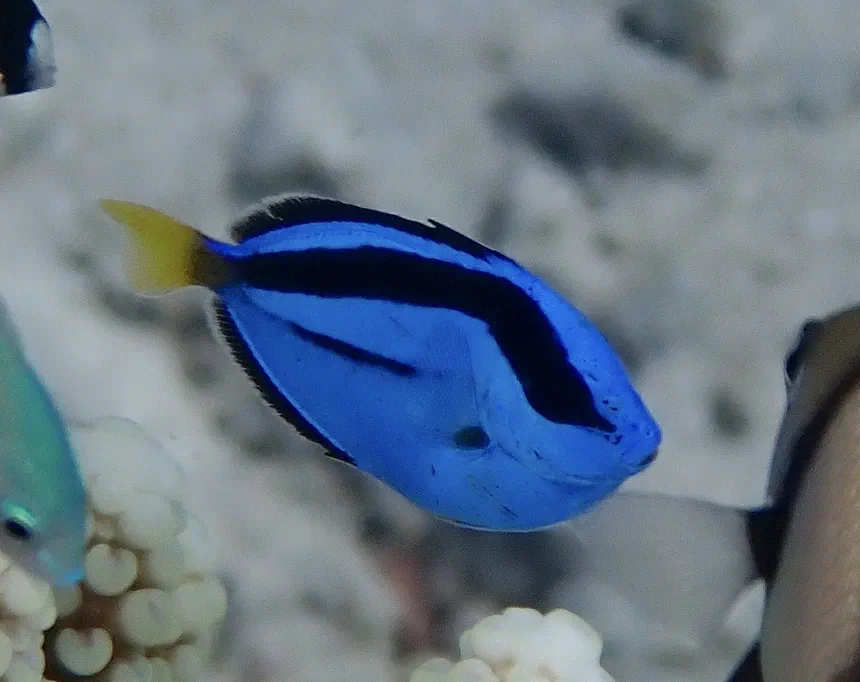
The blue tang is instantly recognizable by its vivid royal-blue body, bold black “palette” marking that sweeps back along the flanks, and a bright yellow triangular tail. The body is oval and laterally compressed, giving it a flat, disk-like profile that helps it maneuver through tight reef spaces. Juveniles tend to be a brighter yellow that deepens into blue as they mature. Adults typically reach about 25 to 30 centimeters (10 to 12 inches) in length. Like all surgeonfish, it carries a pair of sharp, retractable spines on either side of the caudal peduncle, which it can raise defensively when threatened.
Habitat and Range
This species is found throughout the tropical Indo-Pacific, from the coasts of East Africa and the Red Sea region across to Indonesia, the Philippines, Japan, and out to the reefs of the Great Barrier Reef and various Pacific islands. Blue tangs favor clear, current-swept outer reef slopes and lagoons, generally staying in relatively shallow water above about 40 meters (130 feet). They are closely tied to living coral, particularly branching corals such as Pocillopora, which provide shelter and refuge from predators.
Diet
Blue tangs are omnivores with a strong herbivorous tendency. Adults graze extensively on algae growing on reef surfaces, and this grazing plays a helpful role in keeping algae from overwhelming corals. They also feed on plankton drifting in the water column, especially when currents carry food past their reef perches. Juveniles rely more heavily on plankton than adults do. Their constant feeding contributes to the overall health and balance of the reef ecosystem.
Behavior
Blue tangs are active, diurnal fish that are often seen in loose aggregations, though they may also be solitary or in pairs. When alarmed, an individual can dart into a coral crevice and wedge itself in place, sometimes lying on its side and remaining motionless to avoid detection. Their tail spines serve as an effective defense, capable of delivering painful cuts to would-be predators or careless handlers. Within groups, individuals establish social hierarchies, and larger fish may dominate feeding areas.
Life Cycle and Reproduction
Blue tangs reproduce by spawning, releasing eggs and sperm into the water column, often in groups and typically timed around dusk. The fertilized eggs are small and buoyant, drifting as part of the plankton. After hatching, the larvae go through a planktonic stage lasting several weeks before settling onto a reef and transforming into juveniles. Growth is relatively slow, and individuals can live for well over a decade, with some reaching around 20 years or more in favorable conditions.
Conservation Status
The blue tang is currently listed as Least Concern by the IUCN, reflecting its wide distribution and generally stable populations. However, it faces localized pressures from collection for the aquarium trade, since it has historically been difficult to breed in captivity and most animals sold are wild-caught. Broader threats to coral reefs, including warming seas, bleaching, and habitat degradation, pose the greatest long-term risk to the species’ reef homes.
Frequently Asked Questions
Are blue tangs dangerous to humans? They are not aggressive, but their sharp tail spines can inflict painful cuts if the fish is handled carelessly, so they should be treated with respect.
Can blue tangs be bred in captivity? Captive breeding is difficult and only recently achieved on a limited scale, so most blue tangs in the aquarium trade are still collected from the wild.
What do blue tangs eat on the reef? Adults graze on algae and also feed on drifting plankton, while juveniles depend more heavily on plankton in the water column.
References
The conservation status and key facts in this profile are supported by these sources:
- Animal Diversity Web — Paracanthurus hepatus (accessed 2026-07-29)
- GBIF — Paracanthurus hepatus (Linnaeus, 1766) (accessed 2026-07-29)
Found an error, source problem, or image concern? Report this page.