Fish Guide
Blobfish
What Is a Blobfish? The blobfish (Psychrolutes marcidus) is a deep-sea fish belonging to the fathead sculpin family, Psychrolutidae. It lives on the seabed off southeastern Australia, Tasmania, and New Zealand, at depths …
At a glance
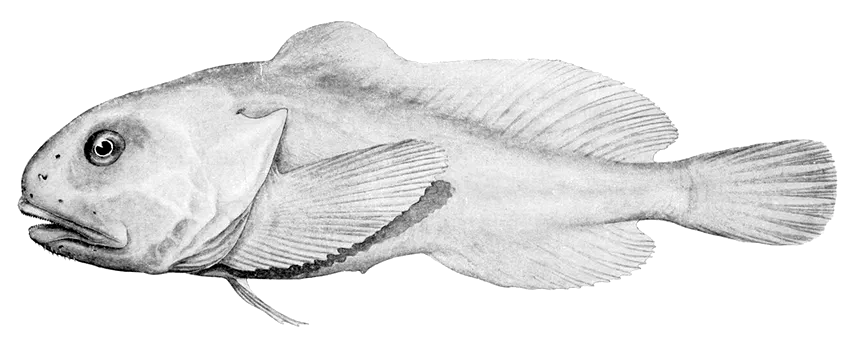
Image: Alan Riverstone McCulloch (1885-1925) — Public domain · source
What Is a Blobfish?
The blobfish (Psychrolutes marcidus) is a deep-sea fish belonging to the fathead sculpin family, Psychrolutidae. It lives on the seabed off southeastern Australia, Tasmania, and New Zealand, at depths where sunlight never reaches and pressure is many times that at the surface. Despite its fame as an unusually “ugly” animal, that saggy appearance is largely an artifact of being hauled up from the deep.
Appearance and Identification
In its natural habitat, the blobfish looks like a fairly ordinary, tadpole-shaped fish with a large head, tapering body, and soft, loosely structured flesh. Its body is pale, ranging from pinkish to grayish, and it lacks the firm musculature and dense skeleton of many shallow-water fishes. Instead of a swim bladder, which would collapse under deep-sea pressure, its tissues are a gelatinous mass slightly less dense than water. Adults reach roughly 30 centimeters (about 12 inches) in length. The famously drooping, melted appearance seen in photographs occurs only after the fish is brought to the surface, where the loss of surrounding pressure causes its soft body to sag and its face to slump.
Habitat and Range
Blobfish inhabit the deep waters of the continental slope, typically at depths of around 600 to 1,200 meters (roughly 2,000 to 4,000 feet), though records span a wide bathyal zone. They are found in the cold, dark waters off the coasts of mainland Australia, Tasmania, and New Zealand. At these depths the water is near freezing and the pressure is enormous, so the blobfish is adapted to a still, low-energy existence resting on or just above the muddy seafloor.
Diet
The blobfish is a carnivore that feeds on whatever small edible material drifts within reach. Its diet consists largely of slow-moving or immobile invertebrates such as crustaceans, mollusks, sea urchins, and other seabed animals, along with organic detritus. Rather than actively chasing prey, it is believed to hover just above the bottom with its mouth open, letting food come to it. This sit-and-wait strategy suits an animal that conserves energy in a food-scarce environment.
Behavior
Little is known about the day-to-day behavior of the blobfish because it lives far beyond the reach of casual observation. Its low metabolism and gelatinous, nearly buoyant body allow it to float effortlessly above the seabed without expending much energy swimming. It is thought to be a largely sedentary, solitary animal. Because it does not rely on powerful muscles or fast movement, it depends on its unusual body composition to survive the crushing depths.
Life Cycle and Reproduction
The reproductive habits of the blobfish and its close relatives are not well documented, but observations of related fathead sculpins offer clues. Females are thought to lay large clutches of pink eggs on the seafloor, and some psychrolutid relatives have been seen gathering in nesting areas where a parent may remain near the eggs. This suggests a degree of parental care unusual among deep-sea fishes. Growth and lifespan figures are uncertain, but deep-sea fishes commonly live many years and mature slowly in their cold, stable environment.
Conservation Status
The blobfish has not been formally assessed by the IUCN, so it carries no official conservation ranking. It is not targeted by fisheries, but it is vulnerable to being caught accidentally as bycatch in deep-sea bottom trawling, which also disturbs the fragile seabed habitats where it lives. Because so little is known about its population size or reproduction, the true impact of trawling on blobfish numbers remains unclear.
Frequently Asked Questions
Why does the blobfish look so strange in photos? Its melted, droopy look is a side effect of decompression. At its natural depth the pressurized water supports its soft body, and it appears far more fish-like; only at the surface does it slump.
Is the blobfish dangerous to people? No. It is a slow, harmless deep-sea fish that poses no threat to humans and lives far below where people swim or dive.
What does the blobfish eat? It feeds mostly on small seafloor invertebrates such as crustaceans and mollusks, plus bits of drifting organic material, gathering food with minimal effort.
References
The conservation status and key facts in this profile are supported by these sources:
- Animal Diversity Web — Psychrolutes marcidus (accessed 2026-07-29)
- GBIF — Psychrolutes marcidus (McCulloch, 1926) (accessed 2026-07-29)
Found an error, source problem, or image concern? Report this page.