Fish Guide
Blacktip Reef Shark
What Is a Blacktip Reef Shark? The blacktip reef shark (Carcharhinus melanopterus) is a small, agile requiem shark named for the conspicuous black tips on its fins. It is one of the most commonly seen sharks on shallow …
At a glance
What Is a Blacktip Reef Shark?
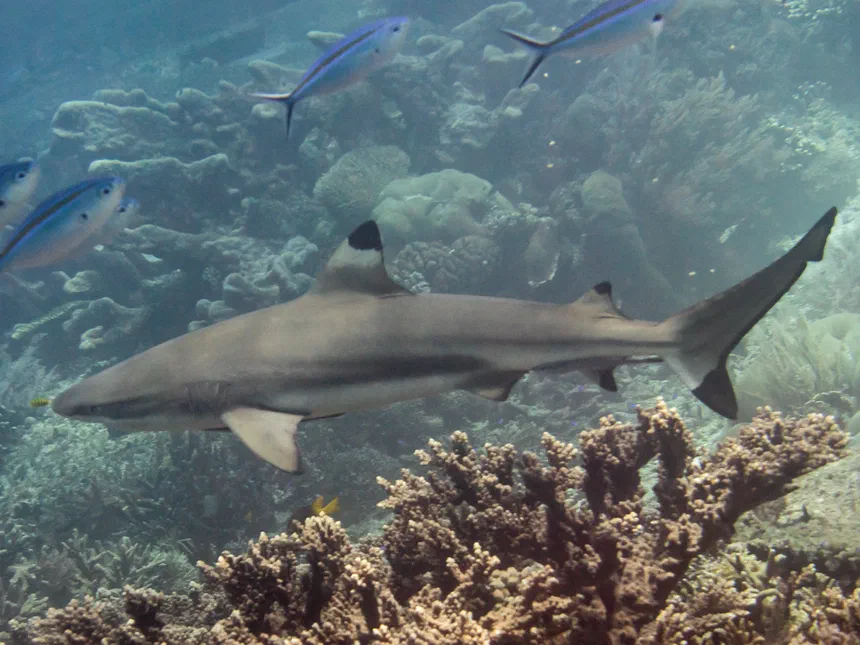
The blacktip reef shark (Carcharhinus melanopterus) is a small, agile requiem shark named for the conspicuous black tips on its fins. It is one of the most commonly seen sharks on shallow Indo-Pacific coral reefs, where its dark-marked dorsal fin often breaks the surface in ankle-deep water.
Appearance and Identification
This species has a streamlined, torpedo-shaped body with a short, rounded snout. Its upper surface is a brownish bronze-gray that fades to a white underside, and a faint pale band runs along each flank. The most reliable field mark is the bold black tip on the first dorsal fin, which is set off by a lighter area behind it; the pectoral fins, second dorsal, and lower tail lobe also carry dark tips. Most adults measure roughly 1.2 to 1.6 meters (4 to 5.3 feet), though the species can occasionally grow somewhat larger. It is frequently confused with the blacktip shark (Carcharhinus limbatus), a larger open-water relative, but the reef species stays smaller and keeps to shallow habitats.
Habitat and Range
Blacktip reef sharks live in warm, shallow coastal waters throughout the Indo-Pacific region, from the Red Sea and East Africa across to the central Pacific islands. They favor coral reef flats, lagoons, and the margins of reefs, often in water so shallow that their dorsal fins are exposed. Individuals tend to be strongly tied to particular reef areas, showing a high degree of site fidelity and returning to familiar patches year after year. Some enter brackish estuaries and mangrove zones, and a few have been recorded in freshwater, though they are principally marine.
Diet
As an active predator, the blacktip reef shark feeds mainly on small reef fishes such as wrasses, mullet, and surgeonfish. It also takes cephalopods like squid and octopus, along with crustaceans, shrimp, and other invertebrates. On shallow reef flats these sharks sometimes hunt cooperatively in loose groups, herding schools of fish into confined spaces, and they occasionally thrash into very shallow water to seize prey trapped by falling tides.
Behavior
These sharks are generally shy and wary of people, often retreating when approached by divers or swimmers. They are most active around dawn, dusk, and at night, patrolling reef edges and lagoon flats. Blacktip reef sharks are social to a degree, forming loose aggregations, and they display strong homing ability, navigating back to preferred home ranges after moving away. While bites on humans are rare, they can occur when the sharks mistake a splashing foot or hand in murky shallows for prey.
Life Cycle and Reproduction
Blacktip reef sharks are viviparous: developing embryos are nourished through a placental connection, much as in mammals. After a gestation period of roughly 8 to 11 months, a female gives birth to a small litter, typically two to four pups, in shallow nursery areas that offer protection from larger predators. Newborns measure around 30 to 50 centimeters and are largely independent from birth. The species grows slowly and matures at several years of age, traits that make its populations slow to recover from decline.
Conservation Status
The IUCN lists the blacktip reef shark as Vulnerable. Its shallow, near-shore habits place it within easy reach of coastal fisheries, and it is caught for its meat, fins, and liver oil, as well as taken as bycatch. Because it reproduces slowly and produces few young, heavy fishing pressure can quickly reduce local populations. Habitat loss from coral reef degradation adds further strain, making healthy reefs essential to the species’ long-term survival.
Frequently Asked Questions
Are blacktip reef sharks dangerous to humans? They are timid and rarely aggressive, and most encounters end with the shark swimming away. The few recorded bites usually involve wading people in murky shallows and are seldom serious.
How can I tell a blacktip reef shark from a blacktip shark? The reef species is smaller, sticks to shallow coral reefs and lagoons, and has a very prominent black tip on its first dorsal fin. The blacktip shark is larger and ranges through more open coastal waters.
Where are blacktip reef sharks found? They inhabit warm Indo-Pacific waters, including the Red Sea, East African coast, Southeast Asia, northern Australia, and many Pacific island reefs.
References
The conservation status and key facts in this profile are supported by these sources:
- Animal Diversity Web — Carcharhinus melanopterus (accessed 2026-07-29)
- GBIF — Carcharhinus melanopterus (accessed 2026-07-29)
Found an error, source problem, or image concern? Report this page.